Best Hanbok Making Workshops 2026: Learn Traditional Sewing
The Renaissance of Traditional Garment Making in 2026
In 2026, the global slow fashion movement has catalyzed a massive resurgence in the creation of heritage garments. Sewing enthusiasts, fashion students, and cultural preservationists are increasingly turning away from fast fashion and toward the meticulous, zero-waste construction techniques of traditional Asian dress. Among the most highly sought-after skills this year is the art of Hanbok making. The traditional Korean garment, celebrated for its elegant lines, vibrant colors, and deep philosophical roots, offers a masterclass in both structural design and mindful craftsmanship.
According to recent initiatives supported by the Korea Craft & Design Foundation, enrollment in traditional textile and garment-making seminars has seen a 45% year-over-year increase globally. This surge is driven by a desire to reconnect with cultural ancestry and a growing appreciation for sustainable, made-to-measure wardrobes. Whether you are looking to attend an immersive in-person retreat in Seoul or a hybrid masterclass shipped to your doorstep, 2026 offers unprecedented access to master artisans and accredited institutions.
Top Hanbok Construction Workshops and Seminars for 2026
Finding the right learning environment is crucial when mastering a craft as nuanced as Hanbok construction. Below are the premier workshops and seminars available this year, catering to various skill levels and geographical locations.
1. Korea National University of Cultural Heritage (KNUCH) - In-Person Intensive
Located in the historic city of Buyeo, the Korea National University of Cultural Heritage remains the gold standard for authentic, rigorous training. In 2026, KNUCH introduced a specialized 12-week intensive seminar designed specifically for international students and serious hobbyists. This in-person program immerses students in the complete lifecycle of Hanbok creation, from natural dyeing with indigenous plants to the final hand-stitching of silk layers. The curriculum emphasizes historical accuracy, teaching students how to replicate garments from the late Joseon Dynasty using period-accurate techniques. Tuition for the 2026 semester is approximately $1,400 USD, which includes all raw silk and ramie materials.
2. Korean Cultural Centre UK (KCCUK) - Hybrid Masterclasses
For those unable to travel to South Korea, the Korean Cultural Centre UK has revolutionized the learning experience with its 2026 Hybrid Masterclass series. This program combines high-definition, interactive virtual lectures with physical material kits shipped globally. Students receive pre-measured, sustainably sourced peace silk, traditional wooden rulers, and custom-forged shears. The hybrid model focuses heavily on the construction of the jeogori (jacket) and chima (skirt), with live Q&A sessions allowing instructors to critique students' stitching via augmented reality (AR) camera setups. The 2026 cohort fee is £380 (approx. $480 USD), making it a highly accessible entry point for global learners.
3. Global Artisan Guild Virtual Apprenticeships
Several independent master artisans have partnered with global crafting platforms to offer virtual apprenticeships. These 8-week seminars focus on modern adaptations of the Hanbok, teaching students how to integrate traditional structural elements—like the curved baerae sleeve and the voluminous skirt pleats—into contemporary, everyday wearable pieces. These courses are highly flexible, allowing students to learn at their own pace while receiving weekly video feedback from certified Hanbok Jangin (master artisans).
Essential Tools and Materials for the 2026 Student
Traditional Hanbok making requires specific tools that differ significantly from Western tailoring. While modern equivalents are often used in beginner seminars, understanding the traditional tools provides deeper insight into the craft's geometry. Below is a comparison guide for students preparing for their first workshop in 2026.
| Item Category | Traditional Name | 2026 Modern / Accessible Equivalent | Estimated Cost (USD) |
|---|---|---|---|
| Fabric (Jacket) | Myeongju (Silk) | Ahimsa (Peace) Silk or high-grade Cupro | $45 - $65 / yard |
| Fabric (Skirt) | Mosi (Ramie) | Organic Linen-Ramie blend | $30 - $40 / yard |
| Measuring Ruler | Banchi | Clear acrylic gridded tailor's ruler (60cm) | $18 |
| Scissors | Gawi | Titanium dressmaker shears (10-inch) | $85 |
| Thread | Sil | 100% Silk finishing thread (Size 50) | $12 / spool |
| Collar Stiffener | Dongjeong paper | Heavyweight fusible interfacing | $8 / yard |
Core Techniques You Will Master
Unlike Western garment construction, which relies heavily on darts and complex curved seams to contour the body, the Hanbok is celebrated for its flat-pattern cutting and reliance on draping and tying. In any reputable 2026 seminar, you will spend significant time mastering the following techniques:
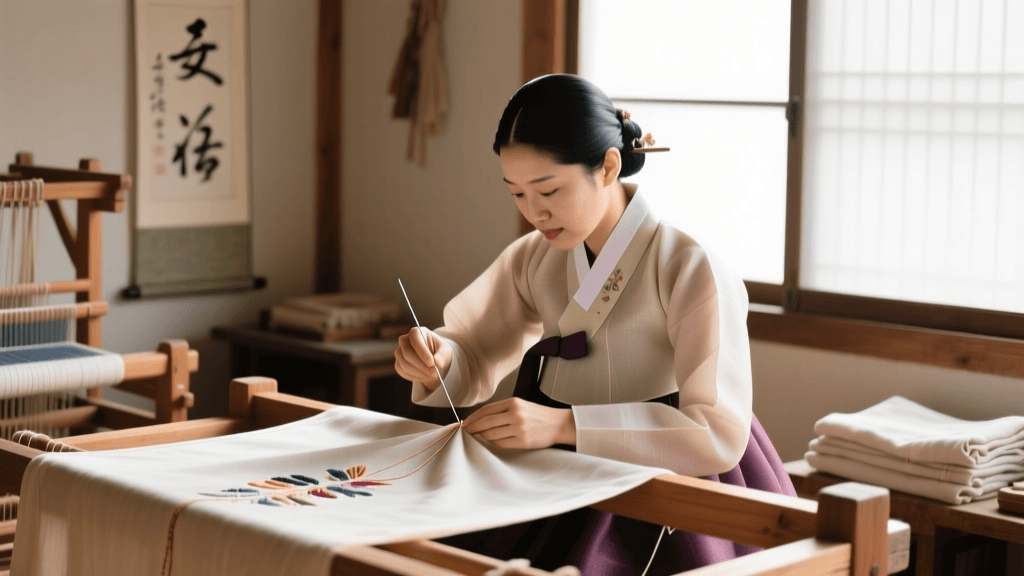
- Gamsimjil (Hidden Stitching): The hallmark of a high-quality Hanbok. This technique ensures that no seam allowances or raw edges are visible on either the inside or the outside of the garment, creating a pristine, seamless look.
- Baerae Construction: The baerae is the beautifully curved bottom line of the jeogori sleeve. Drafting this curve requires a deep understanding of fabric grain and bias, ensuring the sleeve drapes elegantly when the arm is at rest.
- Goreum Tying and Balance: The goreum are the long, flowing ties that fasten the jacket. Seminars teach not just how to sew them, but how to tie them so that the asymmetrical bow sits perfectly level, reflecting the Korean philosophical pursuit of harmony and balance.
- Sangchim (Topstitching): Used extensively on the edges of the chima and jeogori, this hand-stitching technique provides structural integrity while adding a subtle, rhythmic decorative element to the garment's borders.
Standard 12-Week Seminar Curriculum
If you are enrolling in a comprehensive 2026 certification program, expect your learning journey to follow a structured, progressive pathway. Here is what a standard 12-week syllabus looks like:
- Weeks 1-2: Introduction to Obangsaek (the traditional five-color theory), historical context, and taking precise, non-standard body measurements unique to Hanbok fitting.
- Weeks 3-4: Drafting the chima (skirt) pattern. Focus on zero-waste cutting techniques and calculating pleat ratios based on fabric weight.
- Weeks 5-6: Sewing the chima. Mastering the gamsimjil hidden stitch and attaching the waistband with internal cotton ties.
- Weeks 7-8: Drafting the jeogori (jacket). Focus on the geometric angles of the neckline and drafting the curved baerae sleeve.
- Weeks 9-10: Constructing the jeogori. Attaching the git (collar band) and the dongjeong (removable white paper collar), ensuring crisp, sharp corners.
- Week 11: Crafting the goreum (ties). Learning the structural balance required for the ties to hang correctly without twisting.
- Week 12: Final fitting, traditional pressing techniques using heavy irons and steam, and final certification review.
Sourcing Authentic Fabrics in 2026
A major component of the workshop experience is learning where to source materials. While many seminars provide starter kits, advanced students are encouraged to source their own textiles. In Seoul, the historic Gwangjang Market remains the epicenter for traditional silk and ramie merchants. For international students, 2026 has seen the rise of specialized online cooperatives that connect global buyers directly with Korean weavers, ensuring fair trade practices and authentic material origins. When purchasing silk for a jeogori, always look for Myeongju, a plain-weave silk that provides the perfect amount of structural stiffness while remaining breathable.
"Preserving the Hanbok is not just about saving a garment; it is about keeping the philosophy of harmony, nature, and zero-waste living alive in our modern wardrobes. When a student threads their needle, they are stitching themselves into a centuries-old continuum of mindful creation."
— Master Artisan Kim, 2026 International Heritage Textile Symposium
Planning Your 2026 Learning Journey
Spaces in accredited Hanbok seminars fill up rapidly, often six to eight months in advance. If you are targeting the prestigious KNUCH intensive or the KCCUK hybrid cohorts, registration for the fall 2026 terms opens in early spring. Be prepared to invest not just financially, but temporally; traditional hand-sewing requires immense patience, with a single jacket taking upwards of 40 hours to complete by hand. However, the reward is a profound connection to Asian heritage and the acquisition of a bespoke, masterfully crafted garment that will last a lifetime. Whether you are a seasoned tailor or a passionate beginner, the workshops of 2026 offer a vital bridge between ancient wisdom and contemporary sustainable fashion.