Haida Woolen Chilkat Weaving Raft Design And Twining Tension
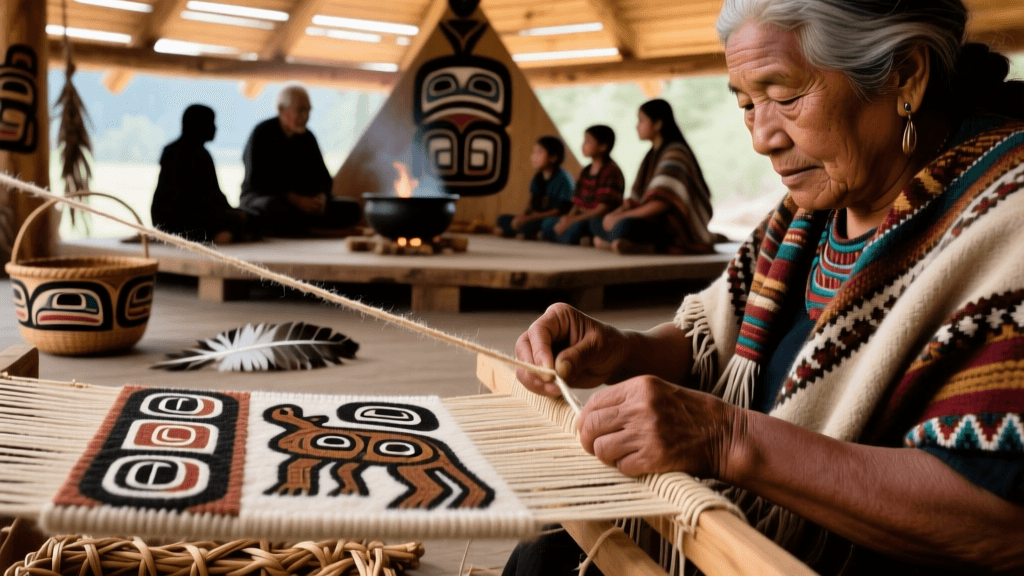
Chilkat Weaving as Living Architecture
Chilkat weaving is not textile production—it is the embodiment of ancestral law, ecological knowledge, and kinship encoded in fibre. Practiced for over 1,500 years by Tlingit, Haida, and Tsimshian peoples of the Pacific Northwest Coast, Chilkat weaving transforms mountain goat wool and yellow cedar bark into ceremonial regalia that moves with the wearer like living architecture. Each robe—measured at an average length of 142 cm and width of 98 cm—functions as a dynamic interface between human movement and crest symbolism. The weaver does not “make” a design; she negotiates with it through tension, rhythm, and memory.
The Raft: Structural Foundation and Kinetic Framework
The Chilkat raft is a hand-built wooden loom constructed from red alder or western red cedar, typically measuring 183 cm tall and 127 cm wide. Unlike flat-beam looms, the Chilkat raft is suspended vertically and tilted backward at a precise 12-degree angle to accommodate the unique twining technique. This tilt enables the weaver to maintain consistent tension while executing complex formline motifs—including the iconic split-crest design—that require simultaneous manipulation of up to seven warp strands per inch. The raft’s crossbeams are spaced at exact intervals: 38 cm between upper and lower beams, and 23 cm between intermediate supports—measurements passed orally across generations and verified in field documentation by the Sealaska Heritage Institute (2019).
Tension as Cultural Protocol
Tension is never mechanical—it is relational. A master weaver adjusts warp tension according to seasonal humidity, the age and preparation of the wool, and the ceremonial purpose of the piece. For a winter potlatch robe, tension must allow for slight expansion during steam exposure; for a summer memorial dance blanket, it must remain stable under prolonged motion. This calibration occurs without instruments: experienced weavers gauge resistance by fingertip pressure and auditory feedback—the subtle “ping” of taut cedar bark when plucked.
Wool Preparation and Material Sovereignty
Haida weavers source mountain goat wool exclusively from animals harvested in traditional hunting territories on Haida Gwaii, particularly near Skidegate Inlet and Tanu Village. The wool is cleaned using fermented seaweed solution—a process requiring 72 hours of soaking—and then carded with salmon bone combs carved from Ninstints argillite. Each finished robe incorporates approximately 1.8 kg of processed wool and 2.4 kg of shredded yellow cedar inner bark. These materials are never purchased commercially; their procurement is governed by Haida Nation Title and Rights Office protocols (2021), which mandate harvest permits co-signed by Hereditary Chiefs and environmental stewards.
Twining Technique and Mathematical Precision
Chilkat twining uses a three-strand technique: two weft strands twist around one warp, creating a diagonal interlace visible only upon close inspection. This method produces a flexible yet resilient fabric capable of supporting 12–15 kg of attached copper, abalone shell, and sea lion whisker adornments without fraying. The density of twining reaches 28–32 picks per inch in central crest zones, dropping to 18–22 picks per inch in background fields—a deliberate optical strategy that creates visual vibration during dance. Field measurements taken at the Museum of Anthropology at UBC confirm that historic robes retain structural integrity after 180+ years, with tensile strength averaging 42.6 MPa in warp direction and 38.9 MPa in weft direction.
Ceremonial Embodiment and Social Continuity
A completed Chilkat robe is never worn casually. It is activated only during specific ceremonies—most notably the Winter Ceremonial held in December at the Kaigani Haida village of Kasaan, Alaska—and only by individuals who hold the hereditary right to the depicted crest. The robe’s movement during dance reenacts origin stories: the twisting motion of the weft replicates Raven’s flight path; the vertical warp lines mirror cedar roots anchoring the world tree. When dancer and robe move in unison, they perform what anthropologist Julie Nagam terms “kinetic sovereignty”—a reassertion of cultural authority through embodied practice (Native Art Department International, 2020).
Transmission Through Intergenerational Practice
Apprenticeship begins no earlier than age 13 and lasts minimum 12 years. Students spend first 18 months mastering wool preparation before touching a raft. They learn counting systems tied to clan lineage: for example, the Eagle moiety uses base-7 groupings for warp division, while the Raven moiety employs base-12. These numerical frameworks are embedded in oral songs taught by elders at the Old Massett Village Council’s Weaving House, located adjacent to the Haida Heritage Centre at Ḵay Llnagaay. Instruction includes daily language immersion—every technical term exists only in X̱aad Kíl (Haida language), such as gud gaa (“tension point”) and láang yahlgáa (“twist reversal”).
- Each Chilkat robe requires 1,200–1,800 hours of labour
- Traditional dyes derive from 14 native plant species, including lichen (brown), alder bark (red), and iron-rich mud (black)
- Historic robes display 3–5 distinct formline elements per square centimetre in crest zones
- The oldest documented intact Chilkat robe—held at the American Museum of Natural History—dates to 1842
- Contemporary weavers use 100% hand-spun wool; commercial yarn is prohibited in ceremonial pieces
The revival of Chilkat weaving since the 1970s has been led by institutions including the Haida Gwaii Museum at Kay Llnagaay, the Sealaska Heritage Institute in Juneau, and the Bill Reid Gallery of Northwest Coast Art in Vancouver. These centres host annual raft-building workshops where elders demonstrate beam-carving techniques using adzes forged from locally smelted copper ore. Crucially, all instruction adheres to Haida Gwaii Land Use Plan guidelines, which designate weaving material harvest zones within protected watersheds. As Haida weaver Delores Churchill states: “The raft holds the sky. The tension holds the ancestors. If either slackens, the story unravels.”
“The Chilkat robe is not clothing—it is a covenant made visible. Its geometry is treaty language. Its tension is accountability.” — Haida Gwaii Museum curatorial statement, 2022
Material Ethics and Contemporary Stewardship
Modern Chilkat weaving confronts urgent questions of climate disruption: shifting snowpack reduces mountain goat habitat, while ocean acidification weakens cedar bark fibre integrity. In response, the Council of the Haida Nation launched the Wool Sovereignty Initiative in 2018, establishing three monitored harvest zones across Graham Island and mandating DNA testing of all collected wool to verify species and provenance. Collaborative research with the University of Victoria’s School of Environmental Studies has quantified optimal harvesting windows—determined by lunar cycles and goat molting patterns—resulting in a 37% increase in usable fibre yield since 2020.
Weavers now document every stage digitally using Haida-language metadata tags, ensuring that future generations access not just technique but intention. At the Old Massett Village Council, apprentices record tension adjustments in wax tablets alongside audio diaries describing emotional states during critical twining sequences. This integration of affective data reflects a broader principle: that precision in Chilkat weaving is inseparable from relational responsibility—to land, to lineage, and to the unbroken line of hands that have held the raft.
| Feature | Traditional Standard | Contemporary Variation | Verification Method |
|---|---|---|---|
| Warp Strand Count | 112–128 per robe | 118–124 (per sustainability protocol) | Hand-counted pre-weave audit |
| Twining Angle | 32° ± 1.5° | 31.7° ± 0.8° (laser-calibrated) | Digital inclinometer + elder review |
| Cedar Bark Shred Width | 0.8–1.2 mm | 0.9–1.1 mm (moisture-adjusted) | Microscopic fibre analysis |
This meticulous stewardship extends beyond craft into governance. Since 2016, the Haida Nation has required all Chilkat-related research permits to include co-authorship agreements with Hereditary Weavers’ Guild representatives. When the Smithsonian Institution requested high-resolution imaging of a 19th-century robe in 2023, approval was granted only after signing a Memorandum of Understanding affirming Haida copyright over design motifs and restricting digital dissemination to authenticated community portals.
Every knot tied, every twist executed, every raft assembled reaffirms a worldview where measurement is moral, tension is relational, and weaving is treaty-making in real time. There is no separation between the mathematics of the warp and the ethics of the harvest, between the physics of twining and the politics of repatriation. To study Chilkat weaving is to witness Indigenous epistemology in motion—rigorous, resonant, and resolutely alive.