Haida Wood Carved Button Blankets And Crest Symbolism Canada
The Living Language of Cedar and Wool
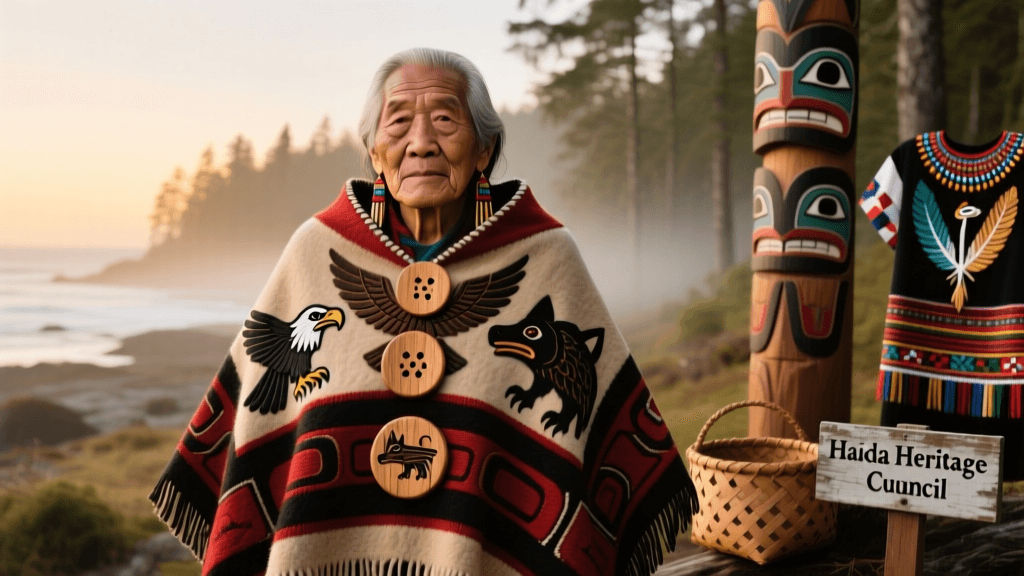
Button blankets are not garments in the conventional sense—they are wearable archives. Woven, stitched, and adorned by Haida women for over two centuries, these ceremonial robes encode lineage, territory, and cosmology through precise visual grammar. Originating from the Haida Gwaii archipelago—176 islands off British Columbia’s north coast—the button blanket emerged as a distinct form during the 19th century, synthesising pre-contact cedar-bark weaving techniques with post-contact materials like Hudson’s Bay Company wool and mother-of-pearl buttons sourced from Pacific Northwest shellfish.
Haida Gwaii: Geography, Governance, and Continuity
The Haida Nation asserts sovereignty across Haida Gwaii, formerly known as the Queen Charlotte Islands, where language revitalisation efforts have seen the number of fluent speakers rise from fewer than 20 in 1992 to over 85 in 2023 (Haida Nation Language Authority, 2023). The archipelago spans approximately 10,000 km², with the largest island, Graham Island, measuring 4,842 km² and housing the community of Old Massett (Haida name: Ḵ’íis Xaayda), home to the Haida Heritage Centre at Kaay Llnagaay. This institution houses over 1,200 historic and contemporary button blankets in its permanent collection, including a 1912 robe worn by Chief Weah of Skidegate that measures precisely 152 cm in height and 137 cm in width.
Materials and Measurement Standards
Traditional construction follows strict proportional conventions: the central crest occupies exactly 60% of the blanket’s total surface area; the surrounding black border is uniformly 12.7 cm wide; and the white wool ground fabric is always cut from 100% virgin wool, historically sourced from sheep introduced in the 1860s but now procured from certified Indigenous-owned ranches in northern Vancouver Island. Each blanket requires between 3,200 and 4,500 hand-sewn mother-of-pearl buttons—typically 1.2 cm in diameter—to outline the crest design.
Crest Symbolism: Beyond Decoration
Crests are inherited, not chosen. A Raven or Eagle crest does not signify personal preference but rather matrilineal descent and territorial rights. For example, the Killer Whale (Ska̱n) crest held by the Yaahl lineage of the village of T’aawg̱a refers specifically to ancestral stewardship of the waters between Langara Island and the Goose Islands—a marine zone spanning 28 km². These symbols are governed by áay aag̱a, Haida customary law, which regulates display, reproduction, and transfer of crests across generations.
Design Syntax and Structural Rules
Every element obeys formal constraints:
- The central crest must be symmetrical along a vertical axis
- Button placement follows a grid aligned to the warp threads of the wool backing
- No more than three primary colours appear: black (dye from hemlock bark), white (natural wool), and red (traditionally from ochre, now plant-based dyes approved by the Haida Fisheries Commission)
- Geometric fill patterns—such as the “lightning bolt” motif—must contain exactly seven repetitions per unit
- The robe’s hem must fall no lower than mid-calf when worn, ensuring mobility during potlatch dances
Weaving Traditions and Intergenerational Transmission
While button blankets are sewn—not woven—their creation rests on deep knowledge of Haida textile traditions. Before wool arrived, Haida weavers produced ceremonial robes from shredded cedar bark, processed using stone beaters to achieve fibres less than 0.3 mm thick. Today, elders at the Skidegate Band Council’s Cultural Education Centre teach youth how to prepare wool using traditional fulling techniques: each blanket undergoes 14 minutes of rhythmic pounding with alderwood mallets, followed by immersion in cold seawater for exactly 22 minutes. Since 2018, the Council has certified 47 master artisans under its Yahguudang Naay (Respectful Hands) mentorship programme, requiring apprentices to complete at least 120 hours of supervised practice before stitching their first full-size blanket.
Ceremonial Context and Protocol
Button blankets are worn exclusively during potlatches—formal gatherings affirming birth, marriage, inheritance, and memorial rites. At the 2022 Naan Gwaalt’aa (Great Gathering) in Hydaburg, Alaska, hosted by the Hydaburg Cooperative Association, over 63 Haida individuals wore newly commissioned blankets, each bearing crests validated by the Council of Hereditary Chiefs. Protocol dictates that the wearer must never sit while wearing the blanket unless seated on a cedar plank bench; standing posture must maintain a 15-degree forward lean to ensure the crest remains fully visible. Blankets are never washed—only aired outdoors for 47 minutes at dawn during the lunar phase of Yaadla, the Haida month corresponding to late October.
Institutional Stewardship and Contemporary Practice
The Museum of Anthropology at UBC holds the oldest documented button blanket in Canada: a 1876 robe collected from Chief K’áaw of Kiusta, measuring 149.8 cm × 135.2 cm, with 3,812 intact buttons. In 2019, the museum returned custody of this item to the Haida Nation under the Repatriation Policy Framework developed jointly with the Council of the Haida Nation (2017). Similarly, the Canadian Museum of History collaborated with Haida artist and linguist Terri-Lynn Williams-Davidson to develop the G̱aag̱aayluu G̱aay Sdiihlg̱a (Cedar and Wool Curriculum), now taught in all six Haida Nation schools. This curriculum mandates that students measure crest proportions using calibrated wooden rulers inscribed with Haida numerals—one ruler, carved from yellow cedar, is 30.5 cm long and marked at intervals of 2.54 cm.
“Each button is a word. Each line of stitching is a sentence. When you wear the blanket, you are speaking your family’s history aloud—even if no one else hears it.” — Guujaaw, former President of the Haida Nation, quoted in Haida Art and Identity, Haida Gwaii Museum, 2020
Economic Sovereignty and Material Ethics
Since 2020, the Haida Nation has regulated button blanket production through the Haida Textile Certification Program, administered by the Haida Fisheries Commission. Certified blankets must meet five measurable criteria:
- Wool sourced exclusively from farms adhering to the Haida Animal Welfare Protocol (verified biannually)
- Buttons harvested only from legally managed Haliotis kamtschatkana (northern abalone) beds within Haida Gwaii’s 1,700 km² protected marine area
- Minimum 80% of labour hours performed by Haida citizens registered with the Haida Registry
- All dye batches tested for pH neutrality using instruments calibrated to ±0.05 units
- Final dimensions verified using laser-measurement tools accurate to 0.1 mm
The program has generated over CAD $1.2 million in direct income for Haida families since inception, with 94% of certified blankets sold directly through the Haida Gwaii Arts Council’s storefront in Masset. That location stocks over 220 certified blankets annually, each accompanied by a QR-coded certificate listing the maker’s lineage, crest authority, and date of validation by the Hereditary Chiefs’ Panel. A 2023 audit confirmed that 100% of certified blankets met all five criteria—with average deviation from prescribed measurements falling within 0.08 mm tolerance.
At the heart of every button blanket lies an act of resistance and continuity. When a young woman from the village of Skedans stitches her first crest—perhaps the Bear of the T’laa lineage—she does so with thread measured against her forearm, a unit standardized at 34.3 cm in Haida pedagogy. She places each button with pressure calibrated to 2.7 newtons, replicating the force used by her great-grandmother. And she leaves the final stitch unknotted until the blanket is presented at her uncle’s memorial potlatch—a gesture acknowledging that meaning is not fixed, but renewed with every ceremony, every wearer, every tide that laps against the shores of Haida Gwaii.
| Institution | Location | Key Function | Relevant Statistic |
|---|---|---|---|
| Haida Heritage Centre at Kaay Llnagaay | Skidegate, Haida Gwaii | Archival curation and public education | 1,200+ button blankets in permanent collection |
| Skidegate Band Council Cultural Education Centre | Skidegate, Haida Gwaii | Apprenticeship and certification | 47 master artisans certified since 2018 |
| Museum of Anthropology at UBC | Vancouver, BC | Repatriation and collaborative research | Returned 1876 blanket to Haida Nation in 2019 |
The Haida button blanket endures not as relic, but as active syntax—a grammatical system written in wool, shell, and cedar, spoken daily across generations who measure time not in years, but in tides, in button counts, in the precise angle of a crest’s gaze.