Miao Traditional Dress: Guizhou Embroidery, Silver & Festivals
Introduction to Guizhou’s Miao Provincial Dress
The mountainous province of Guizhou in southwestern China is home to one of the most visually striking and culturally profound sartorial traditions in Asia: the traditional dress of the Miao (Hmong) people. According to the Encyclopædia Britannica, the Miao are not a single monolithic group but a diverse collection of subgroups, each distinguished by their unique regional folk dress, dialect, and silverwork. For textile collectors, cultural anthropologists, and travelers alike, understanding the nuances of Guizhou’s provincial Miao dress offers a masterclass in indigenous craftsmanship, symbolism, and wearable art. This comprehensive guide explores the anatomy of Miao garments, provides actionable advice for authenticating and purchasing embroidery and silver, and outlines the festival calendar where these magnificent provincial garments are brought to life.
The Anatomy of the Miao Ensemble
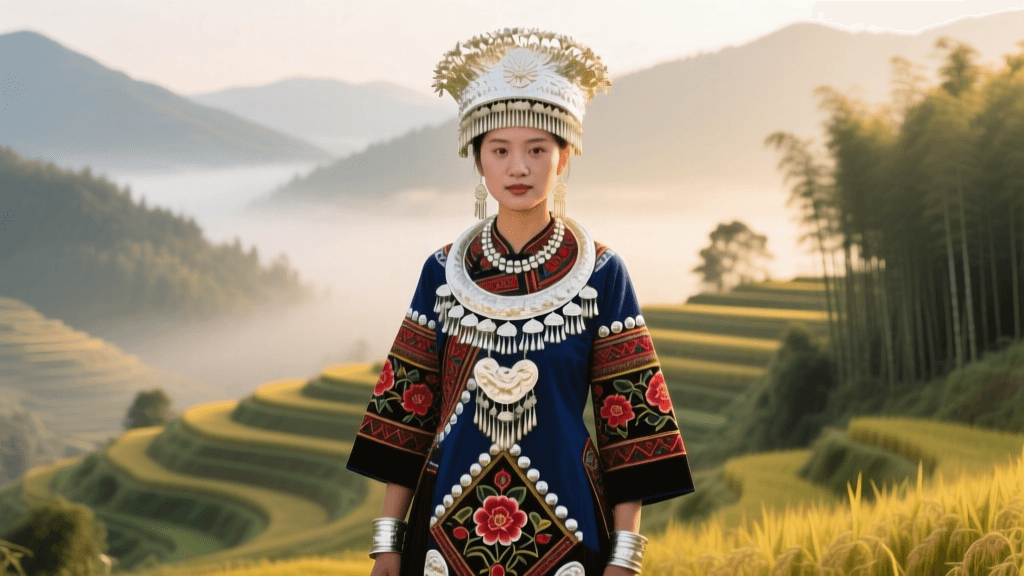
A traditional Miao woman’s festival ensemble from the Xijiang or Shidong regions is a multi-layered masterpiece that can take years to complete. The foundation is often a pleated indigo-dyed skirt, known as a baidaqun. Creating a single skirt requires up to 15 meters of hand-woven cotton, which is dyed repeatedly in fermented indigo vats, beaten with wooden mallets to create a subtle sheen, and then meticulously pleated into hundreds of micro-folds. Over this, women wear a cross-collared jacket adorned with regional embroidery, and a heavily decorated apron. The silhouette is deliberately structured to emphasize the width of the shoulders and the volume of the skirt, creating a majestic, grounding presence.
Regional Variations: Xijiang vs. Shidong
While outsiders may simply see 'Miao dress,' provincial variations are stark. In Xijiang (Leishan County), the 'Long Skirt Miao' favor deep indigo bases with vibrant, raised silk embroidery featuring motifs of the butterfly mother, water buffalo, and dragons. The silver headdresses here are characterized by massive, sweeping horns. Conversely, the 'Short Skirt Miao' of Shidong (Taijiang County) wear skirts that barely reach the knee, allowing for greater mobility during the lusheng (reed pipe) dances. Their embroidery relies heavily on flat satin stitch and intricate seed stitching, often utilizing a brighter, more contrasting color palette of pinks, greens, and yellows against a dark background.
Miao Embroidery (Xiu Hua): A Collector’s Guide
Miao embroidery is widely considered one of the most complex needlework traditions in the world. Because the Miao historically lacked a written language, their textiles served as historical records, encoding migration routes, myths, and clan identities into the fabric. When sourcing authentic Miao embroidery for a private collection or interior design project, buyers must navigate a market flooded with machine-made replicas.
Authenticity Checks: Hand-Stitched vs. Machine-Made
- Examine the Reverse Side: Authentic hand-stitched Miao embroidery is nearly as neat on the back as it is on the front. Machine embroidery will show chaotic, looping bobbin threads and frequent color changes.
- Thread Texture: Traditional Miao silk thread is hand-spun and often dyed with natural plant materials. It possesses a slightly irregular thickness and a matte-to-satin luster, unlike the high-gloss, uniform polyester threads used in factory-made tourist souvenirs.
- The 'Seed Stitch' Test: The Miao are famous for the seed stitch (dazi xiu), a technique where tiny knots are tied on the fabric surface to create a 3D, velvet-like texture. This is virtually impossible for standard commercial embroidery machines to replicate authentically.
Pricing, Measurements, and Sourcing
When purchasing vintage or contemporary Miao jackets, understanding standard measurements and fair market value is crucial. A standard vintage festival jacket typically measures 60 to 75 cm in length, with a wide sleeve span of 130 to 150 cm. Prices vary wildly based on age, condition, and stitch density. A contemporary, hand-stitched jacket commissioned directly from a village artisan in Taijiang will cost between $150 and $400 USD, depending on the complexity of the motifs. Genuine vintage jackets from the 1960s to 1980s, featuring natural dyes and hand-spun silk, command between $500 and $1,500 USD on the international antique textile market. Always request high-resolution macro photos of the stitching before purchasing from overseas dealers.
The Weight of Tradition: Miao Silverwork
No Miao festival ensemble is complete without silver. Silversmithing is a revered, male-dominated craft in Guizhou, passed down through generations. As noted by the Smithsonian National Museum of Asian Art, the integration of heavy silver jewelry into indigenous dress serves both as a display of familial wealth and a spiritual talisman to ward off evil spirits. A full bridal silver set can weigh anywhere from 5 to 10 kilograms, comprising horned headdresses, chest plates, neck rings, and hairpins.
Buyer’s Guide to Miao Silver
If you are traveling to Guizhou to purchase silver, you must be vigilant. Traditional Miao silver is highly pure, often 99% or 99.9%. However, many tourist shops in commercialized villages sell 'Tibetan silver' or 'Miao silver,' which are actually copper-nickel-zinc alloys containing zero actual silver.
- Price Benchmarking: Authentic handcrafted silver is priced based on the daily raw silver market rate plus a craftsmanship premium. Expect to pay between 15 to 35 RMB per gram. If a heavy 500-gram chest plate is being sold for the equivalent of $50 USD, it is an alloy.
- Magnet and Sound Tests: Pure silver is non-magnetic. Furthermore, when gently tapped, pure silver produces a dull, soft thud rather than a high-pitched, ringing chime characteristic of brass or steel alloys.
- Hallmarks and Artisans: Purchase directly from recognized master silversmiths in villages like Shidong or Xijiang. Reputable artisans will provide a certificate of purity and stamp their work with a personal hallmark.
Festival Calendar: When to Experience the Dress
To witness these garments in their intended context—accompanied by the rhythmic stomping of the lusheng and the swirling of pleated indigo skirts—timing your visit to coincide with provincial festivals is essential. The Victoria and Albert Museum frequently highlights the importance of contextualizing indigenous textiles within their ceremonial and communal environments. Below is a practical guide to the major Miao festivals in Guizhou where regional folk dress is prominently displayed.
| Festival Name | Lunar Timing | Gregorian Approximation | Key Garment Features | Prime Location |
|---|---|---|---|---|
| Lusheng Festival | 9th Lunar Month | October / November | Full silver horn headdresses, heavily pleated indigo skirts, embroidered capes. | Xijiang, Leishan County |
| Sisters' Meal Festival | 3rd Lunar Month | April / May | Elaborate floral hairpins, vibrant pink and green silk embroidery, lighter silver neck rings. | Shidong, Taijiang County |
| Miao New Year | 10th/11th Lunar Month | November / December | Multi-layered skirts (up to 20 worn at once to show wealth), maximum silver ornamentation. | Danzhai and Kaili Regions |
| Dragon Boat Festival | 5th Lunar Month | June / July | Water-resistant indigo garments, silver hairpins shaped as dragons, minimal heavy chest plates for river safety. | Qingshui River Basin |
Preservation and Care for Antique Textiles
Collectors who acquire authentic Miao embroidery or indigo-dyed skirts must adhere to strict preservation protocols. The fermented indigo dye used in Guizhou is living and can rub off or degrade if exposed to harsh chemicals. Never dry-clean antique Miao textiles; the solvents will strip the natural oils from the hand-spun cotton and cause the indigo to bleed catastrophically. Instead, store garments flat in archival, acid-free tissue paper. Avoid wire hangers, which will distort the heavy, structured shoulders of the embroidered jackets. Keep the textiles in a climate-controlled environment with a relative humidity of 45-55% to prevent the silk threads from becoming brittle. For silver pieces, store them in anti-tarnish cloth bags with silica gel packets to prevent oxidation from Guizhou's naturally humid climate.
Conclusion
The regional folk dress of Guizhou’s Miao people is far more than mere clothing; it is a wearable archive of history, a testament to masterful provincial craftsmanship, and a living tradition that continues to evolve. Whether you are a collector seeking authentic embroidery, a jeweler studying indigenous silverwork, or a traveler planning a culturally immersive itinerary, approaching Miao dress with an informed, respectful eye ensures the preservation and appreciation of one of Asia’s most magnificent sartorial legacies.