Authentic Chiton & Roman Toga Guide 2026: Patterns & Fit
Introduction to Classical European Garments in 2026
The revival of ancient European folk dress and classical antiquity garments has reached new heights in 2026. Driven by the sustainable slow-fashion movement, high-fidelity historical reenactment societies, and a growing rejection of the 'Hollywood white marble' myth, modern enthusiasts are seeking historically accurate representations of Greek and Roman clothing. Today, costume historians and textile artisans emphasize the vibrant polychromy, complex draping, and specific textile weights that defined the ancient Mediterranean wardrobe.
Whether you are preparing for the 2026 European historical reenactment season, designing for a neo-classical theater production, or simply exploring the roots of European textile traditions, understanding the structural differences between the Greek chiton, the Roman toga, and the stola is essential. This comprehensive guide provides actionable measurements, modern sourcing advice, and step-by-step draping techniques to help you recreate these iconic garments with historical precision.
The Greek Chiton: Doric vs. Ionic Variations
The chiton was the foundational garment of ancient Greece, worn by both men and women. However, its construction varied significantly based on regional styles, historical periods, and the available textiles. According to the World History Encyclopedia, the two primary variations were the Doric and Ionic chitons, each requiring distinct cutting and pinning techniques.
The Doric Chiton (Peplos)
The Doric chiton, often referred to as a peplos when worn by women, was typically crafted from a heavier, rectangular piece of woven wool. The defining feature of the Doric style is the apoptygma—an overfold at the top of the garment that drapes down over the chest and back. To construct an authentic Doric peplos for an adult measuring approximately 173 cm (5 feet 8 inches) in height, you will need a rectangular wool panel measuring roughly 170 cm wide by 150 cm tall. The top 30 cm is folded outward and downward before the garment is pinned at the shoulders using heavy bronze or iron fibulae (brooches). The heavy wool provides structure, allowing the overfold to cascade in stiff, sculptural zig-zag folds that are characteristic of classical Greek statuary.
The Ionic Chiton Draping Techniques
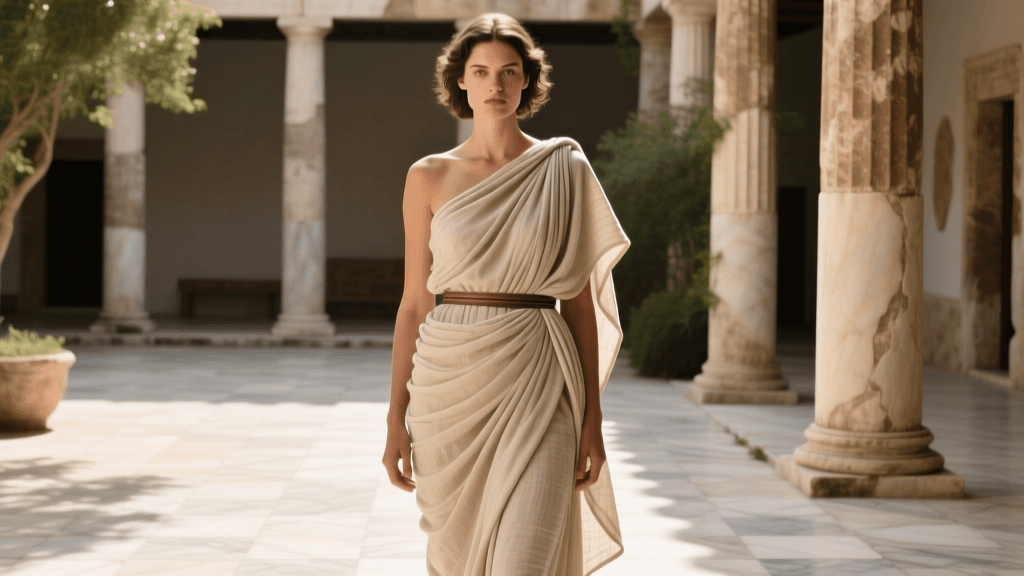
In contrast, the Ionic chiton was made from lightweight, finely woven linen. It was cut much wider than the Doric version—often utilizing a piece of fabric that is 1.5 to 2 times the wearer's arm span. Instead of a single overfold and shoulder pins, the Ionic chiton was gathered and pinned at multiple intervals along the arms, creating the illusion of short, flowing sleeves. For a modern reproduction, source a medium-weight European flax linen. The excess fabric is belted at the waist, and the material is pulled up over the belt to create a kolpos (a bloused effect), which allows for ease of movement and a highly fluid, elegant drape.
The Roman Toga and Stola: Status and Structure
While Greek garments relied on rectangular cuts and vertical draping, Roman dress introduced complex, curved cuts and deeply symbolic social markers. The Roman wardrobe was strictly regulated by sumptuary laws, with specific garments denoting citizenship, gender, and social rank.
The Toga: Engineering a Semi-Circle
The toga was the ultimate symbol of Roman male citizenship. Contrary to popular belief, the toga was not a simple bedsheet wrapped around the body; it was a massive, semi-circular piece of woolen cloth. By the Imperial period, the toga could measure up to 5.5 meters (18 feet) along its straight edge. As detailed in the World History Encyclopedia's guide to the Roman Toga, the draping process was so complex that wealthy Romans often required a slave specifically trained to arrange the folds, known as a vestiplicus.
The most critical elements of the toga drape are the sinus (a deep, pouch-like fold across the chest that could be used to carry small items) and the umbo (a decorative knot or cluster of folds resting on the upper chest). For modern reenactors attempting a 2026-accurate Imperial toga, it is highly recommended to use a lightweight merino wool twill and to practice the draping sequence over a base tunic multiple times before public events.
The Stola and Palla for Roman Women
Roman citizen women did not wear the toga; instead, their formal public garment was the stola. Worn over a tunica intima (under-tunic), the stola was a long, sleeveless or short-sleeved dress suspended from the shoulders by small straps or brooches. The defining feature of the stola was the institia—a decorative, often contrasting border woven or sewn along the bottom hem, which signaled the wearer's modesty and matronly status. When venturing outdoors, Roman women draped a palla (a large rectangular mantle) over their shoulders and head, serving both as a modesty veil and protection from the elements.
Dyeing and Polychromy: Moving Beyond the White Marble Myth
One of the most significant shifts in historical costuming for 2026 is the widespread adoption of polychromy—the understanding that the ancient world was vibrantly colored. While undyed, off-white wool and linen were common for the lower classes and for specific religious rituals, the elite wore vivid colors. Natural dyeing techniques have seen a massive resurgence among artisan dyers. Madder root produces deep reds and terracottas; woad and indigo yield rich blues; and weld or saffron provide brilliant yellows. When sourcing fabric for your chiton or stola, consider commissioning hand-dyed textiles using these historically accurate botanical sources to elevate the authenticity of your garment.
2026 Fabric Sourcing and Sustainability
Sourcing historically accurate textiles is easier than ever in 2026, thanks to a renewed focus on heritage milling and sustainable agriculture. When selecting fabrics for classical garments, the drape and weight are just as important as the fiber content. Below is a comparison chart of recommended textiles for the current market.
| Material | Historical Accuracy | Drape Quality | 2026 Avg. Cost per Yard | Recommended Use |
|---|---|---|---|---|
| 100% European Flax Linen (Medium Weight) | High | Fluid, Elegant | $28 - $38 | Ionic Chiton, Tunica Intima, Palla |
| Merino Wool Twill (Lightweight) | Very High | Structured, Heavy | $42 - $55 | Roman Toga, Doric Peplos, Winter Mantles |
| Hemp-Cotton Blend | Low (Modern Substitute) | Stiff, Utilitarian | $15 - $22 | Budget Theater Productions, Linings |
| Silk Noil (Raw Silk) | Moderate (Elite/Late Empire) | Matte, Luxurious | $35 - $50 | Elite Stola, High-Status Ionic Chiton |
For the most authentic results, avoid modern synthetic blends. Polyesters and rayon melt under the heat of Mediterranean-style summer reenactment events and lack the natural temperature-regulating properties of wool and linen. Heritage mills in Ireland, Italy, and Belgium currently produce slubbed, uneven weaves that closely mimic the hand-loomed textiles of antiquity.
Step-by-Step Draping Guide for the Ionic Chiton
To achieve the classic, multi-sleeved look of the Ionic chiton, follow these actionable steps:
- Cut the Fabric: Measure your arm span from wrist to wrist. Add 20 inches to this measurement for the width. The length should be your height plus 12 inches to allow for the bloused kolpos.
- Prepare the Edges: Hem all four sides. Historically, the edges were sometimes left raw to create a subtle fringe, but a rolled hem is more durable for modern wear.
- Pin the Shoulders: Fold the fabric in half vertically. Starting at the front and back neckline, use small safety pins or replica disc fibulae to join the front and back layers at intervals of 3 to 4 inches across the shoulders, leaving a gap for the head.
- Create the Sleeves: Continue pinning the front and back layers together down the arms. The final pin should sit just above the elbow or mid-bicep, depending on your desired sleeve length.
- Belt and Blouse: Tie a woven wool or linen cord (the zona) around your natural waist. Pull the excess fabric up and over the belt until the hem falls gracefully at your ankles or calves. Adjust the blousing evenly around your torso.
Accessories: Fibulae, Zonae, and Footwear
No classical garment is complete without its accompanying accessories. The fibula (brooch) was both a functional necessity and a canvas for artistic expression. In 2026, artisan metalworkers specializing in lost-wax casting offer incredibly accurate replicas of Greek and Roman fibulae in bronze, brass, and silver. Avoid cheap, mass-produced costume jewelry, which often breaks under the tension of heavy wool.
Belts, or zonae, were typically woven bands of wool or leather. For the Roman toga, footwear was equally regulated. The calceus was a closed leather shoe worn in public by citizens, while the solea (sandal) was reserved for indoor wear or informal settings. Modern bespoke shoemakers catering to the reenactment community now offer historically patterned calcei with authentic vegetable-tanned leathers and iron hobnails for durability.
Conclusion
Recreating the chiton, toga, and stola requires a departure from modern tailoring and an embrace of the art of the drape. By understanding the geometric cuts, sourcing appropriate natural fibers, and respecting the historical context of these garments, you can bring the vibrant, polychromatic world of classical Europe to life. Whether for academic research, theatrical performance, or cultural celebration, the enduring elegance of ancient Greek and Roman dress continues to captivate and inspire in 2026 and beyond.