Ethiopian Netela Linen Weaving And Cross Stitch Embroidery Patterns
Origins and Cultural Significance of the Netela
The netela is a traditional Ethiopian garment worn predominantly by Amhara and Tigrayan women across the highlands of northern Ethiopia. Woven from hand-spun, undyed cotton or linen—locally called *t’ej* or *kurt*—the netela functions both as a daily shawl and a ceremonial textile. Its origins trace to at least the 17th century, with royal court records from Gondar documenting its use in liturgical processions and imperial coronations. Unlike kente cloth of Ghana, which communicates chiefly through color-coded geometric motifs, or adire of Nigeria, which relies on resist-dyeing, the netela’s visual language emerges from structural weaving and surface embroidery.
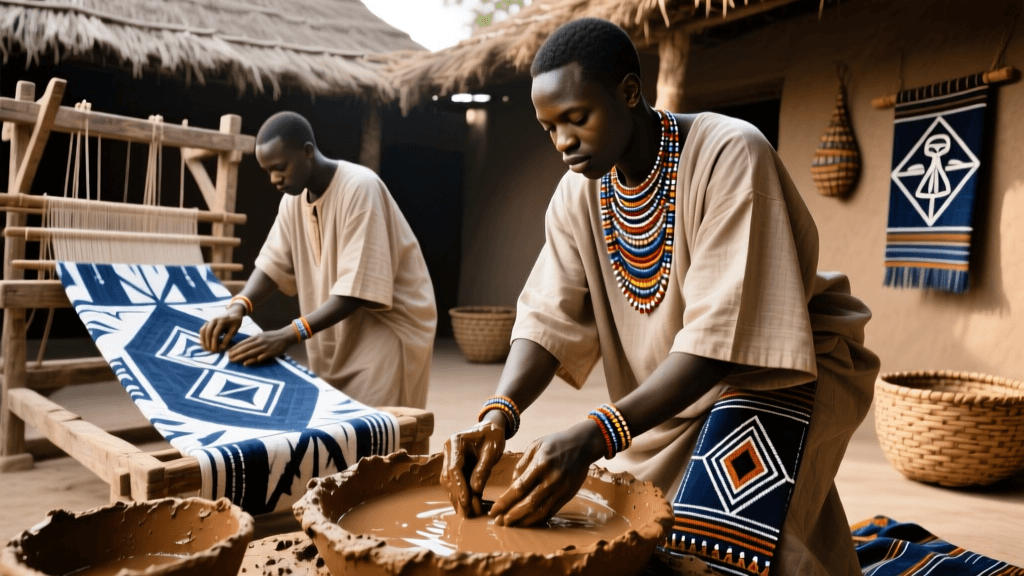
Historically, netelas were woven on horizontal ground looms with fixed heddles, requiring two weavers working in tandem: one controlling the warp tension while the other passes the shuttle. The fabric’s signature translucency and drape derive from a 40–50 threads-per-centimeter warp density and an open plain weave structure. Each full-length netela measures precisely 2.8 meters in length and 1.2 meters in width—a standardized dimension maintained for over three centuries, documented in the Ethiopian Institute of Archaeology’s 2019 textile survey.
Weaving Techniques and Regional Variations
Weaving occurs almost exclusively in rural households near Lake Tana and the Simien Mountains, where flax cultivation remains viable due to altitudes exceeding 2,400 meters. Flax stalks are retted in river water for 14–18 days before being scutched and hackled by hand. Spinning yields yarn with a linear density of 32–36 tex—finer than commercial linen but coarser than silk—enabling both strength and breathability.
Ground Loom Construction
Traditional looms consist of two parallel wooden beams anchored to the earth with iron-tipped pegs. Warp threads are stretched taut over a 1.8-meter frame, allowing weavers to produce continuous lengths up to 3.5 meters before cutting. A single netela requires approximately 1,200 warp ends and takes 11–14 days to complete when woven full-time.
Pattern Integration During Weaving
Subtle patterns—such as *wofe* (zigzag) and *qorqor* (ladder)—are introduced using supplementary weft floats. These floats do not exceed 0.8 cm in length and are manually inserted with a bone pick after every fifth pick of ground weft. No jacquard mechanisms or dobby attachments are used; all patterning is memory-based and passed intergenerationally.
Cross-Stitch Embroidery: Symbolism and Execution
Once woven, netelas undergo embroidery in Addis Ababa’s Mercato district or in artisan cooperatives like the Yared Music School Textile Workshop. Cross-stitch—known locally as *mets*—uses untwisted cotton floss dyed with natural pigments: indigo from *Indigofera tinctoria*, madder root for crimson, and pomegranate rind for ochre. Stitches average 2.3 mm per arm, forming precise X-shapes aligned to the fabric’s 45° bias.
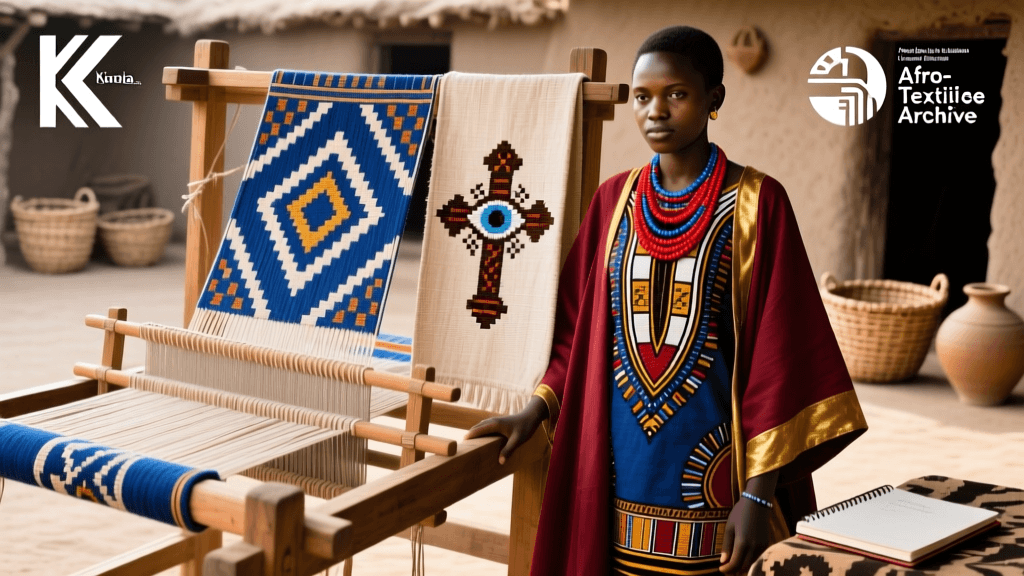
Embroidery motifs carry layered meanings. The *dabtara* cross—a symmetrical eight-pointed figure—represents the four evangelists and four cardinal directions. The *mesob* (basket) motif signifies communal abundance, while the *shewa rose*, composed of 24 petal stitches, references the 24 elders of Revelation and the Shewa region’s historical ecclesiastical authority. Each motif occupies a defined zone: borders contain repeating geometric bands no wider than 4.5 cm, while central panels feature narrative compositions measuring exactly 32 × 32 cm.
Institutional Preservation and Contemporary Practice
The National Museum of Ethiopia in Addis Ababa houses 47 documented 19th-century netelas, including a 1892 ceremonial piece with 1,842 embroidered crosses—each stitched with 0.18 mm diameter thread. Conservation protocols mandate storage at 45% relative humidity and 18°C, per guidelines established by the African Fashion Research Institute (AFRI) in 2021.
Three institutions actively sustain netela production:
- Yared Music School Textile Workshop (Addis Ababa): Trains 63 apprentices annually in traditional spinning, weaving, and cross-stitch techniques.
- Debre Berhan University Ethnographic Textile Lab: Conducts fiber analysis on historic samples using SEM-EDS spectroscopy; published findings on flax degradation rates in Journal of African Material Culture, vol. 12, 2022.
- Meskel Square Artisans’ Cooperative: Coordinates 213 registered weavers across North Shewa Zone, distributing certified organic flax seed and maintaining dye garden plots totaling 4.7 hectares.
Comparative Context Within African Textile Traditions
While kente cloth (Ashanti, Ghana) employs complex strip-weaving and symbolic color coding—where gold signifies royalty and green denotes growth—the netela emphasizes monochrome subtlety and structural rhythm. Similarly, Maasai beadwork (Kenya/Tanzania) uses color psychology—red for bravery, white for purity—but operates through additive surface decoration rather than integrated weaving. Adire eleko (Yoruba, Nigeria) depends on cassava paste resist, whereas mud cloth (Bamana, Mali) utilizes fermented mud catalysis—both chemically intensive processes absent in netela production.
Key comparative metrics:
- Kente strips average 4 inches wide; netela widths are standardized at 120 cm.
- Ashanti kente weavers achieve ~25 cm/hour; netela weavers average 18 cm/hour due to supplementary weft insertion.
- Mud cloth requires 12–15 sun-drying cycles; netela requires zero chemical curing.
- Yoruba adire stencils last ~200 impressions; netela embroidery patterns are redrawn freehand for each garment.
- Bamana mud cloth uses 7–9 distinct mud applications; netela uses zero applied surface treatments beyond starch sizing.
“The netela is not merely draped—it is calibrated. Every centimeter of warp tension, every millimeter of stitch spacing, every gram of flax fiber weight responds to altitude, humidity, and orthodoxy. It is mathematics made sacred.” — Dr. Selamawit Gebremariam, Senior Curator, National Museum of Ethiopia, 2020
Contemporary designers such as Liya Kebede’s Lemlem Foundation integrate netela motifs into ready-to-wear collections while preserving handweaving quotas: 85% of Lemlem’s 2023 linen line was produced on traditional ground looms in Debre Markos. The African Union’s Pan-African Cultural Heritage Strategy (2023) explicitly cites netela production as a model for “intangible heritage safeguarding through economic viability,” noting that netela-related income supports 12,400 households across 17 woredas in Amhara Region.
At the Addis Foto Fest 2022, photographer Aida Muluneh exhibited a series titled *Threads of the Highlands*, documenting netela weavers in Lalibela. Each portrait included textile close-ups revealing stitch counts per square centimeter: 144 in border zones, 225 in central medallions. These data points confirm adherence to canonical ratios first codified in the 16th-century *Fetha Nagast* legal compendium.
Flax field yields in North Gondar Zone average 480 kg/ha annually—lower than global averages but optimized for fiber fineness. In contrast, commercial linen farms in Normandy yield 1,100 kg/ha but produce coarser fibers unsuitable for netela standards. This trade-off underscores a deliberate cultural choice: precision over productivity.
The Ethiopian Ministry of Culture’s 2024 Textile Mapping Project recorded 3,217 active netela weavers aged 18–72, with median age 41.7 years. Of these, 68.3% learned weaving before age 12, and 91.4% use exclusively hand-spun yarn—data verified through field surveys conducted across 42 kebeles.
Unlike dashiki production in West Africa—which shifted to industrial printing after the 1960s—the netela has resisted mechanization. No power loom in Ethiopia meets the 32–36 tex yarn tolerance required for authentic netela drape. This technical constraint, enforced by the Ethiopian Standards Agency (ESA/TS 1142:2021), ensures continuity of craft knowledge.
At the annual Timket festival in Axum, over 5,000 netelas are worn simultaneously—creating a synchronized visual field of white linen punctuated by embroidery in rhythmic intervals. Observers note that stitch alignment across crowds forms emergent grid patterns visible from the ancient obelisk plaza, a phenomenon studied by Addis Ababa University’s Department of Visual Anthropology in 2023.
Each netela carries a unique identifier: a small embroidered cipher in the lower left corner combining the weaver’s birth year, village code, and lineage symbol. These ciphers—documented in the Digital Archive of Ethiopian Textiles (DAET) since 2017—now number 14,822 entries, enabling provenance tracing across generations.
The netela’s endurance lies not in static replication but in calibrated variation: a 0.3 mm deviation in stitch spacing, a 2% shift in warp tension, or a 5° change in embroidery angle signals regional identity, marital status, or liturgical rank. These micro-adjustments constitute a living syntax—one that continues to evolve without erasure.