2026 Guide to Draping the Ancient Greek Chiton & Stola
The Enduring Legacy of Classical Draping in 2026
As we navigate the cultural landscape of 2026, the revival of historical European folk dress and ancient Mediterranean garments has moved beyond simple costume play into a rigorous pursuit of material authenticity. Whether you are preparing for an immersive historical reenactment, designing for a contemporary theatrical production, or participating in one of Europe's many Hellenic and Roman heritage festivals, understanding the precise mechanics of classical draping is essential. The ancient Greeks and Romans did not tailor their clothing to the contours of the body; instead, they mastered the art of wrapping, folding, and pinning rectangular textiles. This guide explores the construction, fabric sourcing, and draping techniques for the iconic Doric chiton and the Roman stola, providing you with actionable, historically grounded methods for the modern era.
The Philosophy of the Rectangle: Zero-Waste Antiquity
Before cutting any fabric, it is crucial to understand the foundational philosophy of ancient Mediterranean dress. Garments were woven to size on vertical warp-weighted looms, resulting in finished rectangles that required absolutely no cutting or sewing. This ancient practice aligns perfectly with the zero-waste and sustainable fashion movements dominating the textile industry in 2026. By utilizing single, continuous pieces of fabric, the ancients ensured that their clothing could be easily washed, repaired, or repurposed. When constructing your own chiton or stola today, resist the urge to use modern tailoring techniques like darts or curved seams. The beauty of these garments lies entirely in their geometric simplicity and the way gravity and tension interact with the textile.
The Anatomy of the Doric Chiton (Peplos)
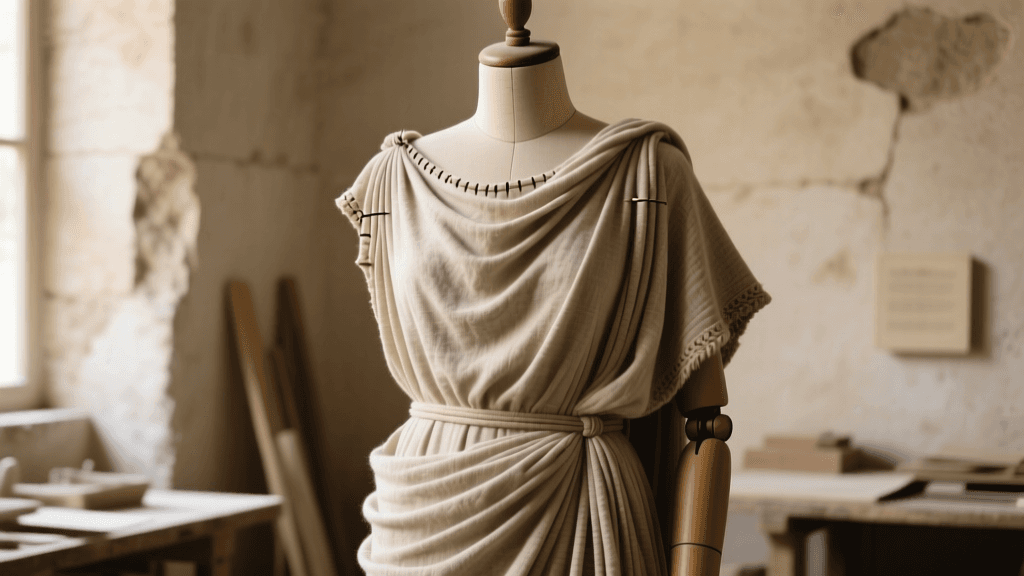
The Doric chiton, often referred to as a peplos, is the quintessential garment of ancient Greek women and, in its shorter form, Greek men. It is characterized by its heavy, structured drape and the distinctive apoptygma (the overfold at the top of the garment). According to The Metropolitan Museum of Art, the fundamental principle of Greek dress was that clothing was not tailored to the body, but rather draped, allowing the fabric to fall in natural, sculptural folds.
To construct a Doric chiton, you need a single rectangular piece of heavy linen or lightweight wool. The width of the fabric should be approximately 1.5 times the wearer's hip circumference, while the height must equal the distance from the wearer's shoulder to the floor, plus an additional 40 to 50 centimeters. This extra length is vital; it is folded down at the top to create the apoptygma and later bloused over the belt to create the kolpos, the elegant, cascading pouch of fabric at the waist that defines the Greek silhouette.
The Ionic Chiton and the Roman Stola
While the Doric chiton relied on heavy folds and a single pin per shoulder, the Ionic chiton utilized lighter, wider fabrics—often fine linen or imported silk—gathered at intervals along the arms to create flowing, sleeve-like effects. This style requires multiple small pins (fibulae) or sewn tacks along the upper edge.
Transitioning from Greek to Roman traditions, the female wardrobe was dominated by the stola. The Roman counterpart carried heavy social weight. As detailed by the World History Encyclopedia, the stola was the traditional garment of the Roman matron, symbolizing modesty, citizenship, and marital status. Worn over a base tunic (tunica interior), the stola was a long, sleeveless or short-sleeved dress suspended by shoulder straps (institiae). It was almost always worn with a palla, a large rectangular mantle draped over the shoulders and head when in public. Furthermore, the Metropolitan Museum of Art's guide to Roman Textiles highlights that Roman weaving techniques allowed for intricate borders and clavi (stripes) that denoted social rank, a detail modern reenactors should pay close attention to when sourcing fabrics.
Garment Construction Comparison Chart
| Garment Type | Primary Material | Fabric Dimensions (W x H) | Fastening Method | Distinctive Feature |
|---|---|---|---|---|
| Doric Chiton (Peplos) | Heavy Wool or Linen | Width: 1.5x hips, Height: Shoulder to floor + 45cm | Single or double heavy fibula per shoulder | Apoptygma (overfold) and deep kolpos |
| Ionic Chiton | Fine Linen or Silk | Width: Arm span + 50cm, Height: Shoulder to floor + 20cm | Multiple small pins or sewn tacks along arms | Flowing, gathered false sleeves |
| Roman Stola | Wool or Linen (often with woven borders) | Width: 1.2x hips, Height: Shoulder to floor | Institiae (shoulder straps) or sewn shoulders | Worn over a tunic, signifies matron status |
| Roman Palla | Wool or Linen | Width: 2.5 meters, Height: 1.5 meters | Friction and wrapping (no pins) | Large mantle, often draped over the head |
Sourcing Authentic Fabrics in 2026
The success of your historical garment relies entirely on the drape and weight of the textile. Modern synthetic blends or overly processed cottons will hang stiffly and ruin the classical silhouette. In 2026, the best approach is to source heritage-weave European flax linen or lightweight merino wool. Look for 'slubby' or hand-loomed linens that mimic the irregularities of ancient warp-weighted looms. For a Doric chiton, a medium-to-heavy weight linen (around 250-300 GSM) is ideal, as it will hold the sharp, architectural folds of the apoptygma. For the Ionic chiton or Roman stola, a lighter, softer linen (150-180 GSM) that has been washed and softened will provide the necessary fluidity. Avoid bleached white fabrics; the ancients favored natural ecru, saffron yellow, madder red, and Tyrian purple (which can be ethically replicated today using sustainable botanical dyes like madder root and indigo).
Hardware: Selecting the Right Fibulae
Pins, or fibulae, are not merely decorative; they are the structural load-bearers of the chiton. Using modern safety pins will instantly break the historical illusion and often fail to support the weight of heavy linen. Instead, invest in historically accurate reproduction fibulae. For the Doric chiton, a large penannular brooch or a crossbow-style brooch (for later Roman periods) made of bronze or brass is essential. Ensure the pin mechanism is tight and the catch is deep enough to prevent the heavy fabric from slipping off during movement. In 2026, several specialized historical reproduction smiths offer museum-quality bronze fibulae crafted using traditional lost-wax casting methods, providing both historical accuracy and the tensile strength required for active reenactment.
Step-by-Step Draping Tutorial: The Doric Chiton
- Step 1: The Overfold. Lay your rectangular fabric flat. Fold the top edge down by 35 to 45 centimeters, depending on your torso length. This creates the apoptygma.
- Step 2: The Wrap. Wrap the fabric around your body, starting at the side seam. The folded edge should be on the outside, resting against your upper chest and back.
- Step 3: The Shoulder Pins. Bring the front and back layers together at your shoulders. Pin them securely using your fibulae, leaving enough room for your neck and arms to move comfortably. The side of the garment can be left open (traditional for the Doric style, revealing the leg when walking) or lightly tacked shut for modern modesty standards.
- Step 4: The Belt (Zone). Tie a woven wool or linen cord tightly around your natural waist, either over or under the apoptygma depending on the desired look.
- Step 5: The Kolpos. Reach down and pull a generous amount of fabric up and over the belt, allowing it to blouse out evenly. This hides the belt and creates the iconic cascading folds that allow for ease of movement.
Care, Maintenance, and Storage
Because these garments are essentially large, heavy blankets, they require specific care. Never machine wash heavy heritage linen or wool, as the agitation will cause severe shrinkage and distort the drape. Instead, hand wash in cool water with a pH-neutral wool detergent. To dry, lay the garment flat on a mesh rack out of direct sunlight to prevent fading. When storing your chiton or stola for the off-season, do not hang it; the weight of the wet or heavy fabric will stretch the fibers and distort the neckline. Fold it loosely with acid-free tissue paper and store it in a breathable cotton canvas bag. By treating these textiles with the same reverence as the ancients did, your garments will last for decades, serving as a timeless bridge to the classical world.