Academic Hanfu Reconstruction: Digital Tools in 2026
The Evolution of Chinese Fashion History Education in 2026
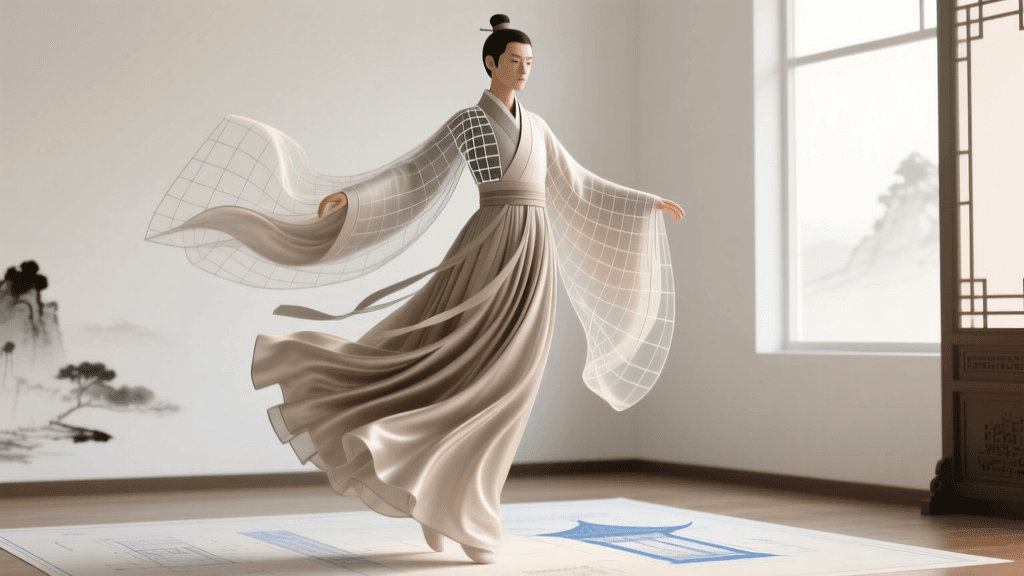
The academic study of Chinese fashion history has undergone a radical transformation by 2026. No longer confined to dusty archives and fragile, light-sensitive textiles, university-level research now leverages advanced 3D digital reconstruction and fabric drape analysis. This technological renaissance allows scholars to examine the intricate construction of traditional Hanfu without risking damage to priceless artifacts. As the global fascination with the Xin Zhongshi (new Chinese style) movement accelerates, academic institutions are racing to provide historically accurate, data-driven foundations for the next generation of designers and historians.
Leading institutions, including Donghua University and Tsinghua University, have fully integrated digital twin technology into their textile heritage curriculums. Students no longer rely solely on 2D sketches or flat photography. Instead, they manipulate virtual garments in three-dimensional space, analyzing how ancient weaving techniques interact with human kinematics. This shift is particularly vital for studying Silk Road textiles, where surviving fragments are often too degraded to be draped on physical mannequins. According to the UNESCO Silk Roads Programme, digital preservation is now the gold standard for safeguarding the material culture of ancient trade routes.
Top 3D Simulation Engines for Historical Garments
For academic researchers focusing on Chinese fashion history, selecting the right simulation engine is critical. The physics of traditional Chinese garments—characterized by flat cutting, wide sleeves, and intricate pleating—require software that can calculate complex fabric behaviors like shear, bending stiffness, and bias drape. In 2026, three primary platforms dominate the academic landscape, each offering distinct advantages for historical reconstruction.
| Software Platform | Drape Accuracy Score | 2026 Academic License Cost | Primary Academic Use Case |
|---|---|---|---|
| CLO 3D | 98/100 | $1,200 / year | Precise historical pattern simulation and stress mapping |
| Marvelous Designer | 92/100 | $950 / year | Concept visualization and historical animation |
| Blender (Cloth Sim) | 85/100 | Free (Open Source) | Environmental rendering and digital museum archiving |
CLO 3D remains the undisputed leader for rigorous academic research. Its ability to import exact 2D CAD patterns and simulate specific textile properties makes it ideal for reconstructing complex garments like the Ming Dynasty Mamianqun (horse-face skirt). The CLO Virtual Fashion Education Portal has recently updated its 2026 material library to include historically accurate Chinese silks, such as Zhangzhou velvet and Song brocade, calibrated using real-world Kawabata Evaluation System (KES-FB) data.
Case Study: Digital Reconstruction of the Ming Dynasty Mamianqun
The Mamianqun is a cornerstone of Chinese fashion history education. Characterized by its flat front and back panels with deeply pleated sides, this skirt presents a unique challenge for digital drape analysis. In 2026, academic labs follow a strict, multi-phase methodology to ensure historical accuracy.
Step 1: Historical Data and Pattern Drafting
Researchers begin by analyzing extant artifacts and historical texts, such as the Tiangong Kaiwu (The Exploitation of the Works of Nature). Unlike Western tailoring, which relies on darts and curved seams to fit the body, traditional Chinese garments utilize geometric, flat-cut patterns. A standard Ming Mamianqun requires two identical trapezoidal panels that overlap at the waist. In the digital workspace, students draft these patterns using exact historical measurements, typically utilizing a fabric width of 60 centimeters per panel to maintain the authentic pleat ratio.
Step 2: Digital Material Calibration
The drape of a Mamianqun is entirely dependent on the weight and stiffness of the silk. Modern commercial Hanfu often uses stiff polyester blends, which skew historical understanding. Academic labs use KES-FB testing data to calibrate their digital fabrics. By inputting precise values for tensile strain, bending rigidity, and surface friction, researchers can simulate the fluid, liquid-like drape of authentic 22-momme mulberry silk. This calibration allows scholars to observe how the pleats behave during movement, revealing why ancient tailors applied specific starching techniques to the waistbands while leaving the skirt body untreated.
Step 3: Avatar Morphology and Kinematics
To understand the garment in motion, researchers utilize 2026 standard historical avatars. These avatars are modeled using osteological data from the Ming era, reflecting the slightly different posture and proportions of historical populations. By running kinematic simulations—such as walking, bowing, or sitting—students can analyze the stress points on the silk. This data is crucial for conservationists, as it predicts where physical artifacts are most likely to degrade over time.
Bridging Ancient Weaving and the Xin Zhongshi Movement
The rigorous academic research conducted in these digital labs directly fuels the contemporary Xin Zhongshi (new Chinese style) movement. As modern consumers demand greater authenticity in their traditional dress, commercial brands are turning to university research to inform their designs. By understanding the exact drape coefficient of historical fabrics, modern designers can create Xin Zhongshi garments that honor traditional aesthetics while utilizing sustainable, modern textiles.
For instance, recent academic papers published in early 2026 have demonstrated how the structural integrity of the Mamianqun waistband can be maintained using recycled cellulose fibers instead of traditional silk, without altering the visual drape of the skirt. This synergy between ancient weaving techniques and modern material science is a major focus of current international design weeks, where academic researchers frequently collaborate with commercial fashion houses.
Setting Up a 2026 Digital Heritage Lab
For educational institutions looking to establish a Chinese fashion history lab in 2026, specific hardware and software investments are required. A standard academic workstation must feature high-end GPU rendering capabilities to calculate real-time cloth simulations without lag. Furthermore, the integration of haptic feedback gloves has become a standard in top-tier labs. These gloves allow students to 'feel' the virtual resistance and texture of digital silk, providing a tactile understanding of historical garments that a mouse and keyboard cannot replicate.
Additionally, 3D scanning of museum artifacts is a prerequisite for accurate pattern drafting. Portable, non-invasive photogrammetry rigs allow researchers to capture the exact dimensions of fragile textiles without physical contact. The Metropolitan Museum of Art's Heilbrunn Timeline of Art History provides extensive open-access data on Chinese silk structures, serving as an invaluable foundational resource for students cross-referencing their digital models with verified historical textiles.
Conclusion
The intersection of Chinese fashion history education and digital technology has fundamentally reshaped how we understand traditional garments. By utilizing advanced 3D simulation, precise material calibration, and rigorous historical methodology, academic researchers in 2026 are preserving the legacy of Hanfu for future generations. As the Xin Zhongshi movement continues to evolve, the data-driven insights generated in these digital labs will ensure that the profound elegance and engineering of ancient Chinese textiles remain a living, breathing part of global fashion culture.