3D Drape Analysis in Chinese Fashion History Education 2026
The Evolution of Chinese Fashion History Education in 2026
In the academic landscape of 2026, the study of Chinese fashion history has undergone a radical transformation. Gone are the days when students relied solely on fragile, static museum artifacts and two-dimensional illustrations to understand the complexities of ancient Asian garments. Today, leading institutions across Asia and the globe have integrated advanced 3D drape analysis and digital textile archiving into their core curricula. This technological leap is not merely a visual upgrade; it represents a fundamental shift in how researchers decode the physics, philosophy, and cultural significance of traditional Chinese clothing.
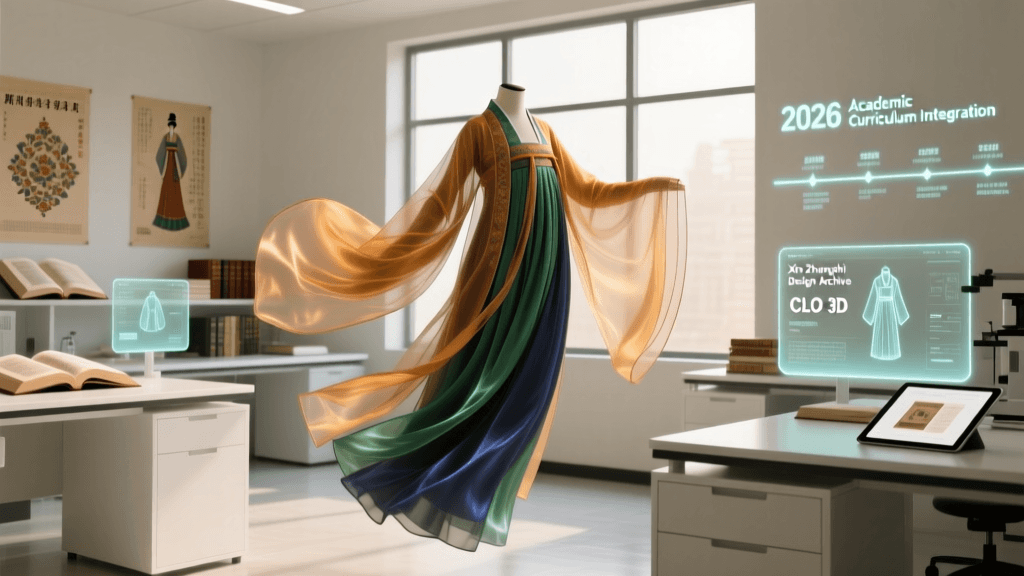
At the heart of this educational revolution is the transition from Western-centric, darted tailoring paradigms to the traditional Chinese philosophy of 'flatness' (pingmian). Historically, Chinese garments were constructed from flat, unbroken lengths of fabric that only achieved their three-dimensional form when worn on the human body. By utilizing advanced physics engines in academic labs, students can now simulate how gravity, body movement, and textile weave structures interact in real-time. This pedagogical approach allows emerging designers and historians to grasp the profound relationship between the wearer and the garment, a concept that is essential for mastering the nuances of traditional Asian dress.
Digital Archiving and the Preservation of Ancient Weaves
The foundation of modern fashion history education rests on meticulous digital archiving. Researchers in 2026 are actively collaborating with international heritage organizations to create high-fidelity digital twins of surviving textiles. The preservation of the Silk Road's material culture is a prime example of this effort. Academic teams frequently reference the extensive trade networks documented by heritage bodies, such as the UNESCO Silk Roads: Chang'an-Tianshan Corridor, to understand how ancient weaving techniques migrated and evolved across continents.
Using multispectral imaging and AI-driven pattern recognition, university labs can now reconstruct the original vibrancy of faded dyes and map the exact warp-and-weft density of decomposed silks. This data is then fed into digital material libraries, creating a comprehensive, open-access database for students. When a student in a 2026 seminar studies the intricate motifs of a Ming Dynasty robe, they are not just looking at a photograph; they are interacting with a fully mapped digital textile that retains the exact physical properties of the original artifact, including its tensile strength, shear resistance, and surface friction.
Simulating the Tang Dynasty Silk Drape
One of the most rigorous modules in contemporary Chinese fashion history programs focuses on the Tang Dynasty (618–907 AD), a period renowned for its cosmopolitan aesthetic and luxurious textiles. Understanding the drape of Tang silks requires a deep knowledge of historical weaving structures. Researchers utilize comprehensive databases, such as the Metropolitan Museum of Art's Asian Silk Collection, to study surviving fragments and extrapolate their physical behaviors.
In the lab, students use industry-standard software to simulate specific historical fabrics. The challenge lies in accurately replicating the unique hand-feel and kinetic movement of ancient weaves. For instance, simulating the ethereal, floating quality of luo (gauze) requires vastly different physics parameters compared to the heavy, structured drape of jin (brocade). Below is a standard reference table used in 2026 academic curricula to map historical fabrics to their corresponding 3D simulation parameters.
| Historical Fabric | Weave Structure | Physical Weight (g/m²) | 3D Simulation Parameter (Bending Stiffness) | Primary Garment Application |
|---|---|---|---|---|
| Luo (Gauze) | Leno / Openwork | 25 - 40 | Ultra-Low (High fluidity, wind-reactive) | Summer shawls, lightweight under-layers |
| Quan (Silk Tabby) | Plain Weave | 45 - 60 | Low-Medium (Crisp but flexible) | Everyday robes, lining fabrics |
| Zhou (Crepe) | Twisted Warp/Weft | 60 - 85 | Medium (Textured, matte drape) | Outer garments, structured sleeves |
| Jin (Brocade) | Compound / Jacquard | 120 - 180+ | High (Stiff, sculptural, heavy) | Ceremonial jackets, winter collars, trim |
The Xin Zhongshi (New Chinese Style) Academic Pipeline
The academic rigor applied to historical drape analysis directly fuels the explosive growth of the Xin Zhongshi (New Chinese Style) movement in 2026. Unlike earlier iterations of 'China-chic' that often relied on superficial motifs, the modern Xin Zhongshi movement demands structural authenticity merged with contemporary wearability. University programs now feature dedicated incubators where history students and fashion design majors collaborate to translate ancient construction techniques into modern streetwear and haute couture.
Through 3D simulation, students can rapidly prototype how a traditional flat-cut sleeve (such as the pipa sleeve or the wide daoxiu) will behave when scaled down or paired with modern, high-stretch technical fabrics. This rapid iteration process eliminates the need for dozens of physical muslins, allowing students to experiment with the intersection of Song Dynasty minimalism and 2026 sustainable biomaterials. The result is a new generation of designers who are not merely copying the past, but actively evolving the grammatical rules of Chinese garment construction for a global audience.
Core Technologies in 2026 Fashion History Labs
To achieve this level of academic and creative synthesis, university labs are equipped with a highly specialized suite of hardware and software. The modern fashion history researcher must be as proficient in digital physics as they are in archival textile analysis. The standard 2026 academic toolkit includes:
- CLO 3D Enterprise & Marvelous Designer: The cornerstone of digital drape analysis. Academic licenses, supported by initiatives like the CLO 3D Education Program, allow students to apply custom physical properties to digital avatars, testing how historical garments move during specific cultural rituals or daily tasks.
- AI-Assisted Pattern Drafting Algorithms: Custom university-built plugins that automatically generate flat 2D patterns based on 3D scans of historical garments, helping students reverse-engineer the lost cutting techniques of ancient tailors.
- High-Resolution Textile Scanners: Desktop-sized spectral scanners that capture the micro-topography of historical weaves, translating the physical bumps of a brocade weave into accurate digital displacement maps.
- Haptic Feedback Gloves: Emerging lab technology that allows researchers to 'feel' the digital resistance and weight of a simulated historical silk, bridging the gap between visual simulation and tactile memory.
Bridging Academia and International Design Weeks
The impact of this technologically driven education extends far beyond the university campus. By the time students graduate, their digital archives and 3D drape analyses are often presented at international design weeks, setting new standards for cultural authenticity in global fashion. The ability to mathematically prove the historical accuracy of a garment's drape provides a powerful narrative tool for designers showcasing Xin Zhongshi collections on the world stage.
Ultimately, the integration of 3D drape analysis into Chinese fashion history education ensures that the profound ingenuity of ancient Asian weavers and tailors is not lost to time. By treating historical garments as complex, dynamic systems rather than static relics, the academic community in 2026 is safeguarding the living heritage of the Silk Road, ensuring it continues to inspire, educate, and evolve for generations to come.