China's Intangible Heritage Textiles: A Buyer's Guide
Introduction to China's Textile Heritage
China’s textile history is a tapestry woven with millennia of innovation, artistry, and profound cultural significance. Today, the preservation of these ancient techniques is safeguarded under the banner of Intangible Cultural Heritage (ICH). For enthusiasts of traditional Chinese clothing, particularly Hanfu, understanding and investing in ICH-certified textiles is not merely a fashion choice; it is an act of cultural conservation. According to the UNESCO Intangible Cultural Heritage registry, China leads the world in the number of inscribed heritage elements, with sericulture and traditional silk craftsmanship holding a place of supreme importance. This guide delves into the most prestigious ICH textiles used in Hanfu, offering actionable advice on sourcing, authentication, and care.
Xiangyunsha: The Mud-Dyed Silk of the Pearl River
Originating from the Foshan region in Guangdong province, Xiangyunsha (Gambiered Canton Gauze) is one of the most expensive and labor-intensive silk fabrics in the world. Recognized as a National Intangible Cultural Heritage, its creation is a symphony of botany, chemistry, and meteorology.
The Artisan Process
The production of authentic Xiangyunsha requires exactly 13 primary steps, heavily dependent on the intense sunlight and specific humidity of the Pearl River Delta. Artisans first soak raw silk gauze in the tannin-rich juice of the Dioscorea cirrhosa (a type of yam). The fabric is then sun-dried and repeatedly soaked up to 30 times. The defining step involves smearing the silk with iron-rich river mud. The tannins from the yam react with the iron ions in the mud, creating a profound chemical transformation that yields a dark, lustrous black-brown surface on one side, and a warm terracotta brown on the reverse. Finally, the fabric is washed in the river and sun-baked one last time. The entire process takes roughly 15 days, and the resulting fabric features a unique, subtle crackled texture known as gui lie wen.
Practical Guide: Buying and Wearing Xiangyunsha
- Cost: Authentic, hand-dyed Xiangyunsha is a luxury investment. Expect to pay between $80 and $200 USD per meter. If a vendor offers it for $20 a meter, it is almost certainly machine-printed polyester or chemically dyed rayon.
- Timing: Because the process relies entirely on intense, natural sunlight to bake the yam juice into the fibers, authentic production only occurs between April and October. Garments commissioned outside this window will not be delivered until the following summer.
- Best Applications: Due to its crisp drape, breathability, and moisture-wicking properties, Xiangyunsha is the ultimate summer fabric. It is historically and practically suited for Ming Dynasty Aoqun (jacket and skirt sets) and lightweight Song Dynasty Beizi (open-front coats).
- Care Instructions: Never machine wash or wring Xiangyunsha. Hand wash gently in cool water using a neutral pH silk detergent. Do not soak for more than three minutes. Dry flat in the shade; while the sun is required to make it, prolonged UV exposure will fade the finished garment.
Su Embroidery: Painting with Silk Threads
While Xiangyunsha represents the pinnacle of fabric dyeing, Su Embroidery (Suzhou Embroidery) represents the zenith of textile embellishment. As documented by the Metropolitan Museum of Art, Chinese silk embroidery has historically served as a marker of elite status and profound artistic expression. Su embroidery, originating from Jiangsu province, is renowned for its delicate patterns, elegant colors, and astonishingly fine needlework.
Technique and Application in Hanfu
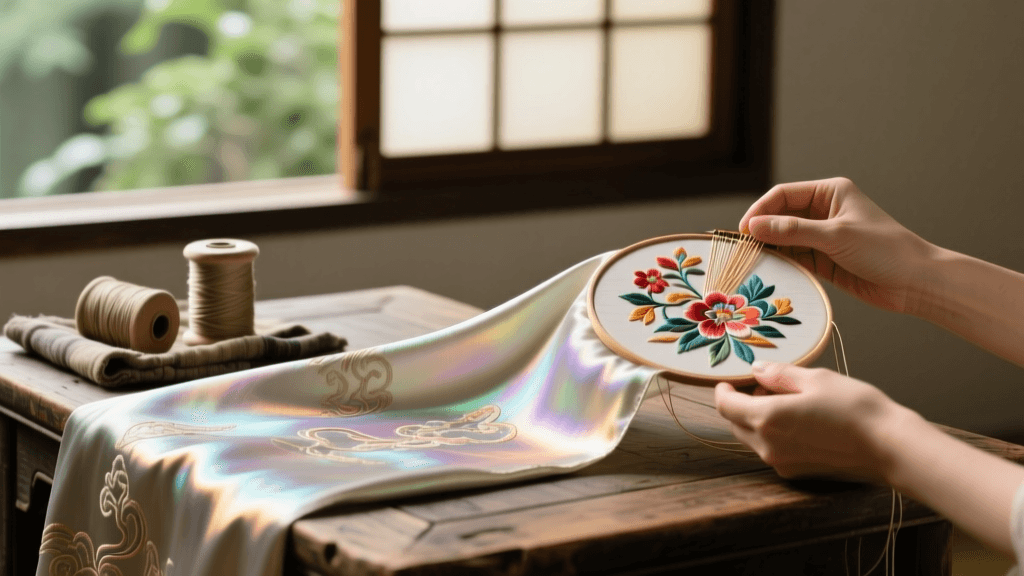
The hallmark of a master Su artisan is the ability to split a single silk thread into multiple microscopic strands. While a standard embroiderer might use a full thread, a master will split it into 1/16th or even 1/48th of its original thickness to achieve seamless color gradients and hyper-realistic textures. The 'Luan Zhen' (interlocking stitch) allows for the blending of colors directly on the fabric, mimicking the brushstrokes of traditional ink wash paintings.
For Hanfu wearers, Su embroidery is most frequently applied to the Mamianqun (horse-face skirt) or the ornate collars of formal robes. When commissioning a custom Su embroidered garment, consider the following:
- Lead Time: A high-quality, hand-embroidered Mamianqun panel requires between 3 to 8 months of continuous labor.
- Cost Indicators: Prices are dictated by thread density and the number of thread splits used. A basic floral motif using 4-split threads may cost around $400 to $800 USD. A masterwork piece utilizing 48-split threads and double-sided embroidery (where the front and back images are identical and perfectly finished) can easily exceed $5,000 USD.
Comparative Guide to Major ICH Textiles
To navigate the market effectively, it is crucial to understand how different heritage textiles compare in terms of cost, origin, and application. The table below outlines the primary ICH textiles utilized in high-end Hanfu reconstruction.
| Textile Type | Origin Region | Key Characteristic | Avg. Cost (USD) | Best Hanfu Application |
|---|---|---|---|---|
| Xiangyunsha | Foshan, Guangdong | Mud-dyed, crackled texture, crisp | $80 - $200 / meter | Summer Ruqun, Ming Aoqun |
| Nanjing Yunjin | Nanjing, Jiangsu | Gold/peacock feather weaving | $300 - $1000+ / meter | Formal Ming Dynasty Robes |
| Song Brocade | Suzhou, Jiangsu | Soft, matte, geometric patterns | $50 - $120 / meter | Song Beizi, everyday wear |
| Su Embroidery | Suzhou, Jiangsu | Hyper-realistic, split-thread | $500 - $5000+ / piece | Mamianqun skirts, collars |
As noted in the UNESCO registry for Sericulture and Silk Craftsmanship, the transmission of these skills relies heavily on master-apprentice relationships. When purchasing Yunjin or Song Brocade, you are supporting the livelihoods of weavers who operate massive, traditional wooden draw-looms that require two people to operate simultaneously—one to manage the warp threads and another to pass the shuttle.
How to Authenticate Intangible Heritage Garments
The rising global popularity of Hanfu has unfortunately led to a proliferation of counterfeit 'heritage' fabrics. Here is how to ensure your investment supports genuine artisans:
1. The Sensory Test for Xiangyunsha
Authentic Xiangyunsha has a distinct, earthy scent reminiscent of dried herbs and river clay, a remnant of the yam juice and mud. Chemically dyed imitations smell of synthetic dyes or have no scent at all. Furthermore, genuine Xiangyunsha is slightly stiff when new but softens beautifully with wear; it will also produce a faint, crisp rustling sound when you walk, often referred to as the 'sound of silk'.
2. Examining the Reverse Side
For brocades and embroideries, always inspect the reverse side of the fabric. Machine-embroidered garments will have messy, continuous jump-stitches and a thick layer of paper or plastic backing. Hand-embroidered Su pieces will have meticulously hidden thread ends and a reverse side that is almost as clean as the front. In double-sided embroidery, the reverse will be a perfect mirror image.
3. Seeking the ICH Certification Label
Reputable heritage brands and artisan cooperatives in China will provide a certificate of authenticity or a physical tag bearing the official Chinese National Intangible Cultural Heritage seal. When buying from international e-commerce platforms, request macro-photographs of the fabric's selvedge and the artisan's workshop stamp before finalizing a high-ticket purchase.
Conclusion
Investing in Chinese Intangible Heritage textiles is a profound way to connect with the sartorial history of Asia. Whether you are draping yourself in the sun-baked, mud-dyed elegance of Xiangyunsha for a summer festival, or commissioning a masterwork of Su embroidery for a formal rite of passage, you are actively participating in the survival of these ancient crafts. By understanding the true costs, timelines, and hallmarks of authenticity, modern Hanfu wearers can ensure their wardrobes are not only historically resonant but ethically and culturally supportive of the master artisans who keep these traditions alive.