Mastering Chinese Traditional Looms & Weaving in 2026
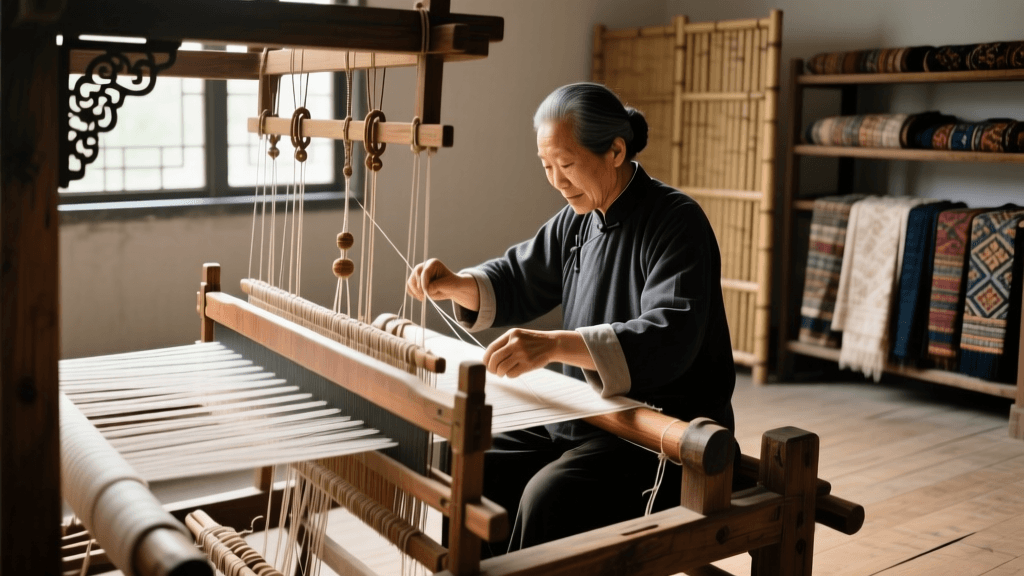
The Renaissance of the Chinese Drawloom in 2026
In the rapidly evolving landscape of global fashion and textile preservation, the year 2026 has marked a profound renaissance for ancient weaving technologies. At the center of this revival is the Chinese traditional drawloom, known as the Hua Lou. Far from being a relic confined to museum glass, the drawloom is actively shaping the Xin Zhongshi (New Chinese Style) movement, providing contemporary haute couture and heritage brands with fabrics that power looms simply cannot replicate. As consumers and designers increasingly demand authenticity, sustainability, and deep cultural narratives, understanding the mechanics and mastery of these ancient looms has never been more relevant.
The Hua Lou is a towering wooden marvel, often measuring over five meters in length and four meters in height. According to the UNESCO Intangible Cultural Heritage registry, the techniques associated with these looms represent some of the most complex hand-weaving traditions in human history. In 2026, heritage workshops in Nanjing, Suzhou, and Chengdu are operating at full capacity, blending centuries-old craftsmanship with modern ethical sourcing to produce some of the world's most luxurious textiles.
The Mechanics of Ancient Binary Coding: How the Drawloom Operates
To appreciate the value of hand-woven Chinese brocade, one must understand the staggering mechanical complexity of the drawloom. Unlike standard pedal looms where a single weaver controls the warp threads with their feet, the traditional Chinese drawloom requires a highly synchronized two-person operation.
The master weaver sits at the front of the loom, managing the shuttle, the beat-up of the weft, and the intricate color changes of the supplementary threads. Meanwhile, the 'drawboy' (or pattern puller) sits on a wooden platform at the very top of the loom. This assistant is responsible for pulling specific bundles of warp threads upward according to a complex sequence, creating the 'shed' through which the weaver passes the shuttle. This process allows for the creation of massive, asymmetrical, and highly detailed patterns that repeat across the fabric without the limitations of standard heddle shafts.
The Pattern Book (Jia Ben)
The true genius of the Chinese drawloom lies in the Jia Ben, or the 'pattern book.' Long before the invention of the Jacquard loom in 19th-century France, Chinese weavers were utilizing a binary coding system. The Jia Ben is a physical matrix of knotted cords that hangs from the top of the loom. Each knot represents a specific intersection of warp and weft. As the drawboy reads the knots and pulls the corresponding cords, he is essentially executing an ancient, physical computer program. In 2026, master weavers still spend months tying a single Jia Ben for a new, complex bespoke design, ensuring that the intellectual property of the pattern is physically locked into the loom's architecture.
The Big Three: Yun, Shu, and Song Brocades
When discussing ancient Chinese weaving, the conversation is dominated by the 'Three Great Brocades.' Each region developed distinct techniques based on local climate, available materials, and historical court demands. Below is a comparative analysis of these legendary textiles as they stand in the 2026 market.
| Brocade Type | Origin | Loom & Technique | Distinctive Features | 2026 Avg. Market Price (per meter) |
|---|---|---|---|---|
| Yun Jin (Cloud Brocade) | Nanjing | Large Drawloom; heavy supplementary wefts | Incorporates real gold leaf threads, silver, and peacock feather yarns. Extremely dense and heavy. | $1,200 - $3,500+ |
| Shu Jin (Shu Brocade) | Chengdu, Sichuan | Multi-colored warp drawloom | Vibrant, saturated colors utilizing complex warp-dyeing. Softer drape, historically used for heavy garments and quilts. | $400 - $900 |
| Song Jin (Song Brocade) | Suzhou | Structural double-weave techniques | Flat, geometric patterns with a subtle sheen. Highly durable, often used for mounting scrolls and modern tailored jackets. | $500 - $1,100 |
As noted by historians at The Metropolitan Museum of Art's Heilbrunn Timeline of Art History, the regional variations in silk production were heavily influenced by the Silk Road trade networks, which introduced foreign motifs, dyes, and metallic thread techniques that were subsequently perfected on Chinese drawlooms.
2026 Preservation: LiDAR, AI, and Digital Archiving
The preservation of ancient weaving techniques has entered a highly advanced technological phase in 2026. The China National Silk Museum and associated heritage institutes have recently completed comprehensive LiDAR scanning projects of antique wooden drawlooms. This ensures that the precise joinery, dimensions, and structural tolerances of these massive machines are preserved in 3D digital space, safeguarding against the loss of physical artifacts due to natural disasters or wood degradation.
Furthermore, artificial intelligence is being utilized to translate surviving fragments of ancient Jia Ben knot codes into digital formats. While purists maintain that true heritage brocade must be hand-woven, these digital translations allow modern electronic Jacquard looms to produce 'heritage-inspired' fabrics for the broader Xin Zhongshi market at accessible price points. This dual-track approach ensures that the elite, hand-woven masterpieces retain their astronomical value and cultural prestige, while the visual language of ancient Chinese weaving reaches a global audience.
Sourcing Authentic Hand-Woven Brocades in 2026
For collectors, interior designers, and fashion houses looking to source authentic Chinese brocades in 2026, navigating the market requires a trained eye. The proliferation of high-speed power looms means that visually similar fabrics are abundant, but they lack the soul, tension variations, and material richness of true drawloom textiles.
Actionable Checklist for Collectors and Designers
- Examine the Reverse Side: Hand-woven drawloom brocades, particularly Yun and Song brocades, often feature a much cleaner reverse side compared to power-loomed jacquards, which tend to have long, messy 'floats' of thread on the back. Master weavers meticulously tie off supplementary threads to keep the back neat.
- Check the Selvedge: Authentic hand-woven pieces from heritage institutes like the Nanjing Yunjin Institute will feature specific selvedge marks or woven 'watermarks' indicating the master weaver's signature and the year of production.
- Feel the Tension and Drape: Because the drawboy pulls the warp threads manually, there is a microscopic, organic variation in thread tension. This gives hand-woven brocade a unique, supple drape that feels 'alive' compared to the rigid, uniform stiffness of machine-made textiles.
- Verify the Metallic Threads: In authentic 2026 Yun brocade, gold threads are not merely synthetic metallic yarns. They are created by slicing ultra-thin sheets of real gold leaf applied to paper or silk substrates, which are then wrapped around a silk core. This gives the fabric a soft, warm glow rather than a harsh, reflective shine.
Integrating Ancient Weaves into the Modern Wardrobe
The Xin Zhongshi movement of 2026 has moved beyond simply copying historical garments. Today's top designers are utilizing the structured durability of Song brocade for modern, tailored blazers and architectural outerwear, while reserving the opulent, heavy Yun brocade for statement evening wear and luxury accessories. The UNESCO Silk Roads Programme continues to highlight how these ancient textile routes fostered cross-cultural exchanges that are still visible in the motifs woven into modern Chinese fashion.
By understanding the immense labor, binary coding, and mechanical genius of the Chinese drawloom, modern consumers can appreciate these textiles not just as beautiful fabrics, but as wearable pieces of ancient technology. Whether you are commissioning a bespoke garment or studying the structural integrity of a museum piece, the legacy of the Hua Lou remains one of humanity's most brilliant engineering achievements.
Conclusion
The survival and thriving of Chinese traditional looms and ancient weaving techniques in 2026 is a testament to the enduring value of human craftsmanship. As digital preservation secures the mechanics of the past, the living, breathing art of the drawloom continues to produce textiles of unmatched beauty and complexity. For those invested in the future of Asian traditions and sustainable luxury fashion, the intricate world of Chinese brocade offers a profound connection to history, woven thread by thread into the fabric of the modern world.