Evolution of the Chinese Dragon Robe: Tang to Qing Court Fashion
Introduction to the Longpao: The Zenith of Imperial Authority
The dragon robe, historically known as the longpao or jifu, represents the absolute zenith of Chinese textile artistry and imperial authority. Far from being a static garment frozen in time, the court fashion of China evolved dramatically across millennia, reflecting shifting political ideologies, foreign influences, and advancements in sericulture. To understand the dragon robe is to understand the very fabric of Chinese history. According to the Metropolitan Museum of Art's Heilbrunn Timeline of Art History, the development of Chinese silk weaving techniques directly paralleled the rise and fall of imperial dynasties, with court garments serving as the primary canvas for these technological and artistic breakthroughs.
This comprehensive guide explores the dynasty-by-dynasty evolution of Chinese court fashion, culminating in a practical, actionable guide for modern collectors, historians, and enthusiasts looking to commission or acquire historically accurate replicas today.
Tang Dynasty (618–907 CE): Cosmopolitan Elegance and the Yuanlingpao
The Tang Dynasty is widely celebrated as the golden age of Chinese cosmopolitanism. Court fashion during this era was heavily influenced by the Silk Road, incorporating elements from Persian, Sogdian, and Central Asian cultures. The quintessential court garment was the yuanlingpao, a round-collared robe with narrow sleeves and side slits, designed originally for horseback riding but elevated to high court wear.
While the iconic five-clawed dragon motif was not yet strictly codified as the exclusive domain of the emperor, Tang imperial robes featured elaborate zhuanghua (woven brocade) motifs of coiling beasts, floral medallions, and geometric patterns. The silhouette was relatively relaxed, often worn with a leather belt adorned with jade plaques, signifying the wearer's official rank. The textiles were vibrant, utilizing heavy silk damasks and gold-thread weaving techniques imported from the West.
Song Dynasty (960–1279 CE): Neo-Confucian Restraint
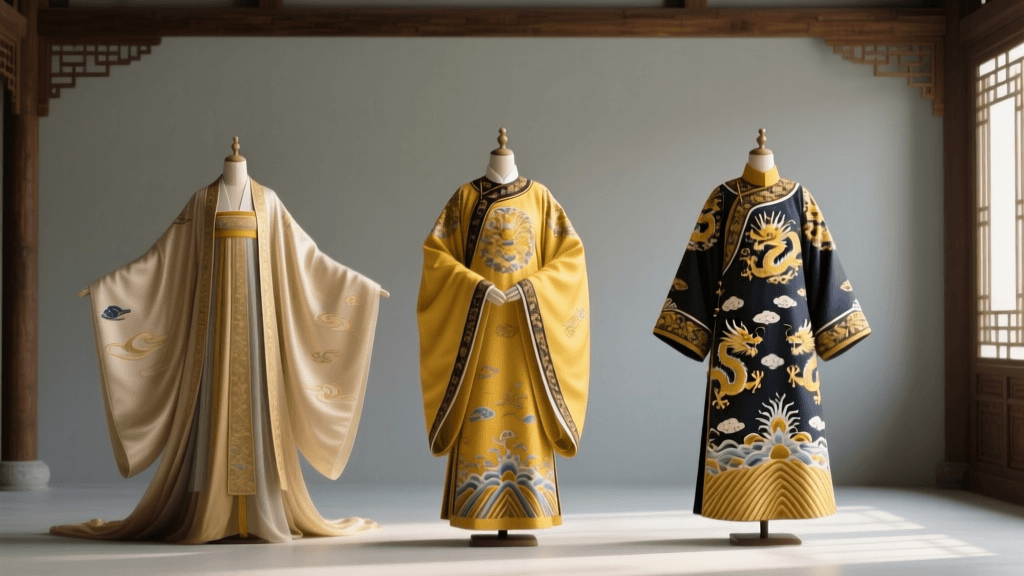
In stark contrast to the exuberant and outward-looking Tang, the Song Dynasty embraced a more subdued, intellectual aesthetic driven by the rise of Neo-Confucianism. Court fashion shifted away from ostentatious displays of wealth toward refined, understated elegance. The silhouette became straighter and more voluminous, with wide sleeves and a cross-collar (jiaoling) returning to prominence.
Imperial robes of the Song era favored monochromatic or subtly patterned silks. The dragon motif was present but often rendered in delicate, tone-on-tone embroidery or subtle tapestry weaves rather than blazing gold. The focus was on the impeccable drape of the silk and the scholarly refinement of the wearer, reflecting a court that valued civil administration over military conquest.
Ming Dynasty (1368–1644 CE): Codification of the Dragon
The Ming Dynasty sought to aggressively restore Han Chinese traditions following the Mongol-led Yuan Dynasty. It was during the Ming era that the longpao (dragon robe) was strictly codified. The emperor exclusively claimed the five-clawed dragon (long), while princes and high-ranking officials were restricted to four-clawed dragons (mang or python robes).
The Ming court robe featured a distinct cross-collar, right-over-left lapel (jiaoling youren), wide sleeves, and a voluminous skirt. The most significant textile innovation of this period was the perfection of kesi (silk tapestry) and the establishment of the imperial weaving bureaus in Nanjing, Suzhou, and Hangzhou. As noted in Encyclopædia Britannica's overview of Chinese dress, the Ming dynasty established rigorous sumptuary laws that dictated not only the motifs but the exact colors, weave structures, and accessories permitted for every tier of the imperial hierarchy.
Qing Dynasty (1644–1912 CE): Manchu Influence and the Jifu
The Qing Dynasty, established by the Manchu people, fundamentally altered the silhouette of Chinese court fashion. The Manchu rulers mandated the adoption of their traditional garments to assert dominance, resulting in the iconic jifu (festive dragon robe). The jifu featured a round collar, a right-over-left wrap closure, and, most distinctively, matixiu (horse-hoof cuffs) designed to protect the hands of archers on horseback.
Qing dragon robes are the most recognizable to modern audiences, characterized by their explosive color palettes, intricate zhuanghua brocade, and the famous 'Lishui' (standing water) wave pattern at the hem, symbolizing the universe. The Victoria and Albert Museum's Asian collections highlight the staggering complexity of Qing imperial textiles, which often incorporated peacock feather filaments and spun gold threads wrapped around silk cores.
Comparative Chart: Court Fashion Across Dynasties
| Dynasty | Primary Silhouette | Collar & Cuffs | Key Motifs & Textiles | Political / Cultural Driver |
|---|---|---|---|---|
| Tang | Fitted, side-slitted Yuanlingpao | Round collar, narrow cuffs | Floral medallions, beasts, heavy damask | Silk Road cosmopolitanism |
| Song | Voluminous, straight drape | Cross-collar, wide sleeves | Tone-on-tone embroidery, subtle weaves | Neo-Confucian restraint |
| Ming | Broad, sweeping Longpao | Cross-collar, wide sleeves | 5-clawed dragons, Kesi tapestry, bright silks | Han restoration, strict sumptuary laws |
| Qing | Wrap-front, tapered Jifu | Round collar, horse-hoof cuffs | Polychrome dragons, Lishui waves, gold thread | Manchu imperial dominance |
Practical Guide: Commissioning Authentic Replicas Today
For collectors, historical reenactors, and haute couture enthusiasts, acquiring a historically accurate dragon robe is a significant undertaking. Modern mass-market 'costumes' fail to capture the structural integrity and textile brilliance of true court fashion. Here is how to navigate the commissioning process for an authentic replica.
1. Sourcing Materials and Artisans
True imperial replicas require heritage textiles. You must source artisans specializing in specific regional weaves:
- Nanjing Yunjin (Cloud Brocade): Essential for Ming and Qing replicas. This UNESCO-recognized technique uses Jacquard looms operated by two people to weave gold threads and peacock feathers into the silk. Expect to commission directly through the Nanjing Yunjin Research Institute or affiliated master workshops.
- Suzhou Kesi (Silk Tapestry): Ideal for Song and Ming court robes. Kesi is woven on a plain loom, creating a 'carved' look where the pattern meets the background. It is painstakingly slow, with weavers producing only a few centimeters per day.
- Hangzhou Silk Crepe: Best for the under-structures and Song dynasty outer layers, providing the necessary fluid drape that heavier brocades cannot achieve.
2. Essential Measurements for Court Garments
Traditional Chinese garments are not tailored to the body's curves like Western clothing; they are constructed from geometric planes of fabric. When commissioning a Ming or Qing robe, provide the tailor with these specific traditional measurements:
- Tongxiu (Total Sleeve Span): Measured from the outer edge of one wrist, across the back of the neck, to the other wrist. Ming robes often require a span exceeding 220cm to achieve the 'water sleeve' drape.
- Jiaoling Overlap: The exact depth of the right-over-left collar overlap, crucial for maintaining the structural integrity of the neckline without modern fasteners.
- Bai (Hem Width): The circumference of the lower hem. A proper Qing jifu requires a hem width of at least 110-120cm to ensure the Lishui wave pattern sits correctly at the ankles without bunching.
3. Costs, Timelines, and Preservation
Commissioning a hand-woven, historically accurate dragon robe is an investment comparable to fine art.
- Cost Estimates: A machine-embroidered theatrical replica costs between $300 and $800. However, a hand-loomed Nanjing Yunjin Ming Dynasty longpao replica will range from $4,500 to $12,000 USD. A full Qing jifu incorporating genuine spun gold and Kesi tapestry panels can easily exceed $15,000 USD.
- Timing: Heritage weaving is seasonal and labor-intensive. Expect a lead time of 6 to 14 months. The weaving of the fabric alone takes 3-5 months, followed by meticulous hand-stitching and lining with heavy silk habotai.
- Preservation: Store the garment flat in acid-free tissue paper within an archival box. Never hang a heavy brocade robe on a standard hanger, as the weight of the gold threads and dense silk will warp the shoulder seams over time. Use camphor wood blocks (never chemical mothballs) to protect against pests.
Conclusion
The evolution of the Chinese dragon robe is a masterclass in how fashion serves as a mirror to society, politics, and technological prowess. From the cosmopolitan round-collars of the Tang to the strictly codified, horse-hoof cuffed jifu of the Qing, these garments are wearable archives of Asian history. By understanding the nuanced differences across dynasties and investing in heritage craftsmanship, modern enthusiasts can help preserve the magnificent legacy of Chinese court fashion for generations to come.