Chinese Couture on the Global Runway: Heritage Styling
The Renaissance of Chinese Heritage in Haute Couture
The intersection of traditional Chinese garments and international haute couture represents one of the most dynamic movements in modern global fashion. For decades, Western interpretations of Asian aesthetics often leaned into pastiche or orientalism. However, the contemporary runway has witnessed a profound shift, driven by native Chinese designers who are reclaiming their sartorial heritage and translating it through the rigorous, avant-garde lens of Parisian and Milanese couture. This evolution moves beyond mere dragon motifs and red silk, diving deep into the structural philosophy, ancient textile techniques, and spiritual symbolism inherent in Chinese dress.
The watershed moment for this global recognition was arguably the Metropolitan Museum of Art’s Costume Institute exhibition, China: Through the Looking Glass. As noted by The New York Times, the exhibition shattered attendance records and forced the global fashion industry to confront the depth, complexity, and historical weight of Chinese sartorial traditions. Today, incorporating these couture-level heritage elements into a personal wardrobe requires an understanding of both historical context and modern tailoring techniques.
Pioneers of the Global Runway: Guo Pei and Uma Wang
To understand how to wear Chinese-inspired couture, one must study the architects of the movement. Guo Pei, the first Chinese national invited to join the prestigious Chambre Syndicale de la Haute Couture in Paris, is renowned for her architectural silhouettes and staggering embroidery. Her work frequently utilizes traditional Su embroidery (Suzhou silk thread work) but scales it to monumental, sculptural proportions. A single couture gown can require up to 50,000 hours of hand-embroidery, utilizing goldwork and split-silk threads that are a fraction of a millimeter thick.
Conversely, Uma Wang approaches heritage through the lens of textile manipulation and philosophical draping. Rather than overt historical replication, Wang draws upon the Daoist concepts of fluidity and imperfection. She frequently employs traditional tea-dyeing and uses Xiangyunsha (gambiered silk), distressing the fabric to create a lived-in, avant-garde silhouette that feels both ancient and fiercely modern. Her work proves that Chinese couture is not just about opulence; it is deeply rooted in the tactile, emotional connection between the wearer and the textile.
Actionable Guide: Translating Couture to Daily Wear
While a 50-pound embroidered Guo Pei train is reserved for the Met Gala, the underlying principles of Chinese couture can be masterfully integrated into a sophisticated, everyday wardrobe. Here is how to source, tailor, and style these elements with precision.
Sourcing Authentic Xiangyunsha (Gambiered Silk)
Xiangyunsha is a legendary silk dyeing technique originating from the Pearl River Delta, recognized by UNESCO as an Intangible Cultural Heritage practice. The silk is dyed with the juice of the薯莨 (Dioscorea cirrhosa) yam and coated with iron-rich river mud, resulting in a fabric that is naturally antibacterial, water-resistant, and possesses a distinctive, subtle crackled texture.
- Cost: Authentic Xiangyunsha is an investment. Expect to pay between $120 and $180 per yard for genuine, sun-dried Gambiered silk.
- Sourcing: Avoid mass-market e-commerce sites. Source directly from specialized heritage textile dealers in Guangzhou or verified boutique silk exporters who can provide certification of the mud-dyeing process.
- Care Instructions: Never machine wash or use alkaline detergents. Hand wash in cool water with a pH-neutral silk wash, and always dry in the shade, as direct UV light degrades the yam-dye pigments.
Tailoring the Modern Qipao Silhouette
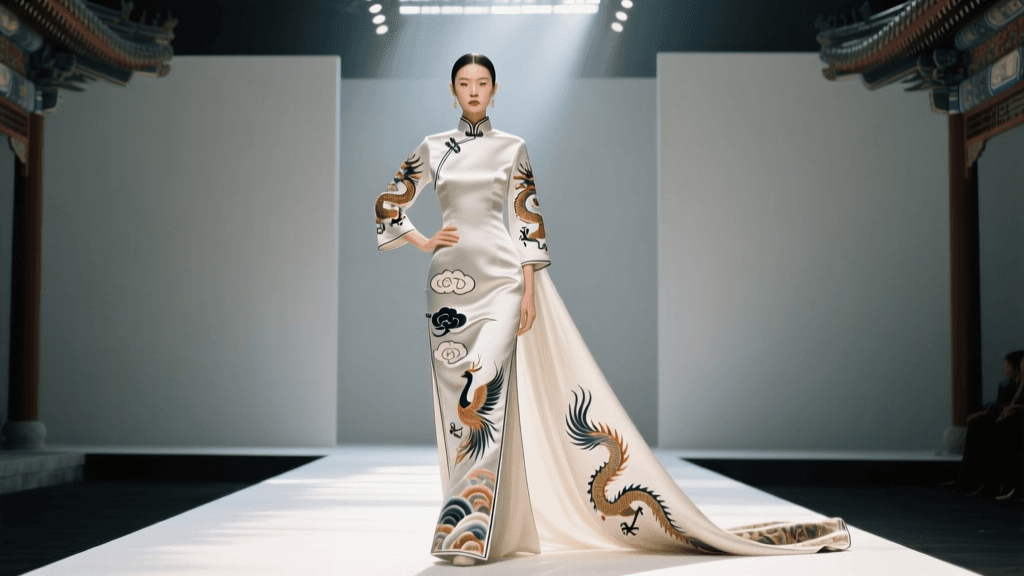
The international runway has moved away from the skin-tight, 1960s cinematic qipao, favoring the relaxed, Art Deco-inspired drops of the 1930s or the oversized, deconstructed silhouettes of modern couture. When commissioning a bespoke qipao or a qipao-inspired jacket, provide your tailor with these specific couture adjustments:
- The Mandarin Collar: Opt for a softened stand collar measuring exactly 3.5 cm to 4.0 cm in height. Request a 15-degree forward slant on the front edges to prevent the collar from digging into the jawline when looking down.
- The Sleeve Pitch: Traditional flat-cut sleeves restrict movement. Ask your tailor to implement a Western-style set-in sleeve with a high armhole pitch, combined with a subtle gusset under the arm. This maintains the clean shoulder line of the qipao while allowing the mobility required for modern life.
- Fastenings: Replace standard knotted frog buttons with hidden magnetic closures for a seamless, minimalist placket, reserving a single, hand-carved jade toggle at the collarbone for a focal point.
Incorporating Hanfu Proportions into Outerwear
The Mamianqun (horse-face skirt) is a staple of Ming Dynasty Hanfu, characterized by its flat front and back panels with deep, overlapping side pleats. Couture designers have adapted this into modern midi and maxi skirts.
Actionable Tailoring Tip: To create a modern, runway-inspired Mamianqun, use 2.5 meters of heavy silk crepe or wool-blend gabardine. Instead of the traditional 10+ flat knife pleats, instruct your tailor to create 4 deep, structured box pleats on each side. Anchor the waist with a wide, structured leather belt rather than a traditional silk sash to bridge the gap between ancient heritage and contemporary street-style edge.
Comparison Chart: Heritage vs. Couture Interpretations
Understanding the difference between strict historical reproduction and haute couture interpretation is vital for building a cohesive wardrobe.
| Garment Element | Traditional Heritage Standard | International Couture Interpretation | Actionable Wardrobe Integration |
|---|---|---|---|
| Collar & Neckline | Stiff, 5cm+ stand collar; tight fit | Softened, 3.5cm curved edge; open plackets | Pair with geometric drop-earrings to elongate the neck. |
| Textile & Drape | Flat crepe, stiff brocade, bright colors | Gambiered silk, tea-dyed, distressed, muted | Use Xiangyunsha for structured blazers; dry clean only. |
| Pleating (Skirts) | 10+ flat knife pleats; floor-grazing | Asymmetric box pleats; midi-length | Anchor voluminous pleats with a fitted, ribbed knit top. |
| Embroidery | Dense, symmetrical, multi-colored motifs | Tone-on-tone, abstract, isolated placement | Choose garments with embroidery only on the cuffs or hem. |
Investment Pieces and Cost Breakdown
Building a wardrobe inspired by Chinese couture is an exercise in slow fashion and investment dressing. Here is a realistic cost breakdown for acquiring high-quality, heritage-inspired pieces:
- Bespoke Silk Qipao (Shanghai/Hong Kong Tailor): $800 – $2,500. This includes the cost of premium mulberry silk, custom pattern drafting, and hand-finished seams.
- Ready-to-Wear Xiangyunsha Trench Coat: $600 – $1,200. Look for contemporary Chinese brands that utilize traditional gambiered silk but apply Western trench coat tailoring (lapels, storm flaps).
- Hand-Embroidered Couture Jacket: $2,500 – $5,000+. Pieces featuring genuine Su embroidery (where a single motif can take hundreds of hours) are museum-quality investments that appreciate in cultural and financial value.
'True elegance in Chinese couture does not shout; it whispers through the friction of the silk, the weight of the embroidery, and the space left between the garment and the body.'
Styling and Accessorizing the Couture-Inspired Wardrobe
When styling these heritage pieces, the key is juxtaposition. Avoid wearing head-to-toe traditional garments, which can veer into costume territory. Instead, anchor a flowing, Hanfu-inspired silk blouse with sharply tailored, wide-leg wool trousers.
Accessorize with intention. Swap Western diamond jewelry for Hetian nephrite jade or cloisonné enamel pieces. A simple, polished jade bangle (measuring 54mm to 58mm in inner diameter, depending on your wrist) provides a subtle, historical weight to a modern silk blouse. For footwear, avoid traditional cloth shoes; instead, opt for architectural leather boots or minimalist pointed-toe mules to maintain the sharp, avant-garde silhouette championed by designers like Uma Wang.
Conclusion
The presence of Chinese fashion on the international runway is no longer a fleeting trend; it is a permanent, evolving dialogue between ancient craftsmanship and modern design. By understanding the mechanics of heritage textiles like Xiangyunsha, the precise tailoring required for a modernized qipao, and the structural philosophy of Hanfu proportions, you can curate a wardrobe that honors Asian traditions while remaining firmly rooted in contemporary global style. Invest in the craft, respect the history, and let the garments speak for themselves.