Decoding Chinese Court Robes: Rank Badges and Color Codes
The Visual Language of Imperial Power
In ancient China, clothing was never merely a matter of personal fashion or aesthetic preference; it was a meticulously regulated visual language that communicated the wearer's exact position within the cosmic and bureaucratic hierarchy. Governed by strict sumptuary laws, the garments of the Ming (1368–1644) and Qing (1644–1912) dynasties served as wearable legal documents. From the vibrant dyes used to color the silk to the intricate embroidery of mythical beasts, every thread was dictated by the imperial court. Understanding these color codes and rank badges—known as buzi—offers a fascinating glimpse into the rigid social stratification and profound symbolism that defined traditional Chinese governance and culture.
The Imperial Color Palette: Who Could Wear What?
Color in traditional Chinese court dress was deeply tied to the Five Elements theory (Wu Xing) and the Mandate of Heaven. The imperial household claimed exclusive rights to specific shades, and unauthorized use was considered treasonous. According to the Metropolitan Museum of Art's Heilbrunn Timeline of Art History, the Qing dynasty codified these color laws with unprecedented strictness.
- Bright Yellow (Ming Huang): The most sacred color, representing the earth and the center of the universe. It was strictly reserved for the Emperor, the Empress, and the Empress Dowager.
- Apricot Yellow (Xing Huang): Designated exclusively for the Crown Prince.
- Golden Yellow (Jin Huang): Worn by the Emperor's other sons and high-ranking imperial princes.
- Stone Blue (Shi Qing): The standard color for the surcoats (bufu) of civil and military officials during the Qing dynasty. Blue represented the east, spring, and the heavens.
- Red and Green: Often utilized for high-ranking nobles, imperial consorts, and specific ceremonial occasions, though heavily regulated in their exact saturation and application.
The dyes themselves were labor-intensive. Imperial yellow was derived from the buds of the pagoda tree (Sophora japonica), while the deep stone blues required multiple dips in fermented indigo vats. The rarity and cost of these natural dyes further reinforced the exclusivity of the garments.
Buzi (Rank Badges): The Ultimate Status Symbol
The most recognizable symbol of bureaucratic rank was the buzi, or rank badge. As detailed by Encyclopædia Britannica, these intricately embroidered squares were affixed to the front and back of an official's surcoat. The Ming dynasty introduced the badges as single, unbroken squares. However, when the Manchu-led Qing dynasty took power, they adapted the badges to accommodate the front-opening design of their traditional riding coats, resulting in the front badge being split down the middle.
Civil officials were represented by birds, symbolizing elegance, literary prowess, and grace. Military officials were represented by beasts, symbolizing courage, strength, and martial ferocity. The specific animal or bird depicted on the badge immediately informed the public of the official's exact rank, from the first rank (the highest) down to the ninth rank.
Civil vs. Military: The Nine Ranks of Power
The following table outlines the strict avian and animal hierarchy enforced during the Qing dynasty:
| Rank | Civil Official (Bird) | Military Official (Beast) |
|---|---|---|
| 1st Rank | Red-Crowned Crane | Qilin (Mythical Chimera) |
| 2nd Rank | Golden Pheasant | Lion |
| 3rd Rank | Peacock | Leopard |
| 4th Rank | Wild Goose | Tiger |
| 5th Rank | Silver Pheasant | Bear |
| 6th Rank | Egret | Panther |
| 7th Rank | Mandarin Duck | Rhinoceros |
| 8th Rank | Quail | Rhinoceros (or Bear in some eras) |
| 9th Rank | Paradise Flycatcher | Sea Horse (Mythical Water Horse) |
Artisans used specialized embroidery techniques to create these badges. Kesi (silk tapestry) weaving was the most prestigious and expensive method, creating a carved-like effect. Other common techniques included Peking knot (seed stitch) for filling backgrounds and couching, where gold-wrapped threads were laid on the surface and stitched down to create shimmering, raised borders.
Dragon Motifs: Counting the Claws
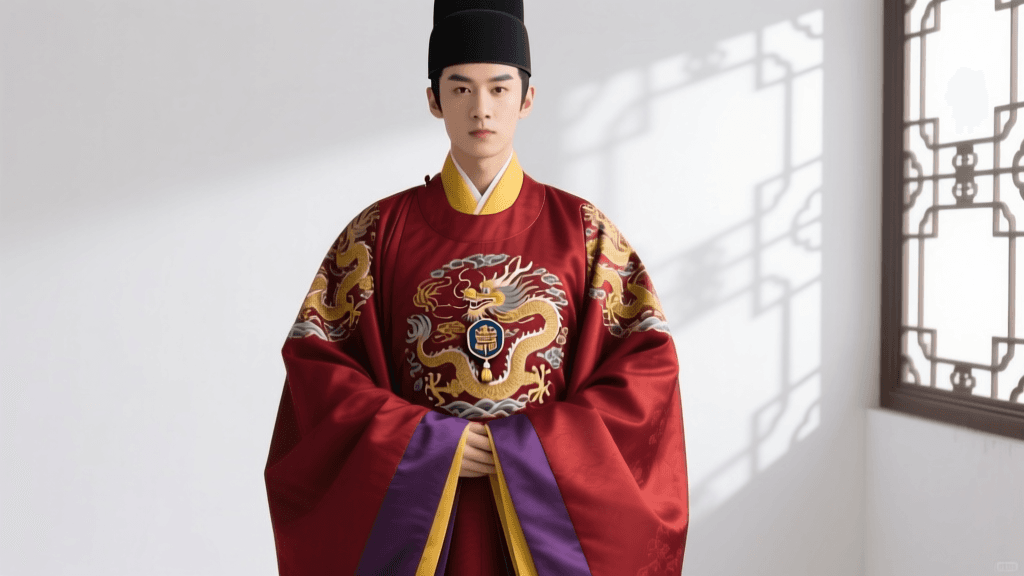
While rank badges denoted bureaucratic status, the dragon motif denoted proximity to the Emperor. However, not all dragons were created equal. The true imperial dragon, known as the long, was depicted with exactly five claws on each foot. This motif was reserved solely for the Emperor and his immediate heirs. Officials and lower nobility were permitted to wear the mang, a dragon-like serpent that possessed only four claws. Wearing a five-clawed dragon without imperial decree was a capital offense. Collectors and historians often examine the claws closely; in some surviving garments, a fifth claw has been hastily removed or added, indicating an owner attempting to either hide treason or falsely elevate their status posthumously.
A Collector’s Guide to Authentic Court Robes and Badges
For modern collectors, antique dealers, and museum curators, acquiring Ming and Qing court textiles requires a keen eye for historical accuracy, material science, and market timing. The survival rate of these silk garments is low due to the fragile nature of the fibers and the historical practice of unpicking gold threads to melt them down.
Sizing, Measurements, and Display
When sourcing or displaying a buzi rank badge, understanding standard historical measurements is crucial for authentication and framing.
- Badge Dimensions: Qing dynasty rank badges typically measure between 28 cm and 32 cm (11 to 12.5 inches) square. Ming badges are often slightly larger and more rectangular.
- Surcoat Dimensions: A standard Qing bufu surcoat measures approximately 140 cm (55 inches) in length and 150 cm (59 inches) across the outstretched sleeves.
- Archival Display: Never hang a fragile antique silk badge by its fabric. It must be mounted flat on an acid-free, buffered mat board using stainless steel pins or invisible silk thread. Display cases must filter out 99% of UV light, and humidity should be maintained strictly between 45% and 55% to prevent silk shattering.
Market Costs, Timing, and Authentication
The market for Chinese imperial textiles is highly competitive, with major auction houses like Sotheby's and Christie's holding dedicated Asian art sales in April and October. Prices vary wildly based on rank, condition, and weaving technique.
- Entry-Level ($800 - $2,500): Late 19th-century Qing badges (8th or 9th rank) featuring standard satin stitch embroidery, often with minor fading or silk shattering.
- Mid-Range ($3,000 - $8,000): Mid-19th-century badges for 4th to 6th rank officials, featuring gold couching, peacock feather threads, and excellent color retention.
- Museum-Quality ($15,000 - $50,000+): Early Qing or Ming dynasty 1st rank Crane or Qilin badges woven in Kesi silk tapestry, or complete Imperial five-clawed dragon robes (jifu) in bright yellow.
Authentication Tip: The most reliable way to date a badge is by examining the dyes. The introduction of synthetic aniline dyes from Europe in the 1860s revolutionized textile coloring. If a badge features a harsh, neon-like magenta or an unnaturally vivid, non-fading purple, it was likely produced in the late 19th or early 20th century. Authentic mid-Qing pieces will feature natural dyes—such as safflower for reds and indigo for blues—which exhibit a soft, complex patina and gentle fading over time. For verified examples of authentic imperial weaving techniques, collectors frequently consult the digital archives of the Metropolitan Museum of Art's Asian Textile Collection.
Ultimately, decoding the color codes and rank badges of Chinese court robes transforms them from mere antique garments into profound historical texts. They are woven records of ambition, artistry, and the unyielding structure of an empire that spanned centuries.