Evolution of Chinese Court Fashion: Zhou to Ming Guide
The Mandate of Heaven Woven in Silk
In the vast tapestry of Asian traditions, few sartorial systems are as deeply intertwined with philosophy, governance, and cosmic order as the historical court fashion of China. For over two millennia, traditional Chinese clothing was not merely a matter of aesthetic preference; it was a visual manifestation of the Mandate of Heaven, Confucian hierarchy, and strict sumptuary laws. From the ritualistic Mianfu of the Zhou Dynasty to the opulent brocades of the Ming Dynasty, court dress evolved to reflect the political and cultural zeitgeist of each era. Today, the global Hanfu revival has sparked a renewed interest in these historical garments, moving beyond casual streetwear to the meticulous recreation of museum-grade court fashion. This guide explores the dynasty-by-dynasty evolution of Chinese court dress and provides a practical, actionable framework for collectors, historians, and enthusiasts looking to commission authentic replicas today.
The Zhou Dynasty: Establishing the Mianfu System
The foundation of Chinese court fashion was laid during the Zhou Dynasty (c. 1046–256 BCE) with the establishment of the Mianfu (冕服) system. Deeply rooted in early Confucian ideals, the Mianfu was the highest grade of ritual dress, worn exclusively by the Emperor and high-ranking nobility during ancestral sacrifices and grand state ceremonies. The ensemble was defined by its profound symbolism. The upper garment (Xuan Yi) was black, representing the heavens, while the lower skirt (Xun Chang) was red, symbolizing the earth.
The most iconic element of the Zhou court was the Mianliu, a crown featuring a rectangular board from which hung bead curtains (liu). The number of bead strings strictly denoted rank: the Emperor wore twelve, while dukes and ministers wore fewer. Furthermore, the garments were adorned with the 'Twelve Symbols of Sovereignty,' including the sun, moon, stars, mountains, and dragons, each representing a specific imperial virtue. According to the Metropolitan Museum of Art's Heilbrunn Timeline of Art History, the early mastery of Chinese silk sericulture during this era allowed these profound cosmological symbols to be woven directly into the fabric of statecraft, establishing a precedent that would influence East Asian court dress for centuries.
Tang & Song Dynasties: Cosmopolitan Flourishes and Refinement
As China entered the Tang Dynasty (618–907 CE), court fashion underwent a radical transformation, reflecting the empire's cosmopolitan reach along the Silk Road. The rigid, wide-sleeved ritual robes of antiquity were supplemented by the Yuanlingpao (round-collar robe), a garment influenced by Central Asian and nomadic equestrian styles. The Tang court introduced a strict color-coded rank system for officials: purple for the third rank and above, deep red for the fourth and fifth, green for the sixth and seventh, and cyan for the eighth and ninth. The Met Museum's overview of the Tang Dynasty highlights how this era's textile arts incorporated exotic motifs, such as pearls, lions, and floral medallions, showcasing an unprecedented era of cultural exchange and sartorial opulence.
Conversely, the subsequent Song Dynasty (960–1279 CE) marked a return to conservative, scholarly refinement. Reacting against the perceived extravagance of the Tang, Song court fashion favored subdued colors, slender silhouettes, and understated elegance. The most recognizable innovation of the Song court was the Zhanchi Futou, a black hat with extraordinarily long, rigid wings extending horizontally from the sides. Historically attributed to Emperor Taizu, these wings were designed to physically prevent officials from whispering to one another during court assemblies, brilliantly merging sartorial design with political control.
The Ming Dynasty: The Pinnacle of Han Court Dress
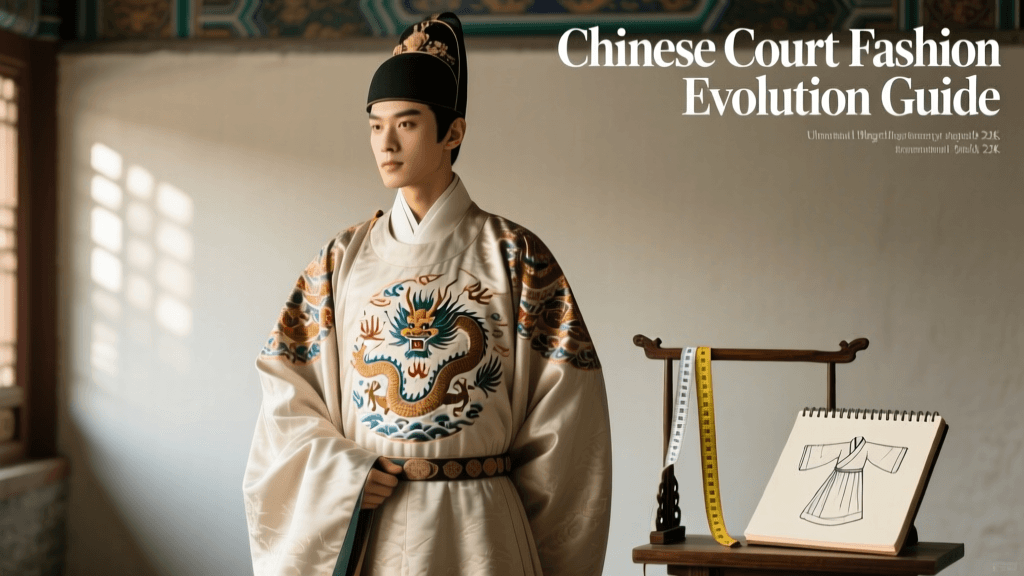
Following the expulsion of the Mongol-led Yuan Dynasty, the Ming Dynasty (1368–1644 CE) sought to restore traditional Han Chinese governance and culture. The Ming court synthesized previous dynastic codes into the most complex and visually spectacular sumptuary system in Chinese history. The Emperor's formal attire returned to the ancient Mianfu and the Pi Bian Guan (leather cap) for ritual occasions, but the daily administrative court dress reached new heights of textile engineering.
Ming officials wore the Buzi (rank badges)—large, intricately embroidered squares affixed to the chest and back of their robes. Civil officials bore bird motifs (e.g., cranes, golden pheasants), while military officials featured beast motifs (e.g., lions, tigers). Beyond standard officialdom, the Emperor granted special favor robes to trusted generals and eunuchs, most notably the Mang (python), Feiyu (flying fish), and Douniu (bull) robes. As noted in the Metropolitan Museum of Art's Ming Dynasty analysis, the era's economic prosperity fueled an insatiable demand for luxury textiles, leading to the perfection of complex brocade weaving techniques that remain highly prized by collectors today.
Practical Guide: Commissioning a Museum-Grade Court Replica
For modern Hanfu enthusiasts, historical reenactors, and textile collectors, acquiring an authentic, court-grade Ming Dynasty replica is a significant investment. Unlike mass-produced, off-the-rack Hanfu (which typically costs between $50 and $150 USD and utilizes polyester or basic cotton), a true court replica requires bespoke tailoring, historical accuracy, and premium materials. Here is an actionable guide to commissioning a high-end Ming-style Feiyu (Flying Fish) robe or official court ensemble.
1. Fabric Selection: The Imperial Standard
To achieve historical accuracy, you must source authentic Jacquard-woven brocade. The gold standard for Ming court replicas is Nanjing Yunjin (Cloud Brocade) or Shu Brocade from Sichuan.
- Nanjing Yunjin: Woven on traditional wooden drawlooms, often incorporating real gold and silver threads, as well as peacock feather yarns. Cost: $300 to $1,200+ USD per meter. A single robe requires 5 to 7 meters.
- Shu Brocade: Slightly more accessible but historically accurate for high-ranking officials. Features vibrant, tight geometric and floral weaves. Cost: $120 to $350 USD per meter.
- Actionable Advice: Avoid digital printing. True court fashion relies on the structural integrity of the weave. Request fabric swatches from specialized ateliers in Suzhou or Nanjing before committing to a full bolt.
2. Measurements and Traditional Tailoring
Historical Chinese garments utilize a flat-cutting method (Pianmian Caijian), which differs vastly from modern Western 3D tailoring. The fabric is not darted to hug the body; instead, it drapes elegantly. When providing measurements to a master tailor, you must specify traditional court proportions:
- Tongxiu (Sleeve Length): Court etiquette required sleeves to cover the hands. For a formal Ming court robe, the sleeve length must extend at least 20cm to 30cm past the fingertips, allowing for the traditional 'returning sleeve' (Hui Xiu) drape.
- Jiankuan (Shoulder Width): Traditional robes feature a drop-shoulder seam. The shoulder measurement should extend 5cm to 10cm past your natural shoulder bone to accommodate the heavy brocade's drape.
- Jiaoling Youren (Cross-Collar): Ensure the inner tie (Zhongdai) is positioned exactly 15cm below the collarbone to maintain the structural integrity of the right-over-left lapel without gaping.
3. Budgeting, Accessories, and Timeline
Commissioning a full Ming court ensemble is a test of patience and financial planning. Below is a realistic breakdown of costs and timing for a bespoke project:
- Fabric & Weaving (4-6 Months): Hand-loomed Yunjin brocade is produced at a rate of merely 5-6 centimeters per day. Budget $2,500 - $5,000 USD for materials.
- Tailoring & Embroidery (2-3 Months): Hand-stitched hems, hidden seams, and supplementary Buzi (rank badge) embroidery will cost between $800 and $1,500 USD.
- Accessories ($400 - $900 USD): A complete look requires a Wusha (black gauze) hat, a leather or jade-inlaid official belt (Yudai), and black court boots with white soles.
- Total Estimated Cost: $3,700 to $7,400 USD.
- Total Timeline: 6 to 9 months from initial consultation to final delivery.
Comparison Chart: Court Dress Codes Across Dynasties
To assist collectors and historians in identifying the correct era for their acquisitions or reenactments, refer to the structural comparison below:
| Dynasty | Primary Court Garment | Signature Headwear | Key Distinguishing Feature | Sumptuary Focus |
|---|---|---|---|---|
| Zhou | Mianfu (Ritual Top/Skirt) | Mianliu (Beaded Crown) | Twelve Symbols of Sovereignty; Black/Red colorway | Ritual purity and cosmic alignment |
| Tang | Yuanlingpao (Round-Collar Robe) | Putou (Soft/Hard Gauze Cap) | Color-coded ranks (Purple to Cyan); Central Asian motifs | Bureaucratic hierarchy and imperial favor |
| Song | Shenyi / Round-Collar Robe | Zhanchi Futou (Long-Winged Hat) | Subdued colors; elongated rigid hat wings | Scholarly modesty and court discipline |
| Ming | Mang / Feiyu / Buzi Robes | Wusha (Black Gauze Hat) | Woven Jacquard brocades; Chest/Back rank badges | Textile opulence and strict civil/military ranks |
Conclusion
The evolution of Chinese court fashion from the Zhou to the Ming Dynasty is a masterclass in the intersection of textile artistry and political philosophy. What began as the solemn, cosmologically aligned ritual garments of antiquity blossomed into the breathtakingly complex brocades and rank badges of the Ming era. For the modern enthusiast, engaging with these traditions goes far beyond simply wearing historical clothing; it is an act of preservation. By understanding the precise measurements, investing in authentic weaving techniques like Nanjing Yunjin, and respecting the sumptuary codes of the past, collectors and Hanfu practitioners can ensure that the Mandate of Heaven continues to be woven into the fabric of the present.