Chilkat and Ravenstail Weaving Traditions: 2026 Guide
The Enduring Legacy of Pacific Northwest Weaving
The Indigenous peoples of the Pacific Northwest Coast—primarily the Tlingit, Haida, and Tsimshian nations—are renowned for their monumental wood carvings, intricate formline art, and, perhaps most impressively, their masterful textile traditions. Among these, Chilkat (Naaxiin) and Ravenstail weaving stand as pinnacles of Indigenous North American dress traditions. As of 2026, these ancient practices are experiencing a profound renaissance. Driven by tribal apprenticeships, museum repatriations, and a renewed commitment to cultural sovereignty, a new generation of weavers is mastering the complex techniques required to create these sacred garments. This guide explores the history, regional variations, material sourcing, and contemporary revitalization of Chilkat and Ravenstail weaving in 2026.
Understanding Naaxiin (Chilkat) Weaving
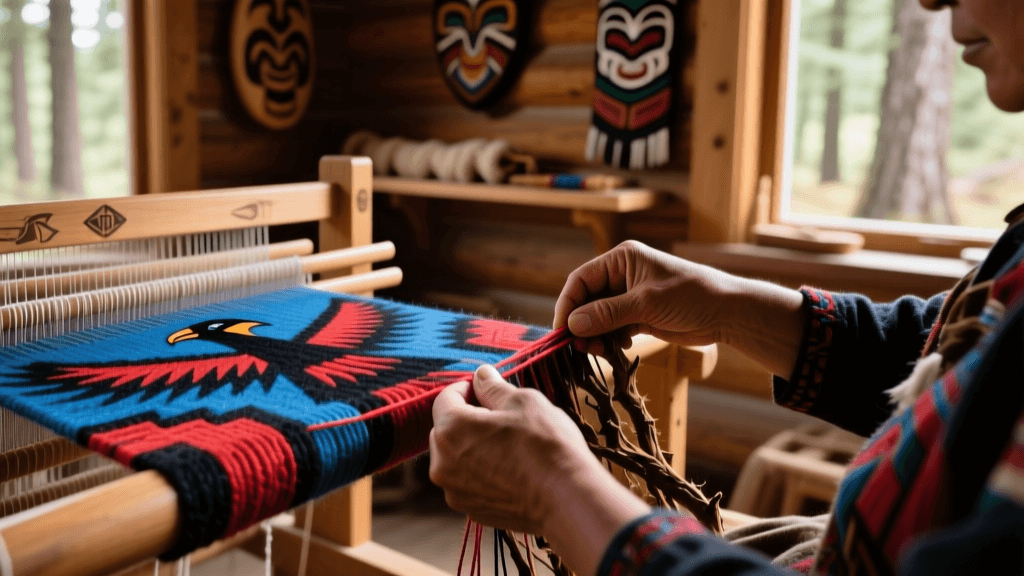
Naaxiin, commonly known as Chilkat weaving, is a highly specialized textile art form that produces heavy, fringed robes adorned with curvilinear formline designs. The term "Chilkat" originates from the Jilkáat Tlingit people of the Chilkat River valley in Southeast Alaska, who were among the most prolific producers and traders of these robes in the 19th century. However, the art form itself was originated by the Tsimshian people before spreading to the Tlingit and Haida.
Unlike European tapestry weaving, which uses a heddle to separate warp threads, Naaxiin is woven on a simple warp-weighted loom. The weaver manually twists the weft threads around the warp threads, a painstakingly slow process that allows for the creation of complex, interlocking curves characteristic of Northwest Coast formline art. A single full-sized dancing blanket, typically measuring five feet wide and four feet long, can take a master weaver over a year of continuous work to complete. In 2026, these robes remain central to potlatches, memorial ceremonies, and clan gatherings, serving as tangible manifestations of ancestral crests and spiritual power.
Ravenstail Weaving: The Geometric Ancestor
Predating the curvilinear Naaxiin style is Ravenstail weaving, an equally complex but visually distinct tradition. Ravenstail robes are characterized by sharp, geometric patterns—often featuring stark black, white, and yellow horizontal bands, zigzags, and diamond shapes. The name "Ravenstail" is an English translation derived from the Tlingit term for the design, which resembles the tail feathers of a raven.
While Chilkat weaving gained wider recognition among collectors and museums, Ravenstail nearly vanished by the early 20th century. Today, however, Ravenstail has seen a massive resurgence. Many contemporary weavers in 2026 choose to begin their training with Ravenstail, as its geometric structures teach the foundational twining techniques and tension control necessary before attempting the fluid curves of Chilkat formline.
Material Sourcing and Preparation in 2026
The creation of authentic Chilkat and Ravenstail regalia relies entirely on natural materials harvested from the temperate rainforests and coastal mountains of the Pacific Northwest. Sourcing these materials in 2026 requires deep ecological knowledge, tribal partnerships, and strict adherence to sustainable harvesting protocols.
| Material | Source | Preparation Method | 2026 Availability & Protocols |
|---|---|---|---|
| Mountain Goat Wool | Coastal Mountain Ranges | Shedding season collection, washing, carding, and spinning with cedar bark core. | Highly restricted; requires tribal permits and ethical partnerships with wildlife agencies. |
| Yellow Cedar Bark | Temperate Rainforests | Spring harvesting, boiling, shredding into fine strips for the warp core. | Sustainable; managed by tribal forestry programs to ensure old-growth protection. |
| Wolf Lichen (Letharia vulpina) | Old-growth conifer forests | Drying and boiling to extract vibrant yellow dye. | Moderate; protected in certain ecological zones, harvested only by permitted elders. |
| Hemlock Bark | Western Hemlock trees | Boiled with iron or copper mordants to create deep black and brown dyes. | Abundant; harvested sustainably during specific lunar cycles in early spring. |
In 2026, the most significant challenge for weavers is acquiring mountain goat wool. Historically, wool was gathered from bushes where goats had shed or through respectful hunting. Today, tribal weavers often collaborate with state and provincial wildlife agencies to collect wool from naturally shedding populations or from goats harvested for subsistence, ensuring that no animal is harmed solely for textile production. The wool is then meticulously cleaned, carded, and spun. The warp threads are uniquely constructed by twisting a core of yellow cedar bark with mountain goat wool, giving the robe its distinctive weight and structure.
Natural Dyes and Color Symbolism
The traditional color palette of Chilkat and Ravenstail weaving is strictly limited to the natural dyes available in the region, each carrying specific cultural weight:
- White: The natural color of the undyed mountain goat wool, representing purity, light, and the spiritual realm.
- Black: Achieved through boiling hemlock bark with copper or iron. Black outlines the formline designs and represents the physical world and structural boundaries.
- Yellow: Extracted from wolf lichen or cottonwood buds. Yellow is used to highlight secondary design elements (the "secondary formline") and represents warmth and life force.
- Blue/Green: Historically rare and highly prized, early blue-green hues were achieved using copper oxide or traded materials. In 2026, while some master weavers experiment with revived copper-oxide techniques, many utilize safe, modern synthetic dyes strictly for practice pieces, reserving natural dyes for sacred ceremonial robes.
Regional Variations Across the Pacific Northwest
While the foundational techniques of Naaxiin and Ravenstail are shared, distinct regional variations exist across the territories of the Tlingit, Haida, and Tsimshian peoples.
Tlingit Territories (Southeast Alaska)
The Tlingit are the most prolific contemporary producers of Chilkat robes. In communities like Haines, Klukwan, and Sitka, weaving is deeply tied to clan identity. Tlingit robes often feature bold, highly stylized animal crests—such as the Bear, Eagle, or Whale—arranged in a symmetrical layout. In 2026, Tlingit weavers are at the forefront of integrating digital archiving with traditional practice, using high-resolution scans of ancestral robes to study forgotten twining patterns.
Haida Gwaii (British Columbia)
Haida weavers adapt the Chilkat tradition to fit their unique formline aesthetic, which is characterized by broader, more expansive ovoids and U-shapes compared to the Tlingit style. Haida Gwaii's isolation has fostered a tight-knit community of artisans who, as of 2026, are heavily focused on integrating Ravenstail geometric borders with central Chilkat crest figures, creating hybrid robes that reflect both ancient history and contemporary Haida identity.
Tsimshian Nation (Northern British Columbia)
As the originators of the art form, Tsimshian weavers maintain a deep spiritual connection to the origins of Naaxiin. Tsimshian designs are often noted for their intricate, densely packed curvilinear elements and complex use of negative space. The Tsimshian approach to the fringe—often twisting the bottom warp threads into elaborate, multi-ply cords that sway dynamically during ceremonial dances—remains a hallmark of their regional style.
Contemporary Revitalization and 2026 Apprenticeships
The survival of Chilkat and Ravenstail weaving in the 21st century is largely due to the tireless efforts of Indigenous-led cultural organizations. The Sealaska Heritage Institute (SHI) has been instrumental in this revival. Through their Native Arts programs, SHI funds master-apprentice partnerships, providing stipends that allow emerging weavers to dedicate hundreds of hours to studying under recognized masters. In 2026, SHI's apprenticeship cohorts are not only learning to weave but are also studying the complex Tlingit language terminology associated with the loom, the warp, and the specific twining stitches.
Furthermore, the repatriation of ancestral robes has played a critical role in modern education. Institutions like the National Museum of the American Indian and the Burke Museum of Natural History and Culture have increasingly facilitated the return of sacred garments to their rightful clans, or at minimum, provided unrestricted access for tribal weavers to study the internal structures of 19th-century masterpieces. Examining the reverse side of an ancestral robe allows modern weavers to decipher the exact path of the weft thread, unlocking techniques that were once thought lost to time.
Essential Tools for the Modern Weaver
Despite the passage of time, the tools used in Chilkat and Ravenstail weaving remain remarkably traditional. A 2026 weaver's toolkit typically includes:
- Warp-Weighted Loom Frame: Usually constructed from local cedar or spruce, consisting of a top crossbar from which the warp threads hang, weighted at the bottom by cedar-bark bundles or stones to maintain tension.
- Weaving Sword: Carved from bone, antler, or dense hardwood, used to pack the weft threads tightly together to create a weather-resistant, dense fabric.
- Spindle Whorl: Often carved from wood or stone, used for spinning the raw mountain goat wool into uniform yarn.
- Pattern Boards: Historically painted on cedar planks, today's weavers may use large paper prints or digital tablets to reference the complex formline designs while working at the loom.
Caring for and Preserving Woven Regalia
Because Chilkat and Ravenstail robes are made from organic materials, they are highly susceptible to environmental damage, pests, and light degradation. In 2026, tribal cultural centers employ advanced, yet culturally appropriate, preservation methods. Robes are stored flat or gently rolled in acid-free tissue paper within climate-controlled cedar chests. The natural oils in the cedar act as a mild insect repellent against moths and carpet beetles, which are the greatest threat to wool textiles.
When worn during potlatches, the robes are subjected to the smoke of alder or cedar fires, a traditional practice that not only blesses the garment but also naturally fumigates it. After ceremonies, robes are aired out in shaded, dry environments before being returned to storage, ensuring that these magnificent testaments to Indigenous North American dress traditions survive for generations to come.
Conclusion
Chilkat and Ravenstail weaving are far more than historical artifacts; they are living, breathing expressions of Indigenous resilience, artistry, and spiritual continuity. As we move through 2026, the sight of a newly woven Naaxiin robe dancing in the firelight of a potlatch hall is a powerful reminder that the traditions of the Pacific Northwest are not merely surviving—they are thriving. Through ethical material sourcing, rigorous apprenticeships, and a deep reverence for ancestral knowledge, the weavers of the Tlingit, Haida, and Tsimshian nations continue to wrap their people in the strength and beauty of their heritage.