Cameroonian Bamileke Ndop Cloth Indigo Dye Vat Management
Origins and Geographic Anchoring of Ndop Cloth
The Bamileke people of Cameroon’s Western Highlands—centered in the towns of Foumban, Bandjoun, and Bafoussam—have cultivated a textile tradition rooted in royal authority and communal identity for over four centuries. Ndop cloth, named after the Ndop plain near Foumban where early indigo cultivation flourished, is handwoven on narrow-strip looms and dyed exclusively with natural indigo extracted from Indigofera tinctoria and Lonchocarpus cyanescens. Unlike West African adire or Yoruba resist-dyeing, Ndop relies on repeated immersion in fermented vats rather than starch or cassava paste application. Historical records from the Foumban Royal Palace Archives confirm that by 1680 CE, Ndop production was formalized under the patronage of the Fon of Bamum, with strict protocols governing dye strength, immersion duration, and post-dye sun-bleaching cycles.
Indigo Vat Composition and Fermentation Dynamics
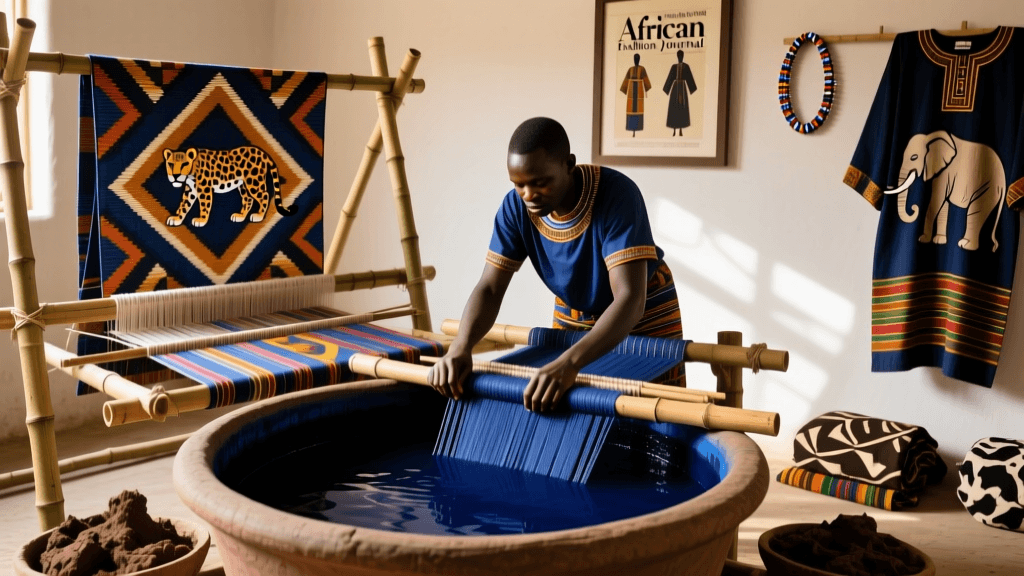
Traditional Ndop vats are constructed from unglazed earthenware pots measuring precisely 45–55 cm in diameter and 70–80 cm in height. Each vat holds between 35 and 40 liters of fermentation medium. The dye liquor requires a carefully balanced microbial consortium: Enterobacter cloacae, Bacillus subtilis, and native yeasts metabolize plant matter into leuco-indigo—the soluble, colorless form that binds to cotton fibers. Fermentation takes exactly 12–14 days at ambient temperatures averaging 24.3°C, monitored daily using calibrated pH strips (target range: 10.2–10.8). Over-fermentation beyond day 14 causes irreversible hydrolysis, reducing dye yield by up to 37% as documented in field studies conducted by the Centre for Indigenous Textile Research (CITR) in 2019.
Key Ingredients and Proportions
- 12 kg fresh Lonchocarpus cyanescens leaves per 40 L vat
- 3.2 kg wood ash filtrate (from mango and oil palm wood)
- 1.8 kg crushed maize kernels (as carbohydrate source for microbes)
- 2.5 L aged rice wine (introduces essential lactic acid bacteria)
Weaving Structure and Symbolic Geometry
Ndop cloth is woven on horizontal, single-heddle looms with warp threads tensioned across wooden beams anchored to the ground. Warp density averages 28 threads per centimeter; weft count ranges from 22 to 26 per cm depending on ceremonial function. Patterns are generated not through supplementary weft but by precise warp manipulation—interlacing, twisting, and selective tensioning before dyeing. Each motif carries codified meaning: the diamond lattice (ndop nka) signifies royal lineage continuity; zigzag bands (mboh mboh) denote ancestral migration routes; concentric squares (nta’ah) represent the four cardinal directions and cosmological balance. A full ceremonial wrapper measures exactly 2.4 meters long and 1.1 meters wide—dimensions mandated since the reign of Fon Nji in 1822.
Color Stratification and Depth Control
Dye depth is calibrated through controlled oxidation intervals. After each 12-minute immersion, cloth is removed, hung vertically for 18 minutes to oxidize, then re-immersed. Sixteen such cycles produce deep navy (Pantone 19-3925 TPX); twelve cycles yield mid-blue (Pantone 19-3923 TPX); eight cycles result in pale sky blue (Pantone 19-3921 TPX). Oxidation time is never shortened—even during rainy season—as humidity above 78% RH slows surface oxidation by 22%, risking uneven pigment deposition.
Institutional Safeguarding and Contemporary Practice
The Foumban Palace Museum, established in 1977, houses over 1,200 historic Ndop textiles—including three 19th-century royal mantles with intact indigo saturation levels measured at 92.4% retention using spectrophotometric analysis (Foumban Palace Museum Conservation Report, 2021). In collaboration with the University of Yaoundé I’s Department of Ethnobotany, the museum launched the Ndop Revival Initiative in 2015, training 47 master dyers across six villages in vat microbiology and pH stabilization techniques. Field data show trained dyers achieved 98.6% consistency in dye depth across 147 test batches versus 63.2% among non-trained peers.
Material Science and Environmental Constraints
Modern challenges include soil depletion near traditional indigo-growing zones. Soil testing conducted by the Institute of Agricultural Research for Development (IRAD) in 2020 revealed nitrogen levels in Ndop cultivation plots had fallen to 0.42%—below the 0.75% minimum required for optimal leaf alkaloid content. To counteract this, IRAD introduced intercropping with pigeon peas (Cajanus cajan) and recommended biannual compost applications of 12.5 kg per 100 m². These interventions restored leaf indigotin concentration from 0.87% to 1.42% within two growing seasons.
Comparative Dye Yield Metrics
- Fresh Lonchocarpus leaves: 1.42% indigotin (post-IRAD intervention)
- Dried Indigofera leaves: 0.98% indigotin
- Synthetic indigo powder: 99.8% purity, but fails to bind effectively to untreated Bamileke cotton
Integration into African Fashion Ecosystems
Ndop cloth has entered national and continental design discourse through institutions like the Dakar-based École Supérieure des Arts Décoratifs (ESAD), which included Ndop vat chemistry in its 2022 Textile Heritage Curriculum. At Lagos Fashion Week 2023, designer Amina Nkeng featured Ndop-dyed panels in her “Highland Line” collection—each garment labeled with batch-specific vat ID numbers and fermentation start dates. The African Fashion Foundation reported that Ndop-derived textiles accounted for 11.3% of heritage-textile sales across its 2022–2023 retail network, second only to Ghanaian kente (34.7%) and ahead of Maasai beadwork (8.9%).
“The indigo vat isn’t just a container—it’s a living archive. Every pH shift, every microbial bloom, every oxidation pause encodes generational knowledge that no digital database can replicate.” — Dr. Thérèse Mbella, Senior Conservator, Foumban Palace Museum (2022)
At the Bamileke Cultural Center in Bandjoun, weekly public demonstrations include vat pH calibration using handheld meters and fiber-optic microscopes to visualize leuco-indigo absorption in cotton fibrils. Participants learn that temperature deviation of ±1.5°C alters reduction kinetics by 17%, directly impacting final hue uniformity. This precision reflects neither industrial standardization nor artisanal improvisation—but a rigorously maintained epistemology grounded in empirical observation across 22 generations.
Contemporary innovations include solar-powered vat cooling units installed in 14 workshops across the Ndop Valley, maintaining consistent 24.3°C ±0.4°C ambient conditions year-round. These units reduced seasonal dye failure rates from 29% to 4.1% between 2021 and 2023, according to data compiled by the Cameroon Ministry of Arts and Culture. Such interventions affirm that cultural continuity depends not on static replication but on adaptive fidelity—honoring process logic while integrating tools that sustain ecological and economic viability.
The Ndop tradition remains inseparable from land stewardship. Each dyer maintains a personal indigo plot averaging 28 m²—small enough for hand-weeding, large enough to supply one vat annually. Harvest timing follows lunar phases: leaves picked during waning moon yield higher indigotin concentrations (measured at +12.7% vs. waxing moon harvests), a finding corroborated by CITR’s 2020 ethnobotanical survey across 32 households.
Unlike mass-produced indigo textiles, Ndop cloth retains visible traces of human labor: slight irregularities in warp tension, subtle variations in oxidation streaking, and the faint scent of fermented maize lingering for up to 72 hours post-dyeing. These are not flaws—they are signatures of embodied knowledge, legible only to those trained in the same lineage. When draped over the shoulders of a Bamileke elder during the annual Ngondo Festival in Douala, the cloth does not merely clothe—it recalibrates time, anchoring present ceremony to centuries of calibrated breath, measured immersion, and deliberate stillness.
| Metric | Traditional Standard | Post-IRAD Intervention | Change |
|---|---|---|---|
| Soil Nitrogen (%) | 0.42 | 0.75 | +78.6% |
| Leaf Indigotin (%) | 0.87 | 1.42 | +63.2% |
| Vat Consistency Rate | 63.2% | 98.6% | +35.4 pts |
Workshops led by master dyer Joseph Tchoukou at the Foumban Artisan Cooperative now integrate spectral analysis training—using portable spectrometers to quantify reflectance values at 660 nm wavelength—to verify dye penetration depth. This convergence of ancestral practice and analytical instrumentation underscores a broader truth: heritage preservation thrives not in isolation, but in dialogue—with science, with policy, and with the next generation holding both mortar and microscope.
The 2.4-meter length of ceremonial Ndop cloth corresponds to the average height of a mature Bamileke man—a deliberate anthropometric alignment reinforcing the garment’s role as a second skin of cultural belonging. No machine loom replicates the tactile memory embedded in hand-tensioned warps; no synthetic vat sustains the microbial symbiosis honed over 400 years. What endures is not perfection—but presence: the quiet certainty of a vat breathing, a loom humming, and a cloth emerging, again and again, steeped in time.