15th-Century Burgundian Houppelande Guide: Sourcing & Sewing in 2026
The Resurgence of the Burgundian Houppelande in 2026
The Burgundian houppelande remains one of the most striking, opulent, and recognizable garments of the European Middle Ages. Originating in the late 14th century and reaching its zenith in the 15th-century courts of Philip the Good, this voluminous gown is characterized by its high collar, massive sleeves, and floor-length skirts. As we navigate the 2026 historical reenactment and living history season, the demand for museum-quality, archaeologically accurate reproductions has never been higher. Modern costumers and historical European martial arts (HEMA) practitioners are moving away from the synthetic blends and princess-seamed costumes of the past decade, opting instead for period-accurate geometric drafting and heritage textiles.
Creating an authentic houppelande requires a deep understanding of medieval tailoring, textile sourcing, and hand-finishing techniques. According to Britannica's comprehensive overview of Medieval European dress, the houppelande was not merely a garment but a profound statement of wealth, utilizing vast amounts of expensive wool broadcloth and luxurious silk linings to demonstrate the wearer's status. This guide will walk you through the exact steps to draft, source, and construct your own 15th-century Burgundian houppelande using the best materials and techniques available in 2026.
The Anatomy of the 15th-Century Silhouette
Before cutting into expensive heritage wool, it is crucial to understand the structural elements that define the Burgundian silhouette. Unlike modern clothing, which relies on darts and curved seams to fit the body, medieval tailoring was predominantly geometric. The houppelande is constructed from large panels, circles, and triangular gores (gussets) that create volume through draping rather than tailored shaping.
The Collar and Neckline
The quintessential Burgundian houppelande features a high, standing collar that often reaches the jawline, sometimes dagged (cut into decorative patterns) along the top edge. The front of the gown typically opens down the center, revealing a contrasting kirtle or cotehardie underneath. The neckline of the underdress is usually a deep V-shape, a hallmark of mid-15th-century fashion.
The Bombard Sleeve
No houppelande is complete without its dramatic sleeves. The "bombard" sleeve is cut as a massive, sweeping cone or bell shape that hangs to the floor, while the actual armhole allows the wearer's arm to slip through a slit higher up. In 2026, the most accurate reproductions line these massive sleeves with contrasting wool, linen, or even faux fur, allowing the lining to flash brilliantly when the arm is raised.
Sourcing Historically Accurate Textiles in 2026
The most significant hurdle in creating an authentic medieval garment today is sourcing the right fabric. The medieval wool trade, particularly the broadcloths of Flanders and England, produced densely fulled, heavily napped fabrics that are rare in the modern mass-market textile industry. Fortunately, a renaissance in heritage weaving has made these fabrics accessible to dedicated costumers in 2026.
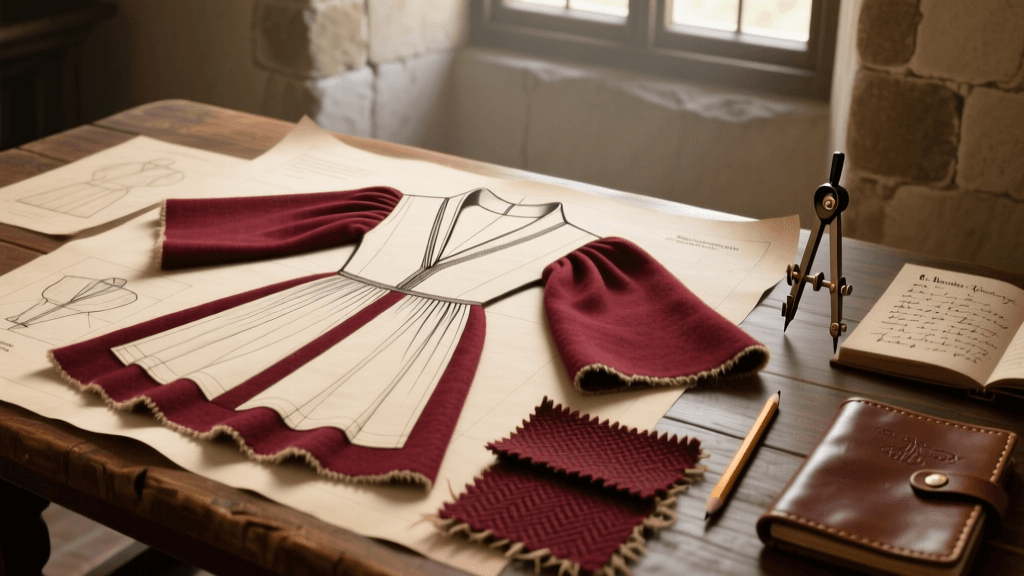
When examining extant garments and historical records, such as those preserved in the Metropolitan Museum of Art's Medieval Art and Textile collection, we see a heavy reliance on diamond twills, herringbone weaves, and heavily fulled tabby broadcloths. For your houppelande, you must avoid modern worsted suit wools, which are too thin, too crisp, and drape incorrectly. Instead, seek out "woolen" yarns that have been woven and then heavily milled (fulled) to create a dense, slightly felted fabric that holds its shape and drapes in heavy, sculptural folds.
- Heritage Wool Broadcloth: Look for 100% wool fabrics weighing at least 14 to 18 ounces per yard. Mills in the UK, such as those in Yorkshire and Wales, continue to produce historically accurate fulled wools.
- Tabby-Woven Linen: For the under-kirtle and sleeve linings, source long-staple, medium-weight linen (5.5 to 7 oz) woven on shuttle looms to replicate the slubby texture of medieval linen.
- Silk Velvet and Damask: For the ultra-wealthy Burgundian court look, heavy silk velvet or period-accurate pomegranate damasks are essential for trims and linings.
2026 Cost Breakdown and Material Requirements
Constructing a floor-length houppelande with bombard sleeves requires a significant yardage. The medieval approach to cutting was highly wasteful by modern standards, as fabric was a luxury item and displaying that wealth through excess material was the entire point of the garment. Below is a detailed breakdown of the materials, estimated yardage, and current 2026 market pricing for heritage textiles.
| Material Component | Weave / Fabric Type | 2026 Avg. Price per Yard | Yardage Required |
|---|---|---|---|
| Main Gown (Houppelande) | Fulled Wool Broadcloth (16oz) | $45.00 - $65.00 | 7 to 9 yards |
| Sleeve & Collar Lining | Contrasting Wool or Linen (6oz) | $22.00 - $35.00 | 4 to 5 yards |
| Under-Kirtle | Medium-weight Tabby Linen | $18.00 - $28.00 | 3 to 4 yards |
| Belt / Sash | Tablet-Woven Silk or Wool | $40.00 (per custom yard) | 2 to 3 yards |
| Thread & Finishing | Silk Buttonhole Twist & Wax | $15.00 (per spool) | 2 spools |
2026 Sourcing Tip: Due to global shipping adjustments and the rising cost of raw fleece, heritage wool prices have stabilized but remain a premium investment. Always order swatches from European and UK-based heritage mills before committing to the 8+ yards required for the main gown.
Pattern Drafting: The Geometric Approach
To achieve the correct 15th-century drape, you must abandon modern pattern drafting software and curved French curves. The medieval houppelande is drafted using basic geometry: circles, rectangles, and triangles. The body of the gown is essentially a large circle with a hole cut in the center for the neck, or a series of rectangular panels with triangular gores inserted at the sides and back to create the sweeping hemline.
Step-by-Step Measurement Guide
- Shoulder to Floor: Measure from the base of your neck, over the shoulder, down to the floor. This is your primary radius for the skirt panels.
- Arm Length: Measure from the shoulder point down to your knuckles. For bombard sleeves, this measurement will be the top edge of the sleeve cone.
- Neck Circumference: Measure the neck where the high collar will sit, adding 1.5 inches for comfort and seam allowance.
- Hem Circumference: A proper Burgundian houppelande should have a hem circumference of at least 120 to 150 inches. Calculate the radius required to achieve this volume when combining your front and back panels.
Once your geometric panels are cut, the volume is controlled at the waist by a wide, heavily decorated leather or tablet-woven belt. The belt is worn high, just under the bust or at the natural waist for women, and at the hips for men, forcing the excess fabric to blouse elegantly over the sash.
Period-Accurate Sewing and Finishing Techniques
In 2026, while many reenactors use sewing machines for the long structural seams to save time, the most dedicated artisans are returning to 100% hand-sewing to achieve the correct tension and drape. Medieval wool broadcloth is thick; machine stitching can create rigid, puckered seams that fight the natural drape of the fulled wool.
The Running Stitch and Flat-Felling
The primary seam used in medieval garment construction is the running stitch. When sewn by hand with heavily waxed linen or silk thread, a running stitch is remarkably strong and flexible. After joining the panels with a running stitch, the seam allowances are trimmed, folded over, and felled down to the main fabric using a hem stitch. This flat-felled seam is virtually invisible from the outside and prevents the thick wool from fraying or unraveling over years of wear.
Dagging and Edge Finishing
Because heavily fulled wool broadcloth does not fray, raw edges were often left exposed and cut into decorative patterns known as dagging. Using sharp, period-style shears, you can cut the edges of your bombard sleeves and hem into scallops, castles, or oak leaves. This technique not only adds visual interest but also reduces the weight of the heavy fabric at the extremities, allowing the sleeves to move more fluidly.
Buttonholes and Closures
If your houppelande features a front opening or tight cuffs on an under-kirtle, you must use period-accurate buttonholes. Modern machine buttonholes are too rigid and historically inaccurate. Hand-worked buttonholes using silk buttonhole twist, finished with a knotted edge, provide a beautiful, durable closure that matches the archaeological record of 15th-century London and Bruges finds.
Conclusion: Wearing Your Houppelande in 2026
Constructing a 15th-century Burgundian houppelande is a labor of love that connects you directly to the textile traditions and master tailors of the Middle Ages. By investing in heritage fulled wools, utilizing geometric pattern drafting, and employing period-accurate hand-sewing techniques, your garment will not only look authentic but will move, drape, and feel exactly as it did in the court of Philip the Good. As the 2026 living history season approaches, stepping into the sweeping, voluminous folds of a properly tailored houppelande is an unparalleled experience in historical immersion.