15th-Century Houppelande: 2026 Tailoring & Fabric Guide
Introduction to the Burgundian Houppelande
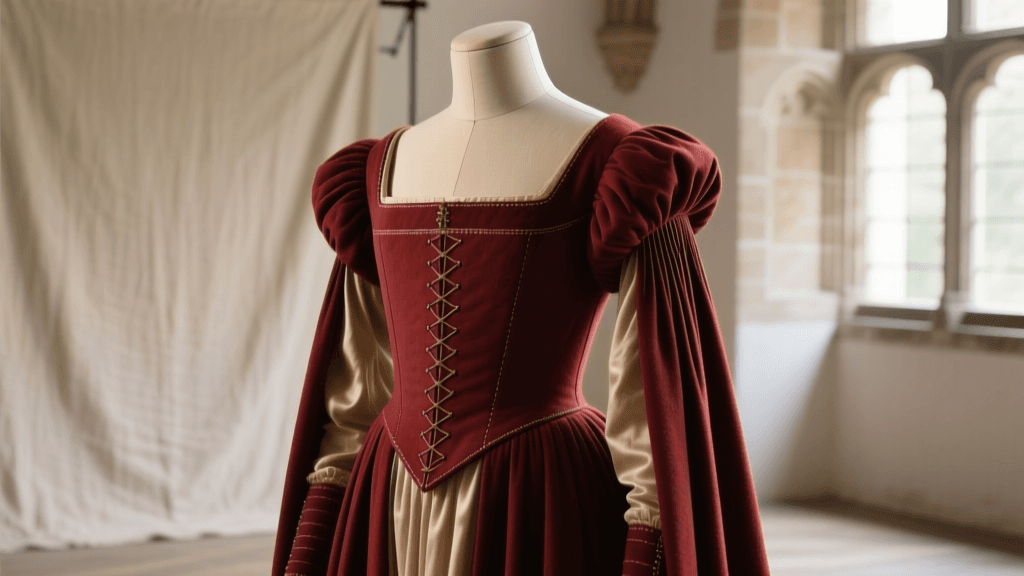
The houppelande is arguably the most iconic and visually striking garment of the late medieval and early Renaissance periods. Emerging in the late 14th century and reaching its zenith in the courts of Burgundy and France during the 15th century, this voluminous gown was a symbol of immense wealth, status, and sartorial excess. Characterized by its sweeping floor-length hemlines, massive bombard sleeves, and a distinctive high, stiffened collar, the houppelande was worn by both men and women, though the tailoring and styling varied significantly between genders.
As we navigate the historical costuming and European folk dress revival landscape in 2026, the demand for period-accurate, museum-quality reconstructions has never been higher. Modern reenactors, historical tailors, and textile historians are moving away from the 'costume' approximations of the past decade, focusing instead on authentic drape, historically accurate textile weights, and period-correct construction techniques. According to archival research and manuscript illuminations preserved at institutions like The Morgan Library & Museum, the houppelande was heavily featured in 15th-century courtly life, often depicted in rich, jewel-toned wools and lined with contrasting silks or furs.
This comprehensive 2026 guide will walk you through the intricate process of drafting, sourcing, and constructing an authentic 15th-century Burgundian houppelande. Whether you are preparing for a high-end historical festival or expanding your bespoke tailoring portfolio, mastering this garment requires an understanding of both medieval geometry and modern fabric behavior.
The Anatomy of the Houppelande
Unlike the fitted cotehardie or the later structured bodices of the 16th century, the houppelande relies entirely on volume, draping, and strategic pleating to achieve its silhouette. The garment is essentially a massive cone of fabric, suspended from the shoulders and belted high on the torso for men, or just under the bust for women. The sheer weight of the fabric creates the deep, tubular folds that are the hallmark of the style.
The High Collar
The collar of a houppelande is one of its most defining features. It stands tall against the neck and jawline, often flaring outward slightly at the top. Historically, this was achieved using heavily starched linen or early forms of buckram. In 2026, historical tailors have access to advanced, breathable thermoplastic interfacings and specialized millinery wires that allow for a perfectly rigid collar without the discomfort and heat retention of traditional starched layers, though purists still advocate for multiple layers of heavily sized linen to maintain absolute historical authenticity.
Bombard Sleeves
The sleeves of the houppelande are famously exaggerated. The 'bombard' sleeve is cut as a massive half-circle or bell shape, often trailing to the floor. To prevent the sleeves from dragging in the mud during outdoor Renaissance festivals, many modern reconstructions incorporate discreet internal tie-backs or silk loops, a practical adaptation that does not compromise the exterior historical silhouette. The armhole is typically cut very deep, sometimes extending down to the waist, allowing for a massive range of motion and accommodating the thick layers of the cote or kirtle worn underneath.
Sourcing Period-Accurate Fabrics in 2026
The success of a houppelande relies entirely on the weight, drape, and finish of the fabric. A lightweight, modern worsted wool will collapse and fail to create the deep, sculptural folds seen in 15th-century portraiture. You must source a heavy wool broadcloth, melton, or a densely fulled coating fabric. According to textile analysis from the Victoria and Albert Museum, medieval wools were heavily processed, fulled, and sheared to create a dense, almost felt-like surface that was naturally water-resistant and held its shape beautifully.
For the lining, silk damask, heavy silk taffeta, or high-quality faux fur (if ethically sourced alternatives are preferred over vintage pelts) are essential. The lining must be heavy enough to counterbalance the wool and provide a rich flash of color when the massive sleeves swing backward.
2026 Fabric Sourcing and Cost Breakdown
| Material | Historical Equivalent | 2026 Avg. Cost/Yard | Recommended Usage |
|---|---|---|---|
| Heavy Wool Melton (24oz+) | Fulled Wool Broadcloth | $65 - $95 | Primary outer shell |
| Silk Damask | Woven Figured Silk | $80 - $140 | Sleeve and hem lining |
| Linen Canvas (Heavy) | Stiffened Linen / Buckram | $25 - $40 | Collar interlining |
| Silk Velvet | Pile Silk | $120 - $200 | Trim, cuffs, and belt |
| Tablet-Woven Trim | Gold/Silver Threaded Bands | $30 - $50 / meter | Hem and collar edging |
When calculating yardage, a standard floor-length houppelande for an average-sized adult requires a minimum of 8 to 12 yards of 60-inch wide wool for the outer shell, and an equal amount for the lining. The sleeves alone can consume up to 4 yards of fabric due to their massive circumference.
Drafting and Draping the Pattern
Unlike modern garments that are drafted using complex, multi-piece bodice blocks, the 15th-century houppelande is based on simple geometric shapes—primarily circles and rectangles. The most historically accurate method for drafting the body of the gown is the 'circle cut' or 'half-circle cut'.
The Circle Cut Method
To achieve the maximum volume without excessive bulk at the waist, the body of the houppelande is cut from a full circle or two half-circles joined at the side seams. The center of the circle features a hole cut for the neck and shoulders. However, simply cutting a circle results in a garment that hangs flat and lacks the deep, organized pleats seen in historical art.
To solve this, tailors use a technique called cartridge pleating. The massive circumference of the wool is gathered into tight, uniform, tube-like pleats that are then whip-stitched directly to a fitted inner yoke or the lining. In 2026, many tailors use specialized pleating boards and heavy-duty waxed linen threads to ensure these pleats hold their shape over years of wear. The pleating is concentrated at the back and sides, while the front panels are often left relatively flat to allow the garment to fall open and reveal the richly decorated kirtle beneath.
Constructing the Iconic Collar and Sleeves
The construction of the collar requires precision. The outer wool and inner silk are cut to the desired height (usually 3 to 5 inches above the collarbone). Between these layers, a stiff interlining of heavy linen canvas, treated with modern fabric stiffeners or traditional rabbit-skin glue, is basted in place. The collar is then attached to the neckline, ensuring it stands away from the neck rather than collapsing inward. A common mistake among beginners is cutting the collar on the straight grain; cutting it slightly on the bias or using a curved pattern piece allows it to follow the natural curve of the human neck more comfortably.
The bombard sleeves are attached to the deep armholes using flat-felled seams to enclose the raw edges, a vital technique when working with heavy wools that are prone to fraying under stress. Because the sleeves are lined, they are constructed as two separate massive bells, sewn right-sides together at the hem, and then turned right-side out. The top edge is then cartridge-pleated to match the deep armhole curve.
Finishing Touches and Accessories
No houppelande is complete without its accompanying accessories. For men, a wide, heavily tooled leather belt worn high on the ribs is essential to create the bloused effect of the torso. Women often wore intricate, jeweled girdles or no belt at all, allowing the gown to flow uninterrupted from the high waist to the floor.
Headwear is equally critical. The houppelande is almost always paired with a chaperon (a complex, draped turban-like hat evolved from the hood) for men, or a steeple hennin and veil for women. In 2026, the integration of 3D-printed, lightweight structural supports inside these hats has revolutionized how reenactors wear heavy headpieces comfortably throughout long festival days.
Constructing a 15th-century Burgundian houppelande is a masterclass in managing volume, weight, and historical geometry. By investing in high-quality, heavy wools and silks, and utilizing period-accurate techniques like cartridge pleating and geometric cutting, modern tailors can bring the breathtaking elegance of the medieval court to life with unprecedented accuracy and craftsmanship.