Norwegian Bunad vs Austrian Dirndl: 2026 Folk Dress Guide
The Renaissance of European Folk Dress in 2026
As we move through 2026, the global fascination with traditional European folk dress has evolved from mere historical appreciation into a vibrant, living sartorial movement. Across the continent, regional garments are being reclaimed, reinterpreted, and worn with immense pride during national holidays, weddings, and cultural festivals. Among the most iconic and meticulously preserved of these traditions are the Norwegian Bunad and the Austrian Dirndl. While both garments serve as powerful symbols of national and regional identity, their construction, historical trajectories, and contemporary markets differ vastly. This comprehensive guide explores the intricate details of these two cornerstones of European folk dress, offering actionable insights for collectors, cultural enthusiasts, and those looking to invest in authentic heritage garments this year.
The Norwegian Bunad: Heritage Woven in Wool and Silver
The Norwegian Bunad is far more than a simple folk costume; it is a meticulously regulated, region-specific garment that serves as a wearable archive of local history. Unlike generic national costumes, a Bunad is intrinsically tied to the wearer’s ancestral homeland or place of residence. In 2026, the demand for authentic, hand-embroidered Bunads continues to outpace supply, with waitlists for master tailors often extending beyond eighteen months.
Construction and Regional Variations
The construction of a Bunad relies heavily on historical accuracy, governed by strict guidelines to ensure the preservation of traditional techniques. The garments are typically crafted from heavy, locally sourced wool, often from the heritage Spælsau sheep, prized for its long, lustrous outer coat and warm, dense undercoat.
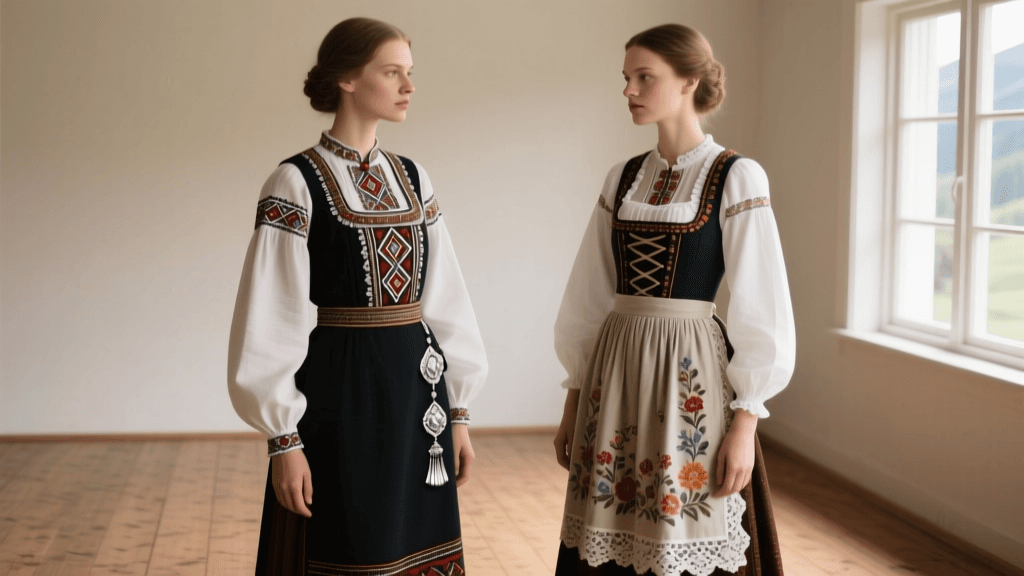
- Hardanger Bunad: Often considered the 'first' Bunad, originating from the Hardangerfjord region. It is characterized by its striking black wool base, vibrant cross-stitch embroidery in red, yellow, and green, and intricate white linen aprons featuring drawn-thread work (Hvitsaum).
- Setesdal Bunad: Recognizable by its dark, somber tones and extensive use of heavy silver filigree jewelry (sølje). The Setesdal tradition heavily incorporates woven bands and elaborate silver clasps that historically denoted the wearer's wealth and marital status.
- Telemark Bunad: Famous for its rich, dark blue or black wool and breathtaking rose-patterned embroidery (rosemaling) translated into textile form, often accented with vivid red and green yarns.
According to the Norsk Institutt for Bunad og Folkedrakt, the modern Bunad movement is deeply rooted in the early 20th-century national romanticism, but today's 2026 iterations emphasize sustainable, traceable supply chains, with artisans demanding ethically spun yarns and recycled silver for their metalwork.
The Austrian Dirndl and Alpine Tracht: Elegance in Motion
While the Bunad is steeped in rigid historical reconstruction, the Austrian Dirndl—and the broader category of Alpine Tracht—embraces a more fluid, fashion-forward evolution while maintaining its core structural elements. The Dirndl consists of four primary components: the bodice (Mieder), the blouse (Bluse), the full skirt (Rock), and the apron (Schürze). In 2026, the Dirndl has solidified its place not just as festival wear, but as a staple of high-end Alpine fashion.
Ausseer and Salzburg Styles
Regional variations of the Dirndl are heavily influenced by local geography, climate, and historical trade routes. The distinction between everyday workwear and festive Tracht remains a crucial element of Alpine dress culture.
- Ausseer Dirndl: Hailing from the Salzkammergut lake region, the Ausseer Dirndl is iconic for its specific color-blocking: a pink skirt, a green bodice, and a black apron. In 2026, master tailors in Bad Aussee continue to use traditional botanical dyes to achieve these exact, historically accurate hues, resisting the push for synthetic alternatives.
- Salzburg Festive Tracht: Characterized by luxurious fabrics such as silk brocade, velvet, and fine alpine linen. The Salzburg style often features a high, closed neckline for winter festivities and elaborate floral embroidery that reflects the region's botanical diversity.
The cultural significance of these garments is meticulously preserved by institutions like the Volkskundemuseum, which continues to document the socio-economic shifts in Alpine textile production. Contemporary designers are currently collaborating with these museums to integrate historical smocking techniques (Froschgoscherl) into modern, eco-friendly linen blends.
2026 Market Trends: Sustainability and Custom Tailoring
The European folk dress market in 2026 is defined by a fierce commitment to sustainability and artisanal craftsmanship. Mass-produced, synthetic 'costumes' are increasingly shunned by serious enthusiasts in favor of bespoke, locally manufactured garments. For the Norwegian Bunad, the use of GOTS-certified organic linens for undergarments and aprons has become the industry standard. Similarly, Austrian Tracht makers are pioneering the use of regenerative alpaca wool and peace silk for premium Dirndl bodices.
Pricing for authentic garments reflects this dedication to quality. A custom-fitted Bunad is considered a generational investment, often passed down through families, while a high-end Dirndl is viewed as a luxury wardrobe staple comparable to haute couture.
Comparative Analysis: Bunad vs. Dirndl
To understand the distinct characteristics of these two pillars of European folk dress, refer to the comparative data table below, updated with 2026 market metrics and cultural data.
| Feature | Norwegian Bunad | Austrian Dirndl |
|---|---|---|
| Origin Era | 19th-century rural revival | 16th-19th century Alpine workwear |
| Primary Materials | Heavy Spælsau wool, linen, silver | Cotton, alpine linen, silk, wool |
| Key Accessories | Sølje (silver filigree), woven belts | Schürze (apron), Charivari (chain) |
| 2026 Avg. Custom Cost | 50,000 - 75,000 NOK | 800 - 2,500 EUR |
| Regulation Level | Strict (Bunad- og Folkedraktrådet) | Fluid (Guided by regional customs) |
| Major 2026 Festivals | Syttende Mai (May 17) | Oktoberfest, Almabtrieb |
Sourcing Authentic Folk Dress in 2026
For those looking to acquire authentic European folk dress, knowing where to source garments is critical to avoiding culturally appropriative or historically inaccurate replicas.
Acquiring a Norwegian Bunad
Purchasing a Bunad requires engaging with certified dealers. The most reputable network of retailers is Husfliden, a cooperative of Norwegian craft associations. When commissioning a Bunad in 2026, expect a multi-step process: an initial consultation to determine your regional affiliation, precise bodily measurements (which dictate the pattern drafting), and multiple fittings. The silver jewelry, or sølje, is often purchased separately from specialized silversmiths in regions like Telemark or Hordaland. Be wary of online retailers offering 'ready-to-ship' Bunads at steep discounts; authentic garments are exclusively made-to-measure.
Acquiring an Austrian Dirndl
The market for Dirndls is more accessible, ranging from high-street boutiques in Munich and Salzburg to exclusive bespoke ateliers. For an authentic, investment-grade Dirndl, seek out established heritage brands such as Gössl or Tostmann Tracht. When purchasing, pay close attention to the apron (Schürze). In Alpine tradition, the placement of the apron bow communicates the wearer's relationship status: a bow on the left signifies the wearer is single, on the right indicates they are married or taken, in the center means virginity (traditionally), and at the back signifies widowhood. In 2026, bespoke ateliers are also offering modular Dirndls, where interchangeable bodices and skirts allow for multiple outfits from a single, sustainably produced base.
Conclusion: Preserving the Threads of History
Whether you are drawn to the rigid, silver-adorned majesty of the Norwegian Bunad or the elegant, adaptable charm of the Austrian Dirndl, both garments offer a profound connection to European heritage. In 2026, wearing these traditional costumes is an act of cultural preservation, a rejection of fast fashion, and a celebration of the master artisans who keep these ancient textile traditions alive. By investing in authentic, regionally accurate folk dress, you are not merely buying a garment; you are becoming a custodian of history.