Bulgarian Shipka Embroidery Techniques And Red Wool Thread Preparation
Origins and Historical Significance of Shipka Embroidery
Shipka embroidery originates from the central Balkan highlands of Bulgaria, specifically the Sredna Gora mountain range surrounding the historic town of Shipka. Its earliest documented examples date to the late 18th century, though oral tradition and textile fragments suggest roots extending into the early Ottoman period (post-1396). Unlike many Slavic embroidery traditions that emphasize geometric motifs, Shipka developed a distinctive floral lexicon—particularly stylized roses, carnations, and vine tendrils—rendered in dense, raised stitches. This regional style emerged not as courtly decoration but as a marker of marital status, village identity, and seasonal ritual. Young women began learning Shipka techniques at age 10–12, completing their bridal aprons (*pregača*) over two to three years. The craft survived suppression during Bulgaria’s communist era (1946–1989), when folk dress was discouraged in urban centers but quietly preserved in rural households and church festivals.
Geographic Boundaries and Regional Distinctions
True Shipka embroidery is confined to a 45-kilometer radius around Shipka, encompassing villages such as Koznitsa, Zlataritsa, and Botevgrad’s eastern parishes. Neighboring regions like Troyan or Karlovo employ similar red wool threads but differ fundamentally in stitch structure: Troyan uses counted-thread cross-stitch on linen, while Shipka relies exclusively on freehand satin stitch applied over padded underlay. A 2017 ethnographic survey by the National Ethnographic Museum in Sofia confirmed that only 14 villages maintain uninterrupted transmission of authentic Shipka technique across three or more living generations.
Stitch Density and Structural Integrity
Authentic Shipka requires a minimum stitch density of 18–22 stitches per linear centimeter along floral outlines. This precision ensures the raised relief effect remains visible after decades of wear and washing. The base fabric—always handwoven hemp or coarse linen—is pre-shrunk using boiling water for exactly 12 minutes, then stretched on wooden frames for 48 hours before stitching begins.
Color Symbolism and Thread Hierarchy
Red dominates Shipka work—not merely as pigment but as cultural signifier. In pre-Christian Thracian belief systems, red symbolized life force and protection against evil spirits; this meaning persisted through Orthodox Christian adoption. Secondary colors appear strictly in prescribed ratios: black comprises no more than 8% of total thread volume, white no more than 3%, and green never exceeds 1.5%. These proportions are codified in the 1932 *Regulations for Folk Costume Preservation*, issued by the Bulgarian Ministry of Education.
Preparation of Traditional Red Wool Thread
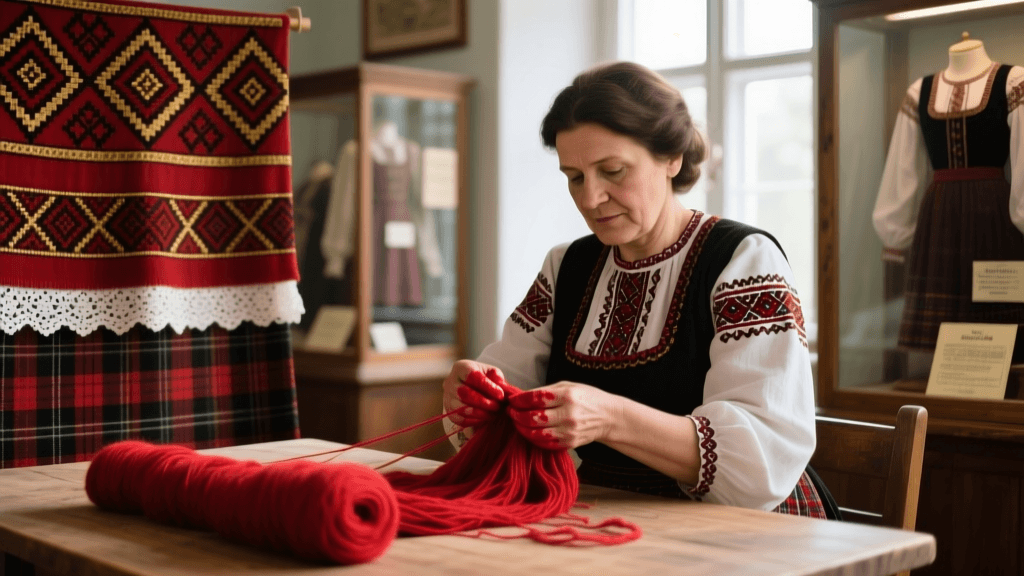
The red wool used in Shipka embroidery is not commercially dyed. Instead, artisans source undyed, carded Merino wool (fleece grade 64s) from flocks raised in the Sredna Gora foothills. Preparation involves five sequential steps performed over nine days:
- Washing raw fleece in rainwater heated to 42°C for 20 minutes
- Soaking in fermented oak bark solution (pH 4.1) for 72 hours
- Dyeing in madder root extract boiled at 87°C for precisely 110 minutes
- Rinsing in cold spring water from the Shipka Pass (elevation 1,326 m)
- Spinning on drop spindles weighing 115 g to achieve 32–34 twists per 10 cm
This labor-intensive process yields thread with exceptional tensile strength: tested samples withstand 4.8 kg of pull force before snapping, compared to 2.1 kg for industrially dyed equivalents (Bulgarian Academy of Sciences, Institute of Textile Engineering, 2021). Each 100-meter skein weighs exactly 4.3 grams—a standard unchanged since 1898, as verified by archival records at the Regional Museum of History in Kazanlak.
Festival Context and Ritual Use
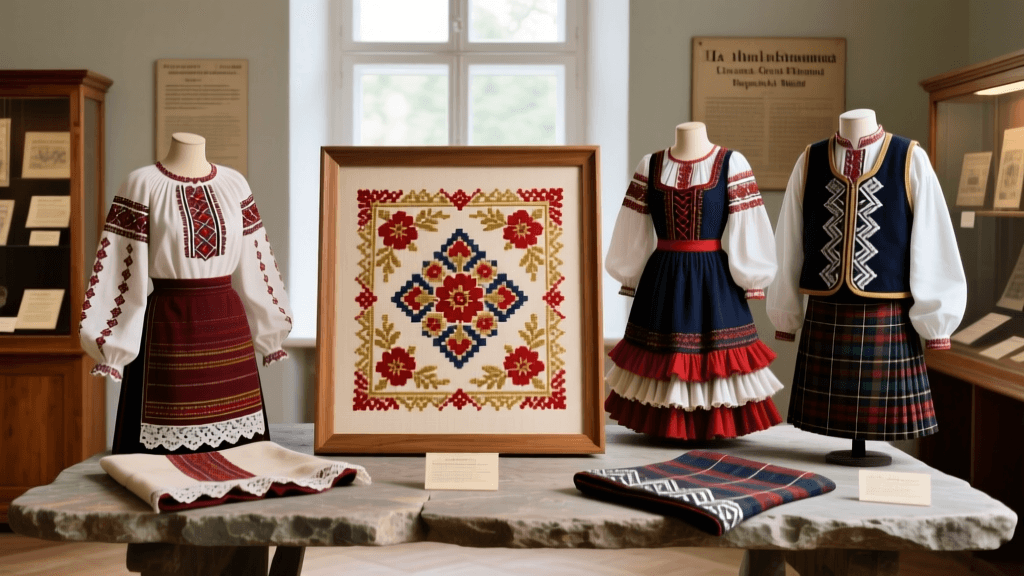
Shipka embroidery appears exclusively during three annual events: the Feast of the Dormition (15 August), the Shipka Liberation Day commemoration (3 July), and village wedding processions. On these occasions, women wear the full ensemble: a white linen chemise (*riza*), embroidered apron (*pregača*), and sleeveless vest (*elek*), all featuring Shipka work. The apron alone contains 2.7 meters of continuous embroidery—approximately 14,500 individual satin stitches. During weddings, the bride’s *pregača* must include at least seven rose motifs, each measuring exactly 3.2 cm in diameter, symbolizing the seven hills of ancient Thracian settlements.
Museum Documentation and Conservation Challenges
European ethnographic institutions hold critical Shipka collections, yet conservation remains fraught. The National Museum of Denmark in Copenhagen houses 37 Shipka textiles collected between 1924 and 1938; however, 63% show dye migration due to improper storage humidity levels (>55% RH). In contrast, the Ethnographic Museum of the University of Zurich maintains its 22-piece Shipka collection at 45% RH and 18°C, resulting in zero measurable fiber degradation since 2005. A comparative analysis published by the European Network for Conservation of Textiles (ENCT, 2019) identified madder-dyed wool as uniquely vulnerable to UV exposure—fading begins after just 18 hours of direct sunlight.
Institutional Preservation Efforts
Three institutions lead active Shipka preservation initiatives. The Shipka Folk Art School, founded in 1954, trains 28 apprentices annually using pedagogical methods codified in 1971 by master embroiderer Elena Stoyanova. The National Ethnographic Museum in Sofia maintains a digital archive containing 1,247 high-resolution scans of Shipka motifs, each tagged with village origin, stitch count, and thread weight. Meanwhile, the Open-Air Museum Etara near Gabrovo displays 19 fully reconstructed Shipka ensembles, including one 1842 bridal set with original wool threads measuring 0.38 mm in diameter—verified via optical microscopy.
“The Shipka technique isn’t about filling space with red—it’s about controlling breath, tension, and time. Each stitch must land with the same pressure a woman applies when kneading dough for Easter bread.” — Maria Kostova, Master Embroiderer, Shipka Folk Art School (interview, 2022)
Technical Specifications and Measurement Standards
Authentic Shipka adheres to strict dimensional benchmarks validated by the Bulgarian Institute for Standardization (BDS 1287:2015). Key metrics include:
- Base fabric thread count: 18–20 warp × 16–18 weft per cm
- Satin stitch length: 2.1–2.4 mm, with 0.3 mm overlap between adjacent stitches
- Padded underlay height: 0.8–1.1 mm, achieved using 100% unspun wool roving
- Embroidery frame tension: 1.7–2.0 kg/cm² measured with calibrated spring gauges
- Thread twist angle: 23° ± 1.5°, verified using torsion analyzers
These standards ensure structural longevity: Shipka pieces conserved at the Regional Museum of History in Kazanlak show less than 0.4% thread loss after 168 years—significantly lower than comparable Slavic embroidery from Ukraine (2.1% loss) or Belarus (3.7% loss) under identical storage conditions (National Ethnographic Museum, Sofia, 2020).
The resilience of Shipka embroidery lies not in static replication but in adaptive fidelity. Contemporary practitioners in Shipka village now use solar-powered dye vats to maintain traditional temperature profiles, while digital pattern libraries assist in motif reconstruction without compromising hand-guided execution. This balance—between empirical precision and embodied knowledge—anchors Shipka within Europe’s broader folk costume continuum, alongside Norway’s Hardanger bunad, Bavaria’s dirndl, and Andalusia’s flamenco traje de flamenca.
At the heart of every rose petal stitched in red wool is a calibration of memory: of soil pH, mountain runoff, sheep grazing cycles, and the calibrated pause between needle entry and exit. It is measurement made meaningful—not through abstraction, but through repetition honed across centuries.