Authentic Oaxacan Zapotec Huipils: 2026 Buying Guide
The Enduring Legacy of the Zapotec Huipil in 2026
The traditional Oaxacan huipil is far more than a simple piece of clothing; it is a wearable codex, a geographic identifier, and a profound expression of indigenous cosmology. As we navigate the global textile market in 2026, the intersection of high fashion and indigenous intellectual property has never been more critical. Following the strengthening of Mexico's federal cultural heritage protection laws, the demand for authentic, ethically sourced Zapotec garments has surged. However, this surge has also brought an influx of mass-produced imitations that threaten the livelihoods of master weavers. For collectors, cultural enthusiasts, and ethical fashion consumers, understanding the intricate anatomy of a genuine Zapotec huipil is essential. This comprehensive 2026 sourcing guide will equip you with the technical knowledge required to distinguish authentic backstrap loom masterpieces from commercial knockoffs, ensuring your investment directly supports the artisans preserving this ancient craft.
The Cultural Codex: Reading the Garment
Before evaluating the physical construction of a huipil, one must understand its cultural weight. In Zapotec communities across Oaxaca, particularly in regions like the Isthmus of Tehuantepec and the Sierra Norte, the motifs woven into the fabric serve as a visual language. Diamonds often represent the cosmos and the four cardinal directions, while stylized flora and fauna reflect the local biodiversity. In 2026, cultural appropriation remains a significant issue, making it vital to purchase garments that respect and accurately represent their communities of origin. Advocacy organizations like Fashion Revolution Mexico continue to campaign for transparency, urging buyers to demand proof of origin and fair compensation rather than purchasing uncredited, factory-made replicas sold by fast-fashion conglomerates.
Anatomy of an Authentic Piece: Fibers and Natural Dyes
The foundation of any premium Zapotec textile lies in its raw materials. Authentic huipils are traditionally woven using native cotton varieties or, for ceremonial garments, artisanal silk. The most prized cotton is algodón coyuche, a naturally brown, drought-resistant cotton that requires no chemical dyeing. Its earthy tone provides a stunning, organic base that contrasts beautifully with vibrantly dyed supplementary weft threads. White native cotton (algodón blanco) is also heavily utilized, prized for its soft hand-feel and breathability in Oaxaca's warm climate.
The dyeing process is where the true mastery of the artisan shines. In 2026, master dyers continue to rely on centuries-old botanical and entomological recipes, avoiding harsh synthetic aniline dyes that degrade quickly and pollute local waterways.
- Cochineal (Dactylopius coccus): This parasitic insect, native to the Oaxacan nopales cacti, is the source of the region's legendary reds. By manipulating the pH levels during the mordanting process—adding acidic lime juice to yield bright oranges, or alkaline wood ash to produce deep purples and maroons—artisans extract a breathtaking spectrum from a single source.
- Indigo (Añil): Cultivated and fermented in clay vats, natural indigo provides rich, colorfast blues. The fermentation process requires immense skill to maintain the correct alkalinity and reduction state, a closely guarded secret passed down through generations.
- Marigold (Cempasúchil) and Pecan Shells: Used to achieve warm yellows, ochres, and deep, earthy browns, these plant-based dyes give the textiles a distinct, organic aroma and a soft, matte finish that synthetics simply cannot replicate.
Institutions such as the Museo Textil de Oaxaca play a pivotal role in preserving these natural dyeing techniques, offering workshops and maintaining archives that help buyers and researchers identify authentic botanical color palettes.
The Backstrap Loom: Identifying the Technique
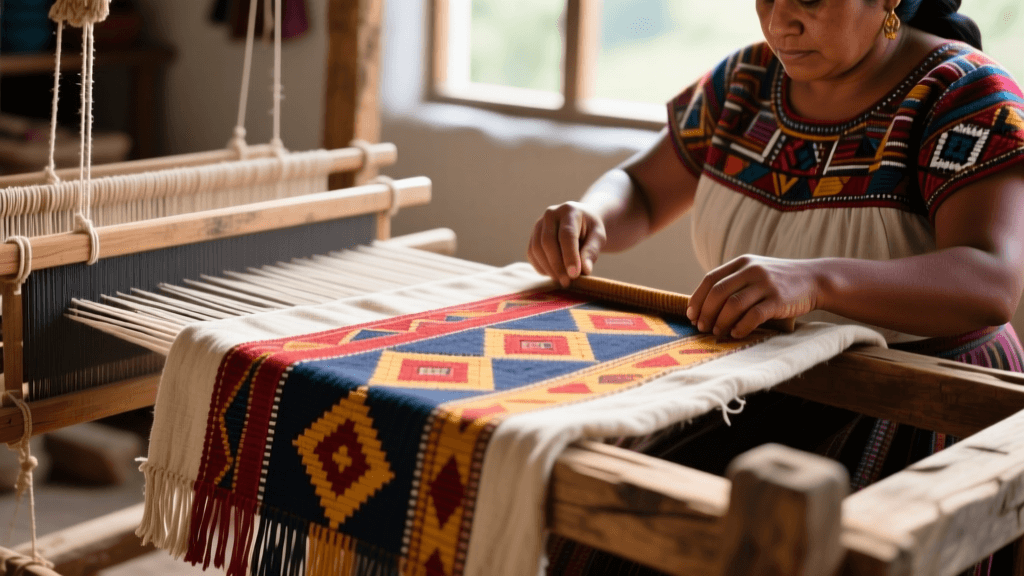
The most critical factor in authenticating a high-end Zapotec huipil is identifying the loom on which it was woven. While pedal looms (introduced by the Spanish) are excellent for producing wide yardage like rugs and blankets, the traditional huipil is woven on a telar de cintura, or backstrap loom. This pre-Hispanic technology relies on the weaver's own body weight to create warp tension. One end of the loom is tied to a sturdy post or tree, while the other is secured around the weaver's lower back via a leather or wooden strap.
Because the width of the fabric is limited by the reach of the weaver's arms, backstrap loom textiles are inherently narrow, typically measuring between 14 and 20 inches wide. To create a full-sized huipil, the artisan must weave two or three separate panels and join them together. When examining a garment, look for the following technical markers of a backstrap loom:
- Intact Selvedges: The side edges of the fabric should be naturally finished by the continuous turning of the weft thread. If you see cut edges that have been hemmed or serged with a machine, it is not a traditional backstrap textile.
- Dense Warp Tension: The structural threads (warp) are pulled incredibly tight, resulting in a dense, durable fabric with a distinct ribbed texture.
- Supplementary Weft Brocade: The intricate patterns are not embroidered on top of the fabric; they are woven directly into the cloth using a secondary thread (supplementary weft) that floats over and under the warp threads, creating a design that is often reversible or has a distinct, tidy underside.
The Randa: The Art of the Join
When the narrow panels are assembled, they are joined using a decorative, hand-stitched seam known as a randa. In authentic 2026 pieces, this joining is a celebrated design element rather than a hidden structural necessity. Artisans use complex, lace-like embroidery stitches—often in contrasting silk or cotton threads—to bind the panels. The randa requires exceptional needlework skill and can take several days to complete on a single garment. Mass-produced imitations typically skip this step entirely, opting to cut wide fabric from a bolt and simply hemming the sides.
2026 Pricing Guide: Valuing Authentic Artisan Labor
Understanding the fair market value of these textiles is crucial for ethical sourcing. A genuine backstrap loom huipil dyed with natural materials represents hundreds of hours of labor, from ginning and spinning the cotton to foraging for dyes and executing the complex brocade patterns. Below is a comparative pricing table reflecting the 2026 market rates for ethical direct-to-artisan purchases versus commercial alternatives.
| Garment Category | Production Method | Materials & Dyes | Estimated 2026 Price (USD) | Artisan Compensation |
|---|---|---|---|---|
| Fast-Fashion Replica | Power Loom / Machine Embroidery | Polyester Blends / Aniline Dyes | $25 - $60 | Exploitative / Wage Theft |
| Workshop Commercial | Pedal Loom / Hand-Finished | Commercial Cotton / Mixed Dyes | $80 - $150 | Fair Hourly Wage |
| Authentic Everyday Huipil | Backstrap Loom / Brocade | Native Cotton / Cochineal & Indigo | $250 - $450 | Direct Fair Trade Premium |
| Ceremonial Masterpiece | Backstrap Loom / Silk & Cotton | Hand-spun Silk / Complex Natural Dyes | $600 - $1,500+ | Master Artisan Premium |
When purchasing in the $250 to $1,500 range, you are not merely buying a garment; you are funding the intergenerational transfer of indigenous knowledge and ensuring the economic sovereignty of Zapotec women.
Red Flags: Spotting Cultural Appropriation and Knockoffs
As the aesthetic of Oaxacan textiles has gained global popularity, the market has been flooded with deceptive imitations. To protect your investment and respect the culture, be vigilant for these common red flags when shopping in 2026:
- Overlocked Edges: If the side seams feature machine serging (overlock stitching) and have been folded and hemmed, the fabric was cut from a wide power-loom bolt, not woven on a backstrap loom.
- Synthetic Sheen and Uniformity: Authentic native cotton has a matte, slightly irregular texture. If the fabric possesses a high, plastic-like sheen and the colors are unnaturally uniform, it is likely spun polyester dyed with harsh chemicals.
- Embroidery vs. Brocade: Inspect the reverse side of the pattern. If the design is created by thousands of messy, overlapping stitches on the back, it is machine or hand-embroidery applied after the fact. True Zapotec brocade is integrated into the weave, meaning the back of the fabric will look remarkably neat, often appearing as a negative image of the front.
- Vendor Evasiveness: Ethical sellers will proudly name the specific community (e.g., Teotitlán del Valle, San Bartolo Yautepec, Santo Tomás Jalieza) and, whenever possible, the name of the artisan or cooperative. If a vendor cannot provide this provenance, walk away.
Ethical Sourcing Channels in 2026
The most secure way to acquire an authentic Zapotec huipil is to purchase directly from artisan cooperatives or through verified fair-trade platforms that enforce strict labor and cultural standards. Organizations like Nest provide rigorous certification for artisan businesses, ensuring that the supply chain is transparent, environmentally sustainable, and free from exploitative middlemen. Additionally, planning a direct visit to the weaving cooperatives in Oaxaca's Central Valleys remains the most rewarding method of acquisition, allowing you to witness the rhythmic clatter of the wooden batten and the meticulous dyeing processes firsthand. By prioritizing these ethical channels, collectors and consumers alike play an active role in safeguarding the magnificent textile heritage of the Zapotec people for generations to come.