2026 Guide to Draping the Greek Chiton & Roman Stola
The Enduring Legacy of Classical Draping in 2026
As we navigate the 2026 historical reenactment season and the broader slow-fashion movement, the appeal of ancient Mediterranean garments has never been stronger. Unlike modern tailored clothing, which relies on complex pattern cutting and sewn seams to achieve a fit, the traditional garments of ancient Greece and Rome were masterclasses in textile manipulation. The chiton, the peplos, and the Roman stola were essentially large, rectangular pieces of woven fabric brought to life through strategic folding, pinning, and belting. For contemporary makers, historians, and costume enthusiasts, mastering these draping techniques offers a profound connection to European antiquity while championing zero-waste, sustainable wardrobe practices.
In this comprehensive guide, we will explore the structural differences between the primary garments of the classical world, provide a 2026 fabric sourcing guide for historical accuracy, and offer step-by-step draping instructions to help you recreate these iconic silhouettes with authenticity and elegance.
Understanding the Greek Chiton: Doric vs. Ionic
The foundation of the ancient Greek wardrobe was the chiton, a versatile tunic worn by both men and women, though the length and draping styles varied significantly by gender, age, and region. According to the World History Encyclopedia, the evolution of the chiton reflects broader cultural shifts in the Mediterranean, transitioning from heavy, structured wools to lighter, more fluid linens as trade routes expanded.
The Doric Chiton (Peplos)
The Doric chiton, more commonly known as the peplos, was the quintessential garment of early classical Greece. It was constructed from a single, large rectangular piece of heavy wool. The defining feature of the peplos is the apoptygma—an overfold created by folding the top edge of the fabric down to the waist before draping it around the body. The garment was left open on one side (usually the left) and fastened at the shoulders with large, ornate pins called fibulae. Because wool holds its shape well, the peplos offered a structured, columnar silhouette that is frequently depicted in marble statues of the Archaic and early Classical periods.
The Ionic Chiton
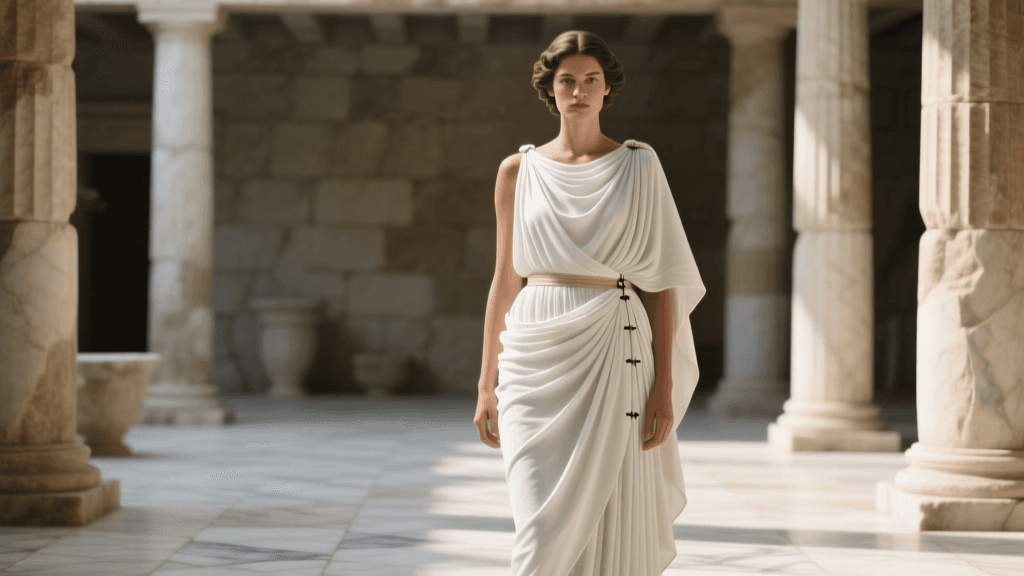
By the 5th century BCE, the Ionic chiton gained prominence. Woven from lightweight linen, the Ionic chiton was significantly wider than the peplos. Instead of a simple overfold and shoulder pins, the wide fabric was gathered and pinned at multiple points along the arms, creating the illusion of short sleeves. The excess fabric was then cinched at the waist or under the bust with a belt, and the fabric was bloused over the belt to create a kolpos (a draped pouch effect). This style allowed for greater freedom of movement and a more fluid, elegant drape that became synonymous with the Hellenistic era.
The Roman Stola and Palla: Matronly Elegance
While Roman men are most famously associated with the toga, the toga was a heavy, cumbersome, and exclusively male garment of citizenship. For Roman women, the equivalent markers of status and modesty were the stola and the palla. As detailed by the World History Encyclopedia, Roman dress was deeply codified, and a woman's garments communicated her marital status, wealth, and moral standing to the public.
The Stola
The stola was a long, sleeveless overdress worn over a base layer called the tunica intima. It was the ultimate symbol of the matrona (a respectable married Roman woman). The stola was typically suspended from the shoulders by short straps or fibulae and gathered at the waist. The most critical identifying feature of the stola was the instita—a decorative, often contrasting band of fabric or embroidery sewn to the lower hem. In 2026, modern textile artists recreating the stola often use tablet-woven trims or natural-dye resist techniques to replicate the authentic look of the instita, which historically signaled the wearer's wealth and adherence to traditional Roman virtues.
The Palla
When stepping outside the domus (home), a Roman woman would drape a palla over her stola. The palla was a large, rectangular shawl, similar to the Greek himation. It could be draped over the shoulders, wrapped around the waist, or pulled up over the head as a veil when passing through sacred spaces or public forums. The draping of the palla required constant adjustment and a graceful posture, serving as a physical manifestation of Roman decorum.
2026 Fabric Sourcing Guide for Historical Accuracy
Achieving an authentic drape relies entirely on selecting the correct textile. Synthetic blends, which dominated the costume market in the early 2020s, have been largely rejected by the 2026 reenactment community in favor of breathable, historically accurate natural fibers. Here is what you need to look for when sourcing materials this year:
- For the Ionic Chiton and Stola (Linen): Seek out 100% European Flax-certified linen. For a fluid drape that mimics ancient Hellenistic and Roman styles, choose a lightweight to medium-weight linen (3.5 oz to 4.5 oz per square yard). Heavier linens (5.3 oz) will stand away from the body and ruin the kolpos blousing effect.
- For the Doric Peplos (Wool): You need a lightweight, tightly woven tropical wool or a finely fulled melton. The fabric must be able to hold a sharp crease for the apoptygma without adding excessive bulk at the shoulder pins. Avoid thick, hairy craft wools, which are historically inaccurate for fine garments and uncomfortable for modern wearers.
- Dimensions: Do not cut your fabric to a specific body-conforming pattern. The beauty of classical dress is its adaptability. A standard Ionic chiton requires a rectangle of fabric that is at least 1.5 to 2 times your widest body measurement (usually the hips or bust) in width, and your height plus 12 inches for the blousing and hem allowance in length.
Step-by-Step Draping: The Ionic Chiton
Follow these actionable steps to drape an authentic Ionic chiton. You will need a wide rectangle of lightweight linen, a woven belt or cord, and several small safety pins or replica fibulae.
- Prepare the Fabric: Lay your linen rectangle flat. If the width is more than twice your body width, fold the excess inward at the sides so the total width is roughly equal to your arm span from elbow to elbow.
- Shoulder Fastening: Bring the top corners of the front and back panels together at your collarbones. Pin them securely. For a more elaborate sleeve effect, pinch and pin the fabric at three or four intervals along your upper arms, stopping before you reach the elbow.
- The First Belt (Waist): Wrap your belt around your natural waist, catching both the front and back panels. Pull the fabric up and over the belt to create the first bloused fold (kolpos). Ensure the hem falls to your ankles.
- The Second Belt (Optional Empire Waist): For a high-waisted Hellenistic look, tie a second, decorative cord just under the bust. Pull more fabric up over this second belt to deepen the kolpos and adjust the tension across the chest.
- Adjust the Neckline: Gently pull the fabric between the shoulder pins to widen the neckline into a graceful boat-neck shape. Adjust the blousing so it falls evenly around your torso.
Comparative Analysis of Classical Garments
To help you choose the right garment for your specific historical impression or theatrical production, consult the comparison table below.
| Garment | Primary Era & Culture | Standard Material | Key Structural Feature | Primary Wearer |
|---|---|---|---|---|
| Doric Peplos | Archaic/Classical Greece | Heavy Wool | Apoptygma (top overfold) | Women |
| Ionic Chiton | Classical/Hellenistic Greece | Lightweight Linen | Multiple arm pins, Kolpos blousing | Men and Women |
| Roman Stola | Roman Republic & Empire | Linen or Fine Wool | Instita (decorative hem band) | Married Women (Matronae) |
| Himation / Palla | Greek / Roman | Wool or Linen Blend | Unpinned, complex wrapped draping | Men (Himation) / Women (Palla) |
Accessories and Footwear: Completing the 2026 Silhouette
A chiton or stola is only half the equation. To achieve a fully realized classical silhouette, you must incorporate the correct accessories. In ancient Greece, the krepis (a leather sandal with a woven thong pattern) was the standard footwear. For 2026 reenactors, sourcing vegetable-tanned leather sandals with hand-woven uppers is highly recommended over mass-produced synthetic gladiator sandals, which lack the correct structural tension and historical patina.
Jewelry also played a vital role. Greek women favored intricate gold hairnets, diadems, and drop earrings featuring granulation techniques. Roman matrons often wore heavy gold necklaces, cameos, and signet rings. When styling your hair, avoid modern center-parts and synthetic hairsprays. Opt for the classical nodus hairstyle (a rolled braid at the front of the head popular in the Augustan era) or a simple low chignon secured with carved bone or wooden hairpins, which are widely available from specialized historical artisans today.
Maintenance and Care for Natural Fibers
Caring for un-tailored, voluminous natural fibers requires specific attention. Linen chitons should be hand-washed or machine-washed on a delicate cycle with cold water and a pH-neutral detergent to preserve the integrity of the flax fibers. Avoid the tumble dryer; instead, line-dry your linen in the shade. The natural stiffness of line-dried linen will soften beautifully against the warmth of your body once draped. Wool peplos garments should be spot-cleaned or dry-cleaned to prevent felting and shrinkage. Always store your draped garments flat or loosely rolled; hanging heavy wool for long periods can distort the weave and stretch the shoulder points where the fibulae bear the weight of the fabric.
Conclusion
The revival of ancient Greek and Roman dress in 2026 is more than a trend; it is a celebration of sustainable, zero-waste fashion and a deep appreciation for textile artistry. By understanding the distinct mechanics of the Doric peplos, the fluid elegance of the Ionic chiton, and the societal weight of the Roman stola, you can step into the classical world with confidence and historical integrity. Whether you are preparing for a museum demonstration, a theatrical production, or simply integrating classical draping into your modern slow-fashion wardrobe, the timeless geometry of these garments continues to inspire and endure.