The 2026 Guide to Authentic Chiton and Roman Stola Draping
The Revival of Classical Mediterranean Garments in 2026
As we navigate the historical reenactment and museum exhibition landscape of 2026, the demand for absolute authenticity in ancient European folk dress and classical garments has never been higher. Gone are the days of relying on synthetic costume satins and inaccurate, machine-stitched hems. Today’s dedicated Hellenic and Roman reenactors, as well as theatrical costumers, prioritize historically accurate draping, sustainable textile sourcing, and artisan-crafted accessories. Whether you are preparing for a major classical antiquity festival this summer or designing for a historically informed stage production, mastering the chiton, peplos, and Roman stola is essential. This comprehensive guide explores the construction, draping techniques, and material requirements for ancient Greek and Roman garments, ensuring your 2026 wardrobe meets the highest standards of historical accuracy.
The Doric Chiton (Peplos): Heavy Wool and Structured Draping
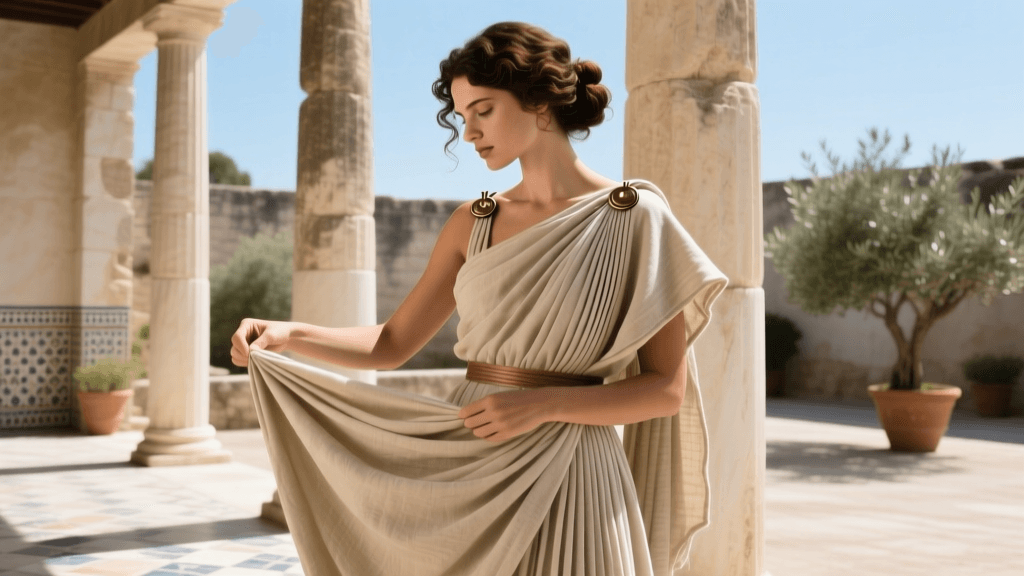
The Doric chiton, often referred to as the peplos when worn by women, is the quintessential garment of early classical Greece. According to the Metropolitan Museum of Art's Heilbrunn Timeline of Art History, the peplos was traditionally a heavy, rectangular woolen cloth that provided both warmth and a striking, structured silhouette. Unlike later garments that required complex sewing, the Doric chiton relied entirely on the art of draping, secured at the shoulders by heavy fibulae (brooches) and belted at the waist.
For modern reconstructions in 2026, sourcing the correct wool is paramount. You must avoid modern suiting wools, which are often tightly woven and lack the necessary drape. Instead, seek out lightweight worsted wools or open-weave wool challis (approximately 7 to 9 ounces per square yard). The natural elasticity and matte finish of these historically accurate wools allow the fabric to cling and fold in the fluted columns characteristic of classical Greek statuary. The defining feature of the Doric chiton is the apoptygma—an intentional overfold at the top of the garment that drapes over the chest and back, providing extra warmth and creating a visually complex, layered bodice effect.
The Ionic Chiton: Lightweight Linen and Flowing Sleeves
Emerging later and heavily influenced by Eastern Mediterranean and Anatolian textile traditions, the Ionic chiton represents a shift toward lighter, more voluminous fabrics. As detailed by the World History Encyclopedia, the Ionic chiton was typically crafted from linen or, in rare luxury cases, imported silk and fine cotton. It was significantly wider than its Doric counterpart, utilizing the excess fabric to create intricate, pleated sleeves that ran down the arms.
To recreate an Ionic chiton for contemporary wear, you will need high-quality, medium-weight European flax linen (around 5.3 to 6 ounces per square yard). The linen must be pre-washed and softened to remove modern factory stiffeners, allowing it to drape fluidly over the body. Instead of a single overfold, the Ionic chiton is pinned at multiple intervals along the upper arms, creating a series of delicate, butterfly-like sleeves. In 2026, many artisans are using lost-wax cast bronze replicas of ancient Greek straight pins to secure these sleeves, ensuring that even the functional hardware matches museum-grade artifacts.
Comparison: Doric vs. Ionic Chiton
| Feature | Doric Chiton (Peplos) | Ionic Chiton |
|---|---|---|
| Primary Material | Lightweight Wool / Wool Challis | Medium-weight Linen / Fine Cotton |
| Silhouette | Structured, columnar, heavy folds | Flowing, voluminous, pleated sleeves |
| Shoulder Fastening | Two large fibulae (brooches) | Multiple small pins or buttons along the arm |
| Overfold (Apoptygma) | Yes, prominent chest/back drape | Rarely used, or very shallow |
| Historical Era | Archaic to Early Classical (c. 600–450 BCE) | Classical to Hellenistic (c. 500–100 BCE) |
Roman Adaptations: The Stola and the Toga
When transitioning from Greek to Roman traditions, the fundamental philosophy of draped garments remained, but the social signaling became far more complex. The Roman stola was the traditional, legally protected garment of the matrona (married Roman woman). Worn over a base tunic (tunica interior), the stola was characterized by its instita—a decorative, often contrasting border or flounce at the hem that signaled the wearer's respectable social status. For 2026 historical interpreters, adding a properly woven tablet-woven wool band to the hem of a linen stola is a critical detail that separates amateur costumes from professional-grade reconstructions.
Meanwhile, the Roman toga remains one of the most notoriously difficult garments to drape correctly. Far from the simple semi-circle often depicted in mid-century cinema, the Imperial toga was a massive, complex elliptical or deeply curved piece of heavy, fulled wool that could measure up to 18 feet in length. The World History Encyclopedia's guide to Roman Clothing emphasizes that the toga was not merely wrapped; it was carefully sculpted to create the sinus (a deep, sweeping pouch across the chest) and the umbo (a decorative knot or fold at the center). Modern reenactors often use hidden, historically plausible linen ties or internal stitching (a debated but practical compromise for modern movement) to maintain the structural integrity of the sinus during active interpretation.
Step-by-Step Draping Guide: The Doric Chiton
Mastering the drape of the Doric chiton requires precise measurements and an understanding of how gravity interacts with woven wool. Follow these steps for a historically accurate fit:
- Cut the Fabric: Measure the wearer’s wingspan (fingertip to fingertip with arms outstretched). Add 12 to 18 inches to this measurement for the width. For the length, measure from the shoulder to the floor, and add 12 inches to accommodate the overfold and blousing.
- Create the Overfold: Fold the top edge of the fabric down by 10 to 12 inches. This creates the apoptygma. The fold should face outward.
- Wrap the Body: Wrap the fabric around the wearer’s body, ensuring the open edge falls on the left side. While Spartan women famously wore the right side open for mobility, Athenian modesty norms generally dictated a closed side; a fully closed or pinned side is safer and more appropriate for modern public events and museum settings.
- Pin the Shoulders: Gather the front and back layers (including the overfold) at the shoulders, roughly halfway between the neck and the shoulder joint. Secure them with heavy, historically accurate bronze or iron fibulae.
- Belt and Blouse: Tie a woven wool or leather zone (belt) around the natural waist or under the bust. Pull the fabric up and over the belt to create a bloused effect (kolpos), which adjusts the hemline to the ankles and creates a secondary draped fold.
Sourcing Authentic Materials and Accessories for 2026
The landscape of historical costuming has evolved significantly. In 2026, the most dedicated artisans are turning away from mass-market costume shops and instead collaborating with specialized heritage weavers. For linen, look for suppliers offering dew-retted European flax, which provides the uneven slubs and natural beige tones seen in surviving archaeological textiles. For wool, small-batch breeders offering naturally dyed merino or Romney fleeces—colored with madder root, weld, or woad—provide the vibrant, colorfast hues favored by the ancient elite.
Accessories are equally vital. The fibulae used to pin a chiton or stola must be functional, not merely decorative. Modern safety pins will slip and ruin the drape. Invest in artisan-crafted penannular brooches or straight pins with tension-coiled springs, which grip the heavy wool securely. Many 2026 jewelers specializing in antiquity replicas now utilize 3D scanning of museum artifacts to cast perfectly balanced bronze fibulae that function exactly as their ancient counterparts did. Footwear should consist of leather krepides (Greek sandals) or Roman caligae, featuring vegetable-tanned leather soles and rawhide lacing. By prioritizing these authentic materials and precise draping techniques, your classical Mediterranean wardrobe will not only honor the rich textile traditions of antiquity but also stand as a benchmark for historical accuracy in the modern era.