Silk Road Astana Textiles: 2026 Weave Analysis Guide
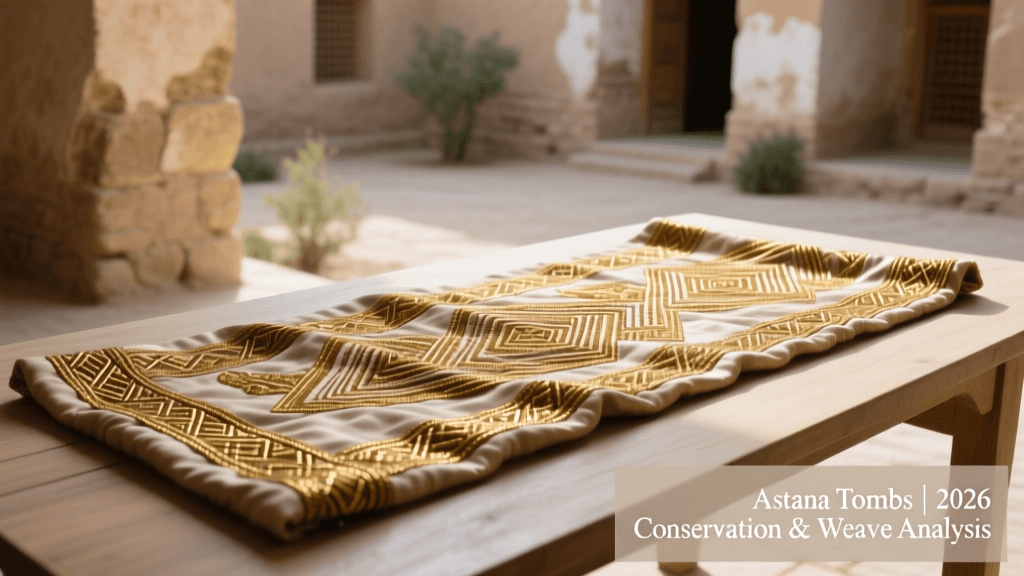
The Astana Tombs: A Time Capsule of Silk Road Exchanges
The Astana Tombs, located in the Turpan Depression of Xinjiang, China, represent one of the most significant archaeological sites for understanding the material culture of the ancient Silk Road. Due to the region's exceptionally arid climate, organic materials that would have decomposed elsewhere have been preserved in remarkable condition. For textile historians, archaeologists, and fashion designers in 2026, the Astana finds offer an unparalleled window into the complex web of trans-Eurasian exchanges. The textiles recovered here are not merely local artifacts; they are physical manifestations of a globalized ancient economy, showcasing a blend of Chinese, Sogdian, Sasanian Persian, and Hellenistic influences.
According to the UNESCO Silk Roads Programme, the movement of textiles along these routes was instrumental in the cross-pollination of weaving technologies and aesthetic motifs. As we advance through 2026, new conservation technologies and digital reconstruction methods have allowed researchers to analyze these fragile garments without causing physical degradation, revealing secrets about ancient loom mechanics, dye chemistry, and trade networks that were previously obscured by time.
The Sogdian Samite: Masterpieces of Weft-Faced Compound Twill
Among the most celebrated finds at Astana are the Sogdian samites. Samite is a luxurious, weft-faced compound twill silk that was highly prized across the ancient world. The Sogdians, an Eastern Iranian people who acted as the primary merchants of the Silk Road, were instrumental in disseminating these textiles. The Metropolitan Museum of Art's Heilbrunn Timeline of Art History notes that Sogdian weavers were masters of adapting foreign motifs to suit the tastes of diverse markets, from the Tang Dynasty elite to the Byzantine aristocracy.
The defining characteristic of the Astana Sogdian silks is the use of the 'pearl roundel' motif. These circular borders, composed of overlapping pearls or dots, often enclose confronting animals, mythological beasts like the senmurv (a bird-dog hybrid), or boar heads. The pearl roundel is a direct borrowing from Sasanian Persian art, adapted by Sogdian weavers who utilized Chinese silk threads to execute the designs. Analyzing the weave structure of these samites reveals a complex interplay of main warps, binding warps, and multiple weft colors, requiring a highly sophisticated drawloom to produce.
2026 Advancements in Non-Destructive Textile Conservation
The fragile nature of millennium-old silk necessitates extreme caution during analysis. In 2026, the standard for archaeological textile study has shifted entirely to non-destructive testing (NDT) methodologies. Conservators now rely on advanced macro-X-ray fluorescence (Macro-XRF) and multispectral imaging to map the elemental composition of dyes and mordants without extracting physical samples.
Multispectral Imaging and AI Weave Mapping
One of the most significant breakthroughs in 2026 is the integration of AI-assisted photogrammetry for weave mapping. By capturing high-resolution multispectral images of a textile fragment, machine learning algorithms can now trace the path of individual warp and weft threads, even when the silk is heavily degraded or encrusted with burial soils. This technology allows researchers to generate precise 3D digital twins of the textile's structure. These digital models can then be fed directly into modern digital Jacquard looms to create exact structural replicas, a process that aids immensely in understanding the drape, weight, and tensile strength of the original garments.
Decoding the Dyes: Madder, Indigo, and Weld in 2026
The vibrant colors of the Astana textiles have long fascinated scholars. Recent 2026 spectroscopic analyses have confirmed the presence of specific organic dyes that highlight the vast reach of Silk Road trade. The deep reds, which were once assumed to be exclusively derived from local madder (Rubia tinctorum), have in some samples been identified as lac dye, an insect-based dye imported from India and Southeast Asia. The blues are predominantly derived from indigo, while the brilliant yellows are attributed to weld or safflower. The presence of these diverse dyestuffs in a single tomb complex underscores Turpan's role as a bustling cosmopolitan hub where raw materials from across Asia converged.
Replicating Ancient Silk Road Weaves: A 2026 Practical Guide
For contemporary weavers, textile students, and historical garment reconstructors, replicating Sogdian samite is a rigorous but rewarding endeavor. The transition from ancient drawlooms to 2026 digital Jacquard technology has made structural replication more accessible, though material authenticity remains paramount.
Sourcing Authentic Materials
To achieve the correct drape and luster of an Astana samite, modern weavers must source high-quality, degummed mulberry silk. As of 2026, the market standard for historical replication is 20/22 denier raw silk, which is subsequently degummed to remove the sericin protein. Sourcing directly from established cooperatives in Hangzhou or Suzhou ensures the filament length and tensile strength match historical precedents. Expect to pay approximately $45 to $60 per kilogram for premium replication-grade silk in 2026, a slight increase from previous years due to global supply chain adjustments and heightened demand from heritage fashion houses.
Loom Configuration and Tensioning
Samite requires a weft-faced compound twill structure. On a digital Jacquard loom, this necessitates a minimum of two warp systems: the main warp (piece) and the binding warp (tie). The main warp provides the structural integrity and ground color, while the binding warp secures the multiple weft threads that create the pattern. Tensioning is critical; the binding warp must be kept at a slightly higher tension than the main warp to ensure the weft threads completely cover the warp on the face of the fabric, achieving the characteristic smooth, unbroken color fields of Sogdian samite.
Comparative Analysis: Astana Textiles vs. Byzantine Silks
To fully appreciate the Astana finds, it is useful to compare them with their Western contemporaries. The International Dunhuang Project provides extensive archival data that allows scholars to cross-reference Central Asian finds with Mediterranean textiles. Below is a comparative analysis of the dominant silk structures of the era.
| Textile Type | Origin/Exchange Hub | Weave Structure | Dominant Motif | 2026 Replication Difficulty |
|---|---|---|---|---|
| Sogdian Samite | Sogdiana / Turpan | Weft-faced compound twill | Pearl Roundels, Senmurv | High (Requires dual warp) |
| Han/Tang Jin | Central China | Warp-faced compound tabby | Cloud scrolls, Dragons | Medium (Complex warp threading) |
| Byzantine Silk | Constantinople / Persia | Samite (often with gold) | Eagles, Lions, Crosses | High (Metal thread integration) |
| Sasanian Taqueté | Persian Empire | Weft-faced compound tabby | Boar heads, Roosters | Medium (Weft tensioning) |
Actionable Steps for Textile Historians and Designers
Whether you are conducting academic research or designing a modern collection inspired by the Xin Zhongshi (new Chinese style) movement, integrating Silk Road archaeological data requires a structured approach. Follow these actionable steps for your 2026 projects:
- Access Digital Archives: Utilize the International Dunhuang Project and regional museum databases to download high-resolution multispectral scans of Astana fragments before attempting physical replication.
- Calculate Thread Counts: Use digital microscopy to determine the exact ends-per-inch (EPI) and picks-per-inch (PPI) of the original samite. Astana samites typically range from 40 to 60 EPI and 80 to 120 PPI, depending on the number of weft colors.
- Test Dye Mordanting: Ancient silk was often mordanted with alum or iron. Conduct small-batch dye tests using historical mordants to achieve the slightly muted, organic color palette characteristic of unearthed textiles, rather than relying on modern synthetic acid dyes.
- Simulate Drape via Software: Before weaving yards of expensive silk, import your AI-generated weave maps into 3D fashion simulation software (such as the 2026 iterations of CLO or Marvelous Designer) to test the fabric's drape and bias stretch.
- Document the Process: Maintain a rigorous lab notebook detailing loom tie-ups, tension metrics, and dye recipes. The replication of archaeological textiles is an iterative science, and your data will contribute to the broader understanding of ancient manufacturing techniques.
Conclusion
The textiles of the Astana Tombs are far more than beautiful remnants of the past; they are complex data sets that encode the technological and cultural exchanges of the ancient Silk Road. By leveraging 2026's advanced non-destructive conservation techniques, AI weave mapping, and precision digital looms, modern scholars and designers can bridge the gap between antiquity and the present. Understanding the intricate mechanics of Sogdian samite not only preserves a vital piece of Asian heritage but also continues to inspire the future of global textile design, proving that the threads of the Silk Road remain unbroken.