Astana Sogdian Samite Silk Finds: 2026 Conservation & Analysis
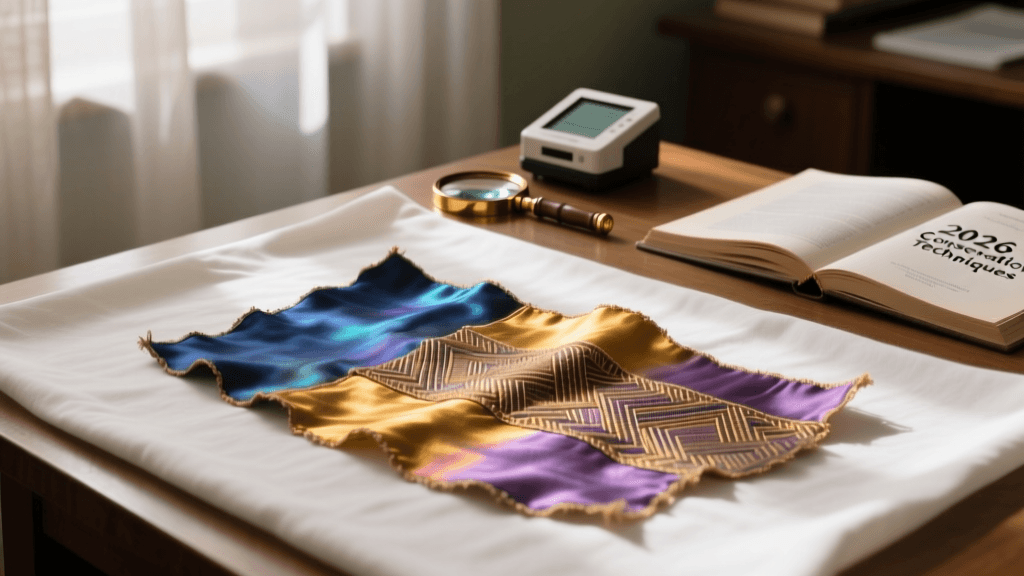
The Legacy of Sogdian Samite on the Silk Road
The Silk Road was not merely a conduit for spices, ceramics, and precious metals; it was the ultimate ancient superhighway for textile innovation and cultural exchange. Among the most coveted commodities exchanged between the Sasanian Empire, Sogdiana, and Tang Dynasty China was samite, a luxurious weft-faced compound twill silk. Characterized by its heavy, rich texture and complex polychrome patterns, samite represented the pinnacle of early medieval weaving technology. In 2026, the study of these ancient textiles has entered a golden age, driven by non-invasive archaeological technologies and a renewed global interest in historical garment reconstruction.
The Astana cemetery complex, located near the ancient oasis city of Gaochang in the Turfan Depression, has yielded some of the most spectacular examples of Sogdian and Tang-era samite. Because of the Taklamakan Desert's extreme aridity, textiles that would have perished in more humid climates were preserved in astonishing detail. These archaeological finds provide an invaluable window into the sartorial preferences, trade networks, and technological capabilities of Silk Road merchants and nobility. Today, conservators and textile historians are utilizing cutting-edge 2026 methodologies to analyze, preserve, and replicate these masterpieces without causing damage to the fragile, 1,300-year-old fibers.
2026 Breakthroughs in Non-Invasive Spectral Analysis
Historically, analyzing the dye composition of ancient Silk Road textiles required destructive sampling—snipping tiny threads to be dissolved and analyzed in a lab. As of 2026, the Getty Conservation Institute and leading global museums have standardized non-invasive spectral imaging as the primary diagnostic tool for archaeological textiles. This shift ensures that priceless samite fragments remain entirely intact while still revealing their chemical secrets.
Two primary technologies dominate the 2026 conservation landscape:
- Hyperspectral Imaging (HSI): Modern HSI cameras capture data across hundreds of narrow, contiguous spectral bands. Conservators use HSI to map the distribution of specific dyes across a samite garment, identifying faded patterns that are completely invisible to the naked eye. This allows researchers to digitally reconstruct the original, vibrant appearance of a Sogdian pearl-roundel motif before centuries of UV exposure took their toll.
- Surface-Enhanced Raman Scattering (SERS): When paired with portable macro-lenses, 2026 SERS technology can identify organic colorants at the molecular level using a harmless, low-power laser. This technique has been crucial in confirming the presence of specific Silk Road dyes, such as madder root (Rubia tinctorum) from the Mediterranean and Indian lac (Kerria lacca), proving the vast geographic reach of ancient dye trade networks.
Archaeological Textile Profiles: Astana vs. Loulan
While Astana is famous for its Tang and Sogdian samite, the nearby Loulan site offers a different snapshot of Silk Road textile history, leaning heavily into earlier Han Dynasty and Hellenistic influences. Understanding the distinct profiles of these sites is critical for conservators and historians in 2026.
| Feature | Astana Cemetery (Turfan) | Loulan Ruins (Lop Nur) |
|---|---|---|
| Primary Era | Tang Dynasty & Sogdian (6th–8th Century) | Han Dynasty & Kushan (2nd Century BCE–3rd Century CE) |
| Dominant Weave | Weft-faced compound twill (Samite) | Warp-faced compound tabby & plain weave |
| Common Motifs | Pearl roundels, confronting boars, Sasanian birds | Geometric patterns, Hellenistic acanthus, dragons |
| Primary Dyes | Madder, indigo, weld, lac | Indigo, madder, safflower |
| 2026 Conservation Priority | Stabilizing brittle weft threads; digital motif reconstruction | Desalination of fibers; structural support for fragmented warp |
Replicating Ancient Weft-Faced Compound Twill in 2026
The UNESCO Silk Roads Programme has heavily promoted the living preservation of ancient textile techniques. For modern weavers, historical reenactors, and academic researchers, replicating Sogdian samite is the ultimate test of skill. The weft-faced compound twill structure requires multiple warp systems and a complex sequence of weft insertions to create the dense, reversible, and richly colored fabric seen in Astana finds.
In 2026, replicators have access to both advanced digital prototyping and authentic raw materials. While electronic Jacquard looms are frequently used to test pattern drafts and calculate thread tension, purists and academic institutions still rely on traditional wooden drawlooms for final, authentic reconstructions.
Sourcing Authentic Materials for Samite Replication
To achieve the correct drape, luster, and historical accuracy, sourcing the right silk and dyes is paramount. Here is a breakdown of the materials and current 2026 market rates for high-fidelity samite replication:
- Wild Tussah Silk Yarn (Warp & Weft): Unlike the fine, highly degummed mulberry silk used for lightweight gauzes, samite requires a thicker, slightly textured thread to hold the compound twill structure. Unbleached Tussah silk, spun at a 20/22 denier weight and plied to 4-ply, is the 2026 standard for historical accuracy. Current cost: $145 per kilogram.
- Organic Madder Root Extract: To replicate the iconic deep Sogdian reds found in the Astana pearl-roundel fragments, synthetic alizarin is strictly avoided by serious conservators. High-grade organic Rubia tinctorum extract, mordanted with alum and cream of tartar, provides the exact historical hue. Current cost: $85 per kilogram.
- Natural Indigo Vat Kits: For the contrasting blues, traditional Japanese sukumo or Indian Indigofera tinctoria fermentation vats are utilized. Pre-reduced organic indigo crystals are popular in 2026 for their consistency in achieving the deep, dark navy backgrounds characteristic of Sasanian-influenced samite. Current cost: $110 per kilogram.
Best Practices for Textile Storage and Display
Whether you are a museum curator managing a Silk Road collection or a private collector preserving vintage Central Asian ikats and silks, the principles of archaeological textile conservation apply universally. The fragile nature of ancient protein fibers means that environmental control is not optional; it is the primary defense against degradation.
According to the latest 2026 guidelines from international conservation bodies, the following parameters must be strictly adhered to when storing or displaying silk textiles:
- Relative Humidity (RH): Maintain a stable RH between 45% and 50%. Fluctuations greater than 5% in a 24-hour period can cause the silk fibers to expand and contract, leading to micro-fractures in the ancient weft threads.
- Illuminance Levels: Light damage is cumulative and irreversible. Display lighting must be strictly below 50 lux, and all UV radiation must be filtered out entirely. In 2026, museums utilize fiber-optic LED systems with built-in UV and IR blocking filters to illuminate samite displays safely.
- Archival Housing: Never fold ancient or highly fragile silks. They should be rolled on acid-free, archival-grade honeycomb polypropylene tubes, wrapped in unbuffered, pH-neutral tissue paper, and stored in custom-fitted clamshell boxes made from lignin-free corrugated board.
- Pest Management: Silk is highly susceptible to webbing clothes moths and carpet beetles. Implement an Integrated Pest Management (IPM) protocol using pheromone traps and regular anoxic (oxygen-deprivation) freezing treatments for any new textiles entering the collection space.
Preserving the Silk Road Legacy for Future Generations
The Sogdian samite silks unearthed from the Astana graves are more than just beautiful artifacts; they are physical records of a deeply interconnected ancient world. The intricate blend of Sasanian motifs, Central Asian weaving techniques, and Chinese silk cultivation speaks to a time when borders were porous to art and innovation. By leveraging 2026's advanced spectral analysis and committing to historically accurate replication and rigorous conservation standards, we ensure that the vibrant legacy of the Silk Road continues to educate and inspire. As research institutions like the British Museum and global heritage organizations continue to digitize and study these collections, the threads of history remain unbroken, weaving the past seamlessly into the future.