Silk Road Samite Preservation: 2026 Archival Storage Guide
The Legacy of Silk Road Samite: From Astana Tombs to Modern Archives
The ancient Silk Road was not merely a conduit for spices and precious metals; it was a vibrant artery of textile exchange that fundamentally altered global fashion and material culture. Among the most prized textiles to traverse these routes was samite, a heavy, lustrous silk fabric woven in a weft-faced compound twill structure. Archaeological excavations in the arid climates of the Tarim Basin, particularly at the Astana Tombs near Turpan and the Yingpan cemetery, have yielded astonishingly well-preserved examples of Sogdian and Tang Dynasty samite. These garments, often featuring iconic pearl roundel motifs enclosing confronting animals or mythological beasts, represent a pinnacle of cross-cultural artistic synthesis.
As we navigate the conservation landscape of 2026, the preservation of these fragile archaeological silk finds—and the high-fidelity museum replicas created for study and display—requires a meticulous, science-backed approach. Silk is a protein fiber composed primarily of fibroin, making it highly susceptible to hydrolysis, photo-oxidation, and mechanical stress. According to the UNESCO Silk Roads Programme, safeguarding the material heritage of these trans-Eurasian exchanges is a paramount priority for global cultural institutions. This comprehensive guide outlines the most current, actionable protocols for storing, handling, and displaying Silk Road samite textiles in 2026.
The Science of Silk Fibroin and 2026 Diagnostic Standards
Before implementing any storage protocol, it is vital to understand the material vulnerabilities of archaeological silk. The fibroin protein chains in ancient samite are often fragmented due to centuries of burial, even in the desiccated environments of Xinjiang. In 2026, the Getty Conservation Institute and allied research bodies have standardized the use of non-invasive Fiber Optic Reflectance Spectroscopy (FORS) and multispectral imaging to assess the degradation state of silk and identify historic dyes, such as madder root and indigo, without requiring physical sampling.
For private collectors, university archives, and smaller museums lacking access to FORS technology, visual and tactile diagnostics remain essential. Conservators in 2026 look for 'shattering' (micro-fractures in the weave), 'tendering' (loss of tensile strength), and 'weeping' of metallic threads often woven into later Silk Road brocades. Once the condition is assessed, the textile must be transitioned into a highly controlled archival environment.
Environmental Parameters: The 2026 Climate Control Matrix
The single greatest threat to archaeological silk is fluctuating relative humidity (RH), which causes the protein fibers to swell and contract, leading to structural fatigue. The ICOM Committee for Conservation strictly advises against broad environmental swings. Below is the definitive 2026 environmental matrix for storing Silk Road samite and similar protein-based archaeological textiles.
| Parameter | Target Range (2026 Standard) | Acceptable 24h Fluctuation | Recommended Monitoring Tool |
|---|---|---|---|
| Temperature | 18°C - 20°C (64°F - 68°F) | ± 2°C | Onset HOBO MX110 Data Logger |
| Relative Humidity | 45% - 50% | ± 3% | Prosorb or Art-Sorb Cassettes |
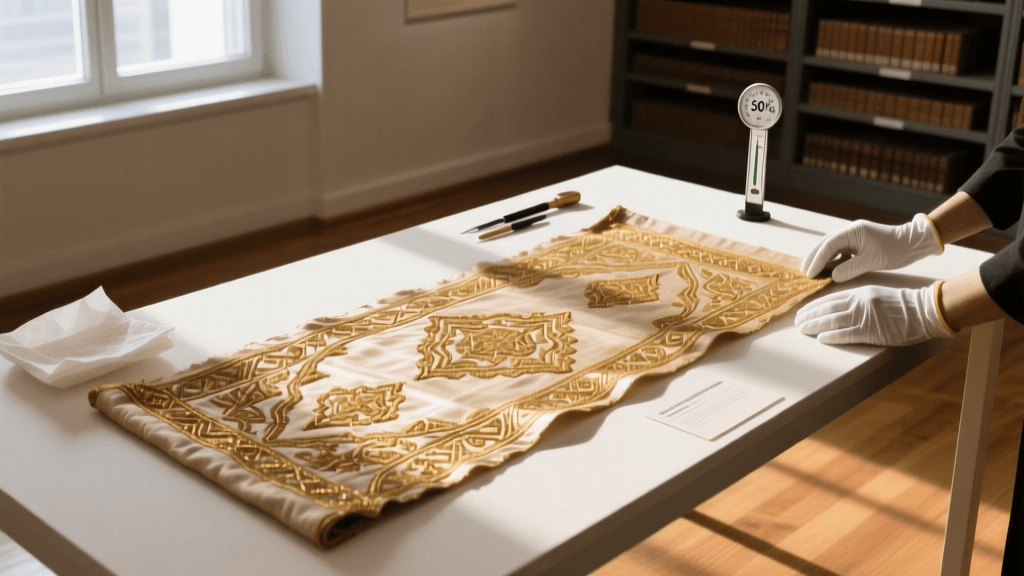
| Illumination (Display) | ≤ 50 Lux | 0 Lux in Storage | Elite Lux UV/Light Meter |
| UV Radiation | 0 µW/lumen | N/A | UV-blocking window films/LEDs |
| Air Quality | Filtered (HEPA + Carbon) | Continuous | Activated carbon filtration units |
Actionable Archival Housing: Flat vs. Rolled Storage
Proper housing is the physical barrier between the ancient silk and environmental pollutants. In 2026, the choice between flat storage and rolled storage depends entirely on the dimensions, weight, and structural integrity of the samite garment or fragment.
Flat Storage for Fragile Fragments and Tunics
Flat storage is mandatory for heavily fragmented samite, garments with brittle metallic thread embroidery, or pieces with rigid, shattered linings.
- The Enclosure: Use custom-sized, unbuffered acid-free archival boxes. Critical Note: Never use buffered tissue or boxes (which contain calcium carbonate to achieve an alkaline pH of 8.5) for silk. The alkalinity will degrade the protein fibers over time. Always specify unbuffered, pH-neutral (7.0-7.5) materials.
- Padding and Support: Line the base of the box with a layer of washed, unbleached cotton muslin or Tyvek. Pad out all folds and creases with loosely crumpled unbuffered acid-free tissue paper to prevent hard creases, which can snap ancient fibroin chains.
- Stacking: Never stack more than three layers of textiles within a single flat box. Use rigid, acid-free honeycomb boards as dividers if multiple pieces must share an enclosure.
Rolled Storage for Intact Textiles and Large Replicas
For structurally sound lengths of samite or heavy, full-length replica garments, rolling is preferred to eliminate fold lines entirely.
- The Core: Utilize acid-free honeycomb paper tubes with a minimum outer diameter of 4 inches (10 cm). Smaller diameters create a tighter roll radius, placing undue stress on the weft-faced twill structure.
- Interleaving: Wrap the tube in a layer of Tyvek or washed muslin. Lay the textile face-down (if the reverse is stable) or face-up (if the surface is highly abraded and needs monitoring), interleaving with sheets of unbuffered tissue.
- The Outer Wrap: Roll the textile smoothly without pulling or stretching. Wrap the exterior in Tyvek and tie loosely with unbleached cotton twill tape. Never use plastic shrink wrap, which traps off-gassing acids and moisture.
Handling Protocols and Display Mounting
The physical manipulation of Silk Road textiles requires strict adherence to modern handling protocols. While the historical consensus favored cotton gloves, the 2026 conservation standard recognizes that cotton gloves reduce tactile sensitivity and can snag on rough, archaeological surfaces or loose metallic threads.
The 2026 Handling Consensus
For the actual touching of fragile samite, conservators now advocate for clean, dry, bare hands, washed with unscented soap and thoroughly dried. This maximizes tactile feedback, allowing the handler to feel micro-tears before they propagate. Nitrile gloves should only be worn when handling the exterior of archival boxes, moving heavy mounts, or dealing with textiles known to have toxic historic mordants (such as arsenic-based dyes occasionally found in Central Asian trade goods).
Display Mounting Techniques
When exhibiting Sogdian pearl roundel samite, gravity must be entirely mitigated.
- Custom Ethafoam Mannequins: Carve inert polyethylene foam (Ethafoam) to match the exact dimensions of the garment's interior.
- Barrier Layer: Wrap the foam in multiple layers of polyester batting, followed by a tightly stitched cover of washed muslin.
- Support: Use hidden magnets (encased in Tyvek) or localized stitching with ultra-fine silk thread to support heavy areas, such as beaded collars or thick hems, ensuring no single point bears the weight of the garment.
"The preservation of Silk Road textiles is not merely about halting decay; it is about maintaining the physical memory of ancient global connectivity. Every fold we prevent and every lux we reduce ensures that the Sogdian merchants and Tang Dynasty weavers continue to speak to future generations." — 2026 Textile Conservation Symposium Proceedings.
Sourcing Archival Materials and Budgeting in 2026
Equipping a storage facility or private collection for archaeological silk requires investment in specialized materials. Below is a practical budgeting guide based on 2026 market pricing for museum-grade conservation supplies.
- Unbuffered Acid-Free Tissue (Ream of 480 sheets): Approximately $85 - $110. Essential for interleaving and padding.
- Custom Archival Corrugated Boxes (e.g., 40" x 30" x 6"): $60 - $95 per box. Look for vendors offering metal edge-drop fronts for easy access without lifting the textile.
- Silica Gel Cassettes (e.g., Prosorb): $45 - $70 per cassette. These are crucial for creating microclimates inside display cases or storage cabinets, buffering the RH to exactly 45%.
- 4-Inch Acid-Free Honeycomb Tubes (60" length): $120 - $150 per tube. Indispensable for rolling heavy samite panels.
Conclusion: Stewardship of the Silk Road
The textiles of the Silk Road are fragile survivors of a monumental era in human history. The weft-faced compound twills of the Astana Tombs and the vibrant dyes of Loulan require our utmost diligence. By adhering to the 2026 standards of pH-neutral housing, strict climate control, and mindful handling, collectors and institutions can ensure that these magnificent garments remain intact. Whether you are preserving a genuine archaeological fragment or a meticulously researched museum replica, the methods outlined above provide a robust framework for safeguarding the woven legacy of the ancient world.