Kimono Storage Preservation 2026: Archival Silk Care & Climate Tips
The Evolution of Kimono Preservation in 2026
Preserving a traditional Japanese kimono is an intricate dance between honoring cultural heritage and applying modern conservation science. As we navigate 2026, the intersection of traditional Japanese textile arts and modern archival methodologies has reached new heights. Silk, the primary fiber for formal garments like the uchikake (wedding kimono) and furisode, is a protein-based fiber highly susceptible to environmental stressors. Photo-oxidation, hydrolysis, and biological pests can irreversibly damage these masterpieces within a matter of years if improperly stored.
For serious collectors, museum curators, and families safeguarding heirloom garments, understanding the precise mechanics of kimono storage preservation is paramount. The days of simply folding a silk garment and tossing it into a cedar chest are over. Today's best practices require a nuanced approach that respects traditional materials like tatoushi (wrapping paper) while integrating advanced climate monitoring and archival chemistry.
Traditional Tatou Paper vs. Modern Archival Materials
Historically, kimonos have been wrapped in tatoushi, a specialized Japanese paper often adorned with subtle patterns or family crests. While culturally significant and aesthetically pleasing, not all tatoushi is created equal. Mass-produced modern variants sometimes contain acidic sizing agents, lignin, or optical brighteners that can off-gas and cause silk fibers to yellow and become brittle over time.
According to the Victoria and Albert Museum's textile conservation guidelines, maintaining a neutral pH environment is critical for protein fibers like silk and wool. In 2026, conservationists recommend a hybrid approach: using unbuffered, acid-free tissue paper for direct contact with the silk, and reserving traditional tatoushi only as a secondary, outer decorative layer if its pH neutrality can be verified.
Comparison of Kimono Wrapping Materials
| Material | pH Level | Breathability | Best Use Case | 2026 Cost Estimate |
|---|---|---|---|---|
| Traditional Tatoushi | Variable (5.5-7.0) | High | Short-term display, cultural authenticity | $15 - $25 per sheet |
| Unbuffered Acid-Free Tissue | 7.0 (Neutral) | Moderate | Long-term archival wrapping, interleaving | $2 - $5 per sheet |
| Tyvek Soft-Structure | Neutral | High | Dust covers, outer protective layers | $10 - $18 per yard |
| Washed Cotton Muslin | Neutral | High | Outer wrapping, breathable storage bags | $8 - $12 per yard |
Climate Control: Managing Humidity and Temperature
Silk is highly hygroscopic, meaning it readily absorbs and releases moisture from the surrounding air. Fluctuations in relative humidity (RH) cause the fibers to swell and contract, leading to mechanical fatigue, creasing, and eventual tearing. The American Institute for Conservation (AIC) Wiki emphasizes that stability is just as important as the absolute numbers when storing historical textiles.
For optimal kimono storage in 2026, maintain a consistent environment:
- Temperature: 65°F to 68°F (18°C to 20°C). Cooler temperatures slow down chemical degradation and deter pest activity.
- Relative Humidity (RH): 45% to 55%. Humidity above 65% invites mold and foxing, while humidity below 40% desiccates the silk, making it brittle.
- Light Exposure: Absolute darkness. UV and even ambient visible light cause irreversible photo-oxidation of silk proteins and fugitive dyes.
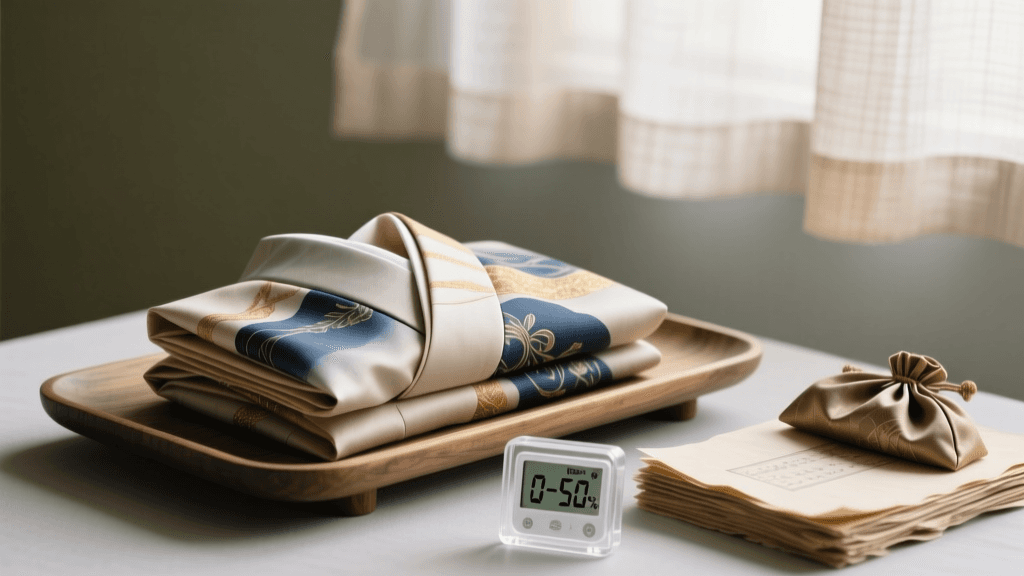
In 2026, the integration of IoT (Internet of Things) micro-climate sensors has revolutionized collection management. Devices like the latest SwitchBot or Govee Bluetooth hygrometers can be placed directly inside tansu (wooden chests) to monitor micro-environments. These sensors push real-time alerts to your smartphone if the RH deviates by more than 3%, allowing for immediate intervention before mold spores can activate.
The Art of the Tansu and Proper Folding
The traditional Japanese tansu, specifically those crafted from kiri (Paulownia wood), remains the gold standard for kimono storage. Paulownia is uniquely suited for textile preservation due to its hygroscopic properties; the wood naturally absorbs excess ambient moisture and releases it when the air is dry, acting as a passive humidity buffer. Furthermore, Paulownia contains natural compounds that deter insects, and it is highly fire-resistant, charring on the outside while sealing the interior from oxygen.
However, the way the garment is folded is just as critical as the chest it resides in. The traditional folding method, known as hon-datami, is designed to distribute stress evenly across the garment and align with the straight seams of the kimono.
Steps for Hon-Datami Folding:
- Lay the kimono face down on a clean, acid-free surface.
- Fold the left front panel over the back, aligning the center back seam.
- Fold the right front panel over the left, creating a long, narrow rectangle.
- Fold the sleeves back so they do not overlap the main body, preventing thick ridges.
- Fold the garment in half or thirds horizontally, depending on the length and the depth of your tansu drawer.
- Interleave the folds with unbuffered acid-free tissue paper to prevent hard creases from setting into the silk.
Pro Tip for 2026: Never store heavy, embroidered obi (sashes) folded inside the kimono. The metallic threads and dense stitching will create pressure points that can permanently crush the delicate silk beneath them. Store obi rolled around acid-free cardboard tubes covered in Tyvek.
Pest Management and the Annual Mushiboshi
Textile pests, such as the webbing clothes moth and the carpet beetle, are the bane of silk collectors. Historically, collectors relied on camphor or naphthalene mothballs. Today, these chemical deterrents are strictly avoided in archival settings. Naphthalene off-gases toxic fumes that can react with metallic threads (like those used in surihaku gold-leaf printing), causing them to tarnish and blacken.
Instead, modern preservation relies on the traditional practice of mushiboshi (insect airing), combined with modern pest monitoring. Mushiboshi involves taking the kimonos out of storage during the dry, cool autumn months to air them out in a shaded, well-ventilated room. This process allows trapped moisture to escape and disrupts the life cycle of any dormant pests.
For continuous protection inside the tansu, use untreated cedar blocks or modern pheromone traps. Cedar blocks must be lightly sanded every six months to release their natural oils, but they must never touch the silk directly, as the oils can stain the fabric. Place the cedar in a small muslin bag and tuck it into the corner of the drawer.
Digital Collection Management for Serious Collectors
As collections grow, managing the rotation, condition, and provenance of dozens or hundreds of kimonos becomes a logistical challenge. In 2026, digital collection management has become an essential component of preservation. Serious collectors and institutions are increasingly utilizing passive RFID (Radio Frequency Identification) tags sewn into the eri (collar) or hidden within the lining.
These tags do not emit radiation and are entirely inert. When scanned with a handheld reader or a smartphone equipped with NFC/RFID capabilities, they pull up a digital dossier for the garment. This database tracks vital preservation metrics:
- Last Airing Date: Ensures no garment is forgotten at the bottom of a chest for a decade.
- Condition Reports: High-resolution macro photos of weak seams or fading, updated annually.
- Material Composition: Notes on specific dyes (e.g., natural indigo vs. synthetic aniline) which dictate specific light and humidity tolerances.
- Provenance and Appraisal: Insurance documentation and historical lineage.
Conclusion
Kimono storage preservation in 2026 is a meticulous discipline that bridges the gap between Edo-period wisdom and 21st-century conservation science. By abandoning acidic wrapping materials in favor of unbuffered tissue, leveraging the natural climate-buffering properties of Paulownia wood, and utilizing IoT sensors to maintain strict environmental controls, collectors can ensure their garments survive for generations. Whether you are safeguarding a single family heirloom or curating a museum-grade collection, treating these silk masterpieces with the archival respect they demand is the ultimate act of cultural preservation.