Historic Kimono Trade Routes: 2026 Import Textile Guide
The Intersection of Global Trade and Japanese Garments
The kimono is globally recognized as a quintessential symbol of Japanese culture, often perceived as an isolated, purely domestic art form. However, the textiles that comprise these historic garments tell a much broader, cosmopolitan story. For centuries, Japan was a vital terminus for vast international trade networks, and the garments worn by the elite were frequently canvases for global exchange. As we navigate the antique textile market in 2026, understanding the provenance of imported fabrics is no longer just an academic exercise—it is a critical skill for collectors, curators, and preservationists.
From the overland caravans of the Silk Road to the maritime galleons of the Nanban trade, foreign textiles profoundly influenced Japanese weaving, dyeing, and aesthetic sensibilities. Today, identifying these historical imports requires a blend of traditional connoisseurship and cutting-edge 2026 authentication technology. This comprehensive guide explores the historic trade routes that shaped kimono textiles and provides actionable advice for identifying and preserving these rare hybrid garments.
Key Historical Trade Routes that Shaped Kimono Textiles
The Silk Road and Continental Influences
Long before the maritime routes opened, the overland Silk Road facilitated the movement of luxury goods from the Mediterranean and Central Asia to East Asia. According to the UNESCO Silk Roads Programme, the exchange of silk, dyes, and weaving techniques fundamentally altered the trajectory of Asian textile production. During the Nara period (710–794), the Japanese imperial court heavily imported Tang Dynasty Chinese textiles, as well as Persian brocades and Indian cottons. These treasures were meticulously preserved in the Shosoin repository in Nara, providing modern historians with a pristine baseline for early imported motifs, such as the iconic shokko (diagonal lattice) and karahana (Tang floral) patterns that eventually became naturalized into Japanese kimono design.
The Nanban Trade and European Imports
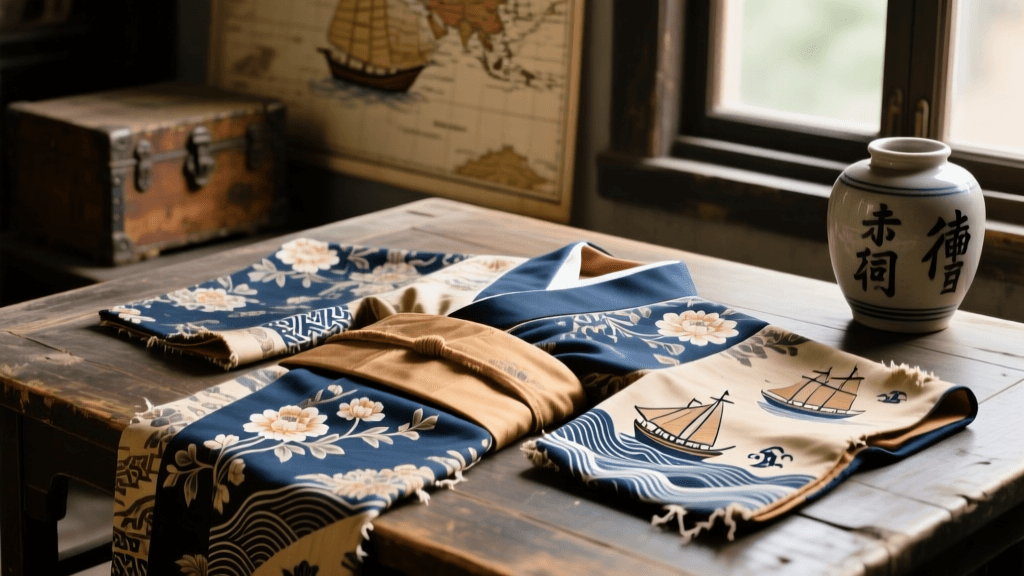
In the late 16th and early 17th centuries, Portuguese and Spanish traders arrived in Japan, initiating the Nanban ("Southern Barbarian") trade. These European merchants brought with them textiles that were entirely alien to the Japanese archipelago: heavy wools, velvets, and brocades woven with metallic threads. Because Japan did not produce velvet domestically at the time, imported European velvet was considered a supreme luxury. Elite samurai and wealthy merchants repurposed these heavy, imported fabrics into jinbaori (surcoats worn over armor) and incorporated small scraps into high-status obi or kimono linings. The bold, foreign crests and exotic ship motifs woven into these textiles remain highly sought after by collectors in 2026.
The Dutch East India Company (VOC) and Indian Chintz
Following the expulsion of the Portuguese, the Dutch East India Company (VOC) became Japan's primary conduit to the outside world during the Edo period's sakoku (isolation) policy. Through the artificial island of Dejima in Nagasaki, the Dutch imported vast quantities of Indian chintz, known in Japan as sarasa. Produced primarily on the Coromandel Coast of India, sarasa featured vibrant, colorfast madder-dyed floral and geometric patterns on cotton. Because Japanese cotton dyeing techniques at the time struggled to achieve such brilliant, wash-resistant reds, Indian sarasa became a sensation. It was heavily utilized for kosode linings, obi, and tea ceremony accessories. The cultural impact of this maritime trade route is still visible in the surviving Edo-period garments that surface in modern auctions.
2026 Authentication: Identifying Imported Textiles in Antique Kimono
For modern collectors, distinguishing between domestic Japanese reproductions of foreign styles and actual historical imports is paramount. In 2026, the secondary market for antique kimono has seen a surge in demand for verified trade-route textiles, making accurate identification a valuable skill. Below is a comparative guide to help you identify the origins of common trade textiles found in antique kimono components.
| Feature | Domestic Nishijin Brocade | Imported Indian Sarasa (Chintz) | Nanban Trade Velvet |
|---|---|---|---|
| Primary Material | 100% Cultivated Silk, metallic threads | Cotton, occasionally silk-cotton blends | Silk pile on a linen or heavy cotton base |
| Historical Dyes | Safflower (red), Indigo (blue), Murasaki (purple) | Madder Root (deep red), Indigo, Chay (yellow) | European Cochineal, Weld, early synthetic dyes (post-1860s) |
| Common Motifs | Cranes, Pine, Plum Blossoms, Chinese Lions | Trailing Floral Vines, Geometric Lattices, Palampore Trees | Foreign Crests, European Ships, Exotic Fauna |
| Weave Characteristics | Complex draw-loom jacquard, extremely tight tension | Plain weave cotton with block-printed or mordant-painted designs | Uncut or cut pile, often with uneven tension due to hand-weaving |
| Typical Garment Use | Outer Kosode, Uchikake, Formal Obi | Obi, Kosode Linings, Tea Ceremony Shifuku (bags) | Jinbaori, Haori collars, rare outer kimono panels |
Advanced 2026 Authentication Techniques
While visual inspection and tactile analysis remain foundational, 2026 has ushered in a new era of non-invasive textile authentication. Institutions like the Kyoto National Museum and private conservation labs now routinely utilize portable X-ray fluorescence (pXRF) spectrometers to analyze historical mordants. For example, Indian sarasa relied heavily on alum and iron mordants to bind madder dye to cotton, whereas domestic Japanese red silk utilized safflower, which requires no metallic mordant. By scanning a garment's fibers with a pXRF device, authenticators can definitively prove whether a red textile is a domestic silk or an imported Indian cotton, drastically altering its valuation.
Furthermore, AI-assisted macro-photography is now widely available to serious collectors. By capturing ultra-high-resolution images of the warp and weft, AI algorithms can compare the weave structure against global databases of historical looms, identifying regional weaving idiosyncrasies that point to specific trade routes.
Preservation Techniques for Hybrid Trade Textiles in 2026
Preserving garments that feature imported trade textiles presents unique challenges, primarily due to the juxtaposition of different fiber types and historical dyes. Research highlighted by the Textile Society of America emphasizes that hybrid garments—such as a silk kimono lined with Indian cotton sarasa—require highly controlled environments to prevent differential degradation.
- Climate Control: In 2026, best practices dictate maintaining a strict 50% relative humidity (±3%) and a temperature of 68°F (20°C). Fluctuations cause cotton linings and silk shells to expand and contract at different rates, leading to seam tearing and structural stress.
- Light Exposure Management: Historical madder dyes in Indian sarasa and cochineal in European velvets are highly fugitive. Garments must be stored in archival, acid-free tatoushi (traditional Japanese paper wrappers) and exposed to no more than 50 lux of LED light during display.
- Pest Mitigation: Wool and velvet imports from the Nanban trade are highly susceptible to webbing clothes moths. Modern 2026 preservation relies on anoxic (oxygen-deprived) treatment chambers rather than chemical fumigants, which can react unpredictably with historical metallic threads and metallic mordants.
- Support and Mounting: When displaying heavy imported velvets or densely woven brocades, custom-padded mannequins made from ethafoam and washed cotton jersey must be used to distribute the weight evenly, preventing the delicate domestic silk seams from bearing the full load of the imported fabric.
Sourcing and Valuing Trade-Route Kimonos Today
The market for trade-route kimono has matured significantly. In 2026, collectors are moving away from pristine, untouched domestic silks and are increasingly valuing the "lived history" of hybrid garments that showcase Japan's global connections. A verified Edo-period sarasa obi, complete with the characteristic Coromandel Coast floral motifs and slight indigo fading, commands between $1,200 and $3,500 in the current market, depending on condition and provenance.
Nanban trade textiles, particularly those integrated into samurai jinbaori or high-ranking haori, are exceptionally rare. When they appear at international auction houses, they frequently exceed $15,000. For collectors on a budget, fragmented trade textiles—such as sarasa patches used in boro (mended) work garments or tea ceremony shifuku bags—offer an accessible entry point, typically ranging from $150 to $500.
When sourcing these pieces, always request high-resolution macro photos of the reverse side of the fabric. Imported block-printed chintz will show dye penetration and distinct motif mirroring on the back, whereas later Japanese domestic stenciled reproductions often exhibit a stark white reverse side. By combining historical knowledge with modern 2026 verification tools, collectors can successfully trace the threads of the Silk Road and maritime trade routes, preserving the global legacy woven into the fabric of the kimono.