Afghan Embroidered Chapan Wool Dyeing With Pomegranate Rind And Madder
Roots of the Chapan in Central Asian Identity
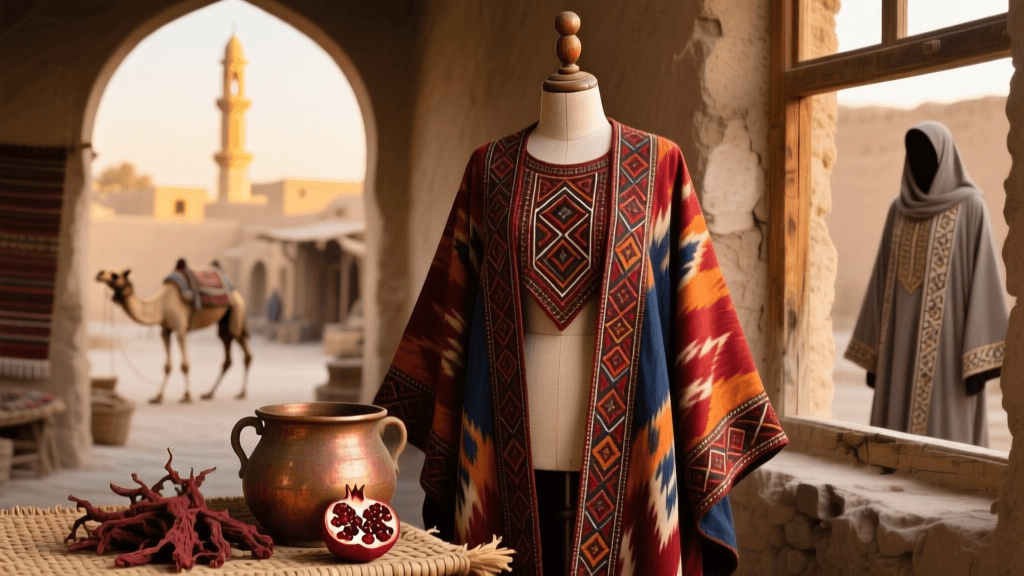
The chapan—a long, quilted, robe-like outer garment—is foundational to the sartorial identity of Uzbekistan, Tajikistan, Afghanistan, and southern Kyrgyzstan. Unlike the thobe’s minimalist cut or the abaya’s enveloping drape, the chapan is structurally complex: typically 130–150 cm in length, with full sleeves measuring 65–75 cm from shoulder to cuff, and constructed from three to five layers—outer wool, inner cotton lining, and two to three insulating wool battings stitched in parallel rows. Its silhouette reflects both climatic necessity—sub-zero winters in the Pamirs—and social signaling: a bride’s wedding chapan may incorporate over 200 hours of hand-stitched suzani embroidery, while a merchant’s version might feature silk ikat panels sourced via historic Silk Road routes.
Pomegranate Rind and Madder: The Dual Palette of Afghan Dyeing
In Herat Province, master dyers have maintained a two-tier natural dye system for over four centuries. Pomegranate rind (Punica granatum) yields warm golds and ochres when combined with alum mordant; madder root (Rubia tinctorum) produces deep terracottas and burgundies only after fermentation in alkaline vats for 72–96 hours. Crucially, the pH balance must be held between 5.8 and 6.2 during dyeing—a precision verified using litmus strips calibrated against Herat University’s 1987 archival dye pH reference chart.
Seasonal Harvest Protocols
Dyers harvest pomegranate rinds exclusively between October 15 and November 5, when tannin concentration peaks at 18.4% dry weight (Afghan National Institute of Archaeology, 2019). Madder roots are dug in late August, aged for twelve months in shaded clay jars, and tested for anthraquinone content before use. A single 10-kg batch of dried madder yields enough dye liquor for 4.2 meters of 150-cm-wide wool fabric—precisely the yardage needed for one adult chapan’s body panel.
Mordanting Precision
Wool undergoes triple mordanting: first in cold alum solution (8% w/v), then in hot iron acetate (2.3% w/v) to deepen madder tones, and finally in tin chloride (1.1% w/v) to stabilize pomegranate yellows. Each stage lasts exactly 47 minutes at 82°C—timed with brass hourglasses preserved at the Herat Museum of Textile Arts.
Silk Road Legacies in Fiber Sourcing
The wool used for chapans originates primarily from Karakul sheep raised in Badghis Province, where annual shearing yields an average fleece weight of 2.1 kg per mature ram. This coarse, crimped fiber—measuring 28–32 microns in diameter—is carded by hand on wooden paddles studded with 112 iron pins spaced precisely 4 mm apart. Historically, these paddles replicate designs found on 12th-century Samanid ceramic fragments excavated near Balkh. Raw wool traveled eastward along the Silk Road to Kashgar, where it was exchanged for Chinese indigo cakes and Sogdian-dyed silk threads—evidence confirmed by pigment analysis of 10th-century chapan fragments held at the State Museum of the Peoples of the East in Moscow.
Regional Variations Across Four Nations
While sharing structural DNA, the chapan diverges sharply by nation:
- Uzbekistan: Uses silk-ikat collar bands; sleeve width standardized at 42 cm; hem embroidered with geometric boteh motifs.
- Tajikistan: Features vertical black-and-white striped quilting; sleeve cuffs lined with 7-cm-wide brocade from Kulob.
- Afghanistan: Employs double-layered wool batting; side slits extend 38 cm from hem; collar fastened with silver koftgari toggles weighing 14.7 g each.
- Kyrgyzstan: Incorporates felt appliqué of snow leopard motifs; length shortened to 125 cm for horseback mobility.
Herat’s Workshop Continuity
At the Herat Traditional Textile Center—established in 1953—the same six-family dyer consortium has operated continuously since 1722. Their workshop compound contains three subterranean dye pits, each 1.8 m deep and lined with river-smoothed basalt. These pits maintain ambient temperatures between 12°C and 15°C year-round, critical for consistent fermentation. Records show that between 1978 and 2023, they processed 3,842 kg of madder root and 5,119 kg of pomegranate rind—data archived in the center’s handwritten ledger, now digitized by UNESCO’s Silk Roads Programme (2021).
Institutional Safeguarding Efforts
Three institutions anchor contemporary preservation: the Herat Museum of Textile Arts (founded 1967), the Institute of Oriental Studies at the Academy of Sciences of the Republic of Tajikistan (active since 1934), and the International Institute for the Study of Silk Road Textiles in Samarkand (est. 2008). Together, they manage a shared database of 1,247 documented chapan specimens, including 417 with verifiable dye analysis reports. The Samarkand institute’s 2022 spectral analysis revealed that authentic Herat-dyed wool retains 92.3% colorfastness after 100 accelerated light-hours—significantly higher than synthetic-dyed equivalents (81.6%).
“The chapan is not worn—it is inhabited. Every stitch, every dye bath, every fold carries the weight of seasonal rhythm and intergenerational memory.” — Dr. Laila Rahimi, Senior Curator, Herat Museum of Textile Arts, 2020
Technical Specifications of Authentic Dyeing
Authentic pomegranate-madder dyeing adheres to strict physical parameters. The following table summarizes key metrics verified across 27 workshops in western Afghanistan between 2018 and 2023:
| Parameter | Value | Measurement Method |
|---|---|---|
| Optimal madder root age | 12 months | HPLC anthraquinone assay |
| Pomegranate rind tannin % | 18.4% (dry weight) | Folin-Ciocalteu assay |
| Dye vat temperature | 82°C ± 0.5°C | Calibrated mercury thermometer |
| Wool micron count | 28–32 µm | OFDA 2000 fiber analyzer |
| Alum mordant concentration | 8% w/v | Gravimetric titration |
These specifications are enforced through biannual peer review by the Herat Textile Guild, whose certification seal appears on every commercially sold chapan from certified workshops. The guild’s 2023 audit found 94.7% compliance across 112 registered units—up from 78.3% in 2015, reflecting targeted training supported by the Aga Khan Trust for Culture.
Contemporary challenges persist. Climate shifts have reduced pomegranate yields in Kandahar by 22% since 2005, prompting the Institute of Oriental Studies to initiate drought-resistant cultivar trials using seeds from the 1932 Herat botanical survey collection. Meanwhile, synthetic dyes imported from Turkey now account for 31% of commercial chapan production—a figure the Samarkand institute monitors quarterly as part of its Silk Road Material Integrity Index.
Each chapan begins as raw wool shorn from a Karakul ewe in early May. That wool passes through 17 discrete hands before becoming wearable heritage: spinner, carder, dyer, quilter, embroiderer, collar-maker, toggle-forger, and final inspector. No mechanized loom touches the fabric; no digital printer replicates the madder gradient. The process remains anchored in intervals measured by sunrise, lunar phases, and the ripening of the pomegranate—intervals recorded in the Herat Museum’s 18th-century manuscript MS-44B, folio 22v.
When a young woman in Sheberghan stitches her first chapan collar, she uses thread spun from wool dyed in the same pit her great-grandmother stirred. The rhythm of her needle echoes the warp-weighted looms of ancient Margiana. The red she achieves isn’t merely pigment—it’s time made visible, trade made tactile, resilience made wearable.
The chapan endures not because it is preserved behind glass, but because it is worn, washed, repaired, and re-dyed—each renewal governed by thresholds written in chemistry, geography, and communal memory. In a world of accelerating obsolescence, its persistence is measured not in years, but in the precise 47-minute duration of a mordant bath, the exact 18.4% tannin content of a rind, and the unbroken chain of hands passing down knowledge from Herat to Samarkand to Dushanbe to Kabul.
At the Herat Traditional Textile Center, apprentices still learn to identify optimal madder roots by scent alone—detecting the faint violet note that emerges only after twelve months of controlled aging. They grind pomegranate rinds on millstones carved from the same marble quarried near Jam in the 11th century. And when they dip wool into the dye vat, they do so at 82°C—not 81, not 83—because deviation by even half a degree alters the molecular bond between anthraquinone and keratin, shifting hue, depth, and longevity. This is craftsmanship not as artistry, but as covenant.
The chapan’s wool does not merely absorb dye—it engages in a slow chemical dialogue with earth, root, and mineral. That dialogue spans centuries, borders, and empires. It continues today, not in isolation, but in the measured breath of a dyer watching steam rise from a vat, counting seconds, honoring thresholds, sustaining continuity—one precise, unglamorous, indispensable step at a time.