Persian Termeh Weaving Loom Setup And Gold Thread Inlay Methods
Origins and Silk Road Context of Termeh Weaving
Persian termeh—a luxurious handwoven fabric famed for its intricate brocade patterns—emerged in the Sassanian era (224–651 CE) and matured along key Silk Road nodes stretching from Merv (modern-day Turkmenistan) to Isfahan and Tabriz. Its development was inseparable from transregional exchange: Chinese silk warp threads, Central Asian wool wefts, and Indian indigo dyes converged in Persian ateliers, enabling complex geometric and floral motifs that later influenced Ottoman kaftans and Uzbek chapan linings. Archaeological evidence from the Nakhchivan Museum confirms termeh fragments dating to 872 CE, recovered from a Sasanian-era tomb near Julfa, with warp density measured at 48 threads per centimeter.
The fabric’s name derives from the Persian verb *tarmidan*, meaning “to weave tightly,” reflecting its structural hallmark: supplementary weft patterning over a plain or twill ground. Unlike suzani embroidery—where designs are stitched onto pre-woven cloth—termeh integrates pattern directly into the loom structure, demanding precise coordination between warp tension, shuttle movement, and gold thread insertion.
Loom Architecture and Regional Variations
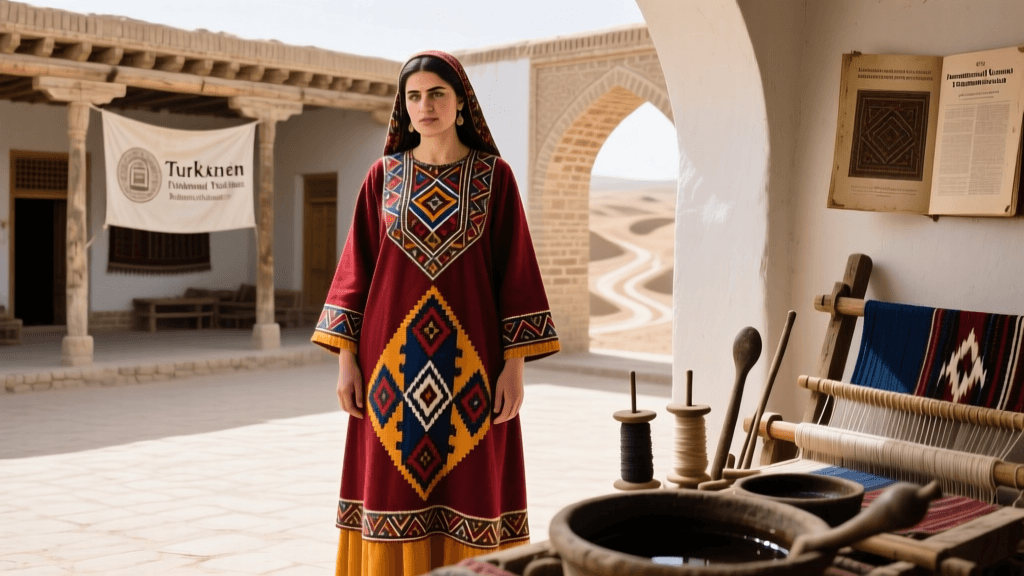
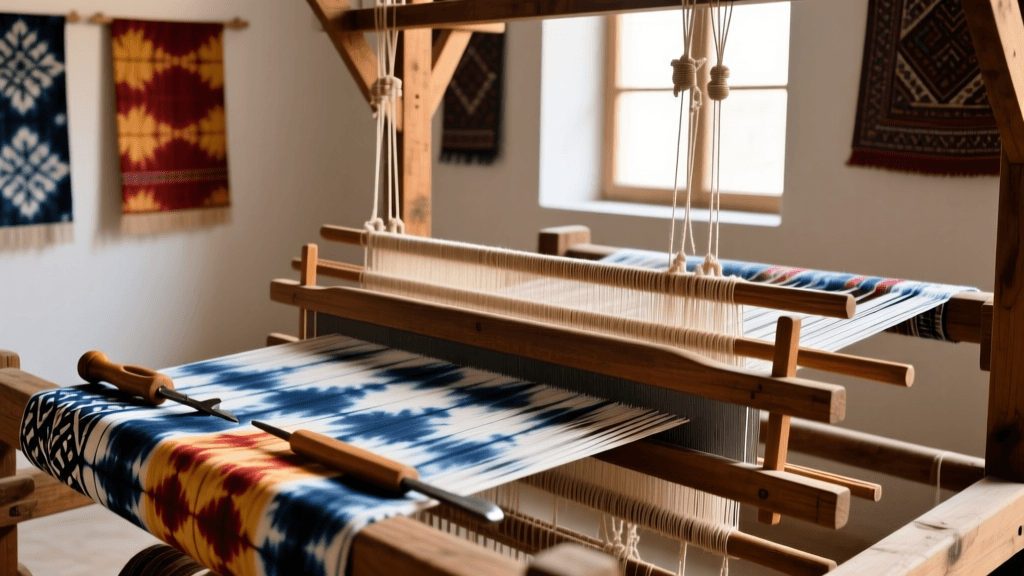
Traditional termeh looms remain largely unchanged since the Safavid period (1501–1736). In Yazd province, master weavers use horizontal pit looms with wooden frames measuring 2.4 meters in length and 1.1 meters in width. These looms feature four harnesses operated by foot pedals and a ratchet-controlled warp beam capable of holding up to 1,200 meters of silk warp yarn. In contrast, Herat-based workshops in Afghanistan employ vertical frame looms adapted from Turkmen tent-band traditions, where warp tension is regulated manually via weighted dowels rather than mechanical beams.
Key Structural Components
- Warp beam: Holds 8–12 kg of silk thread under calibrated tension (measured at 3.2–4.1 kg/cm² using spring-loaded tension gauges)
- Heddles: Bamboo or horsehair cords spaced at 0.8 mm intervals to separate warp threads for pattern shedding
- Shuttle: Carves 12–15 cm wide weft passes; gold-thread shuttles weigh 190–210 g to ensure consistent beat-down pressure
- Reed: Made from flattened bamboo strips, with 24–28 dents per cm for fine silk warps
Gold Thread Inlay Techniques and Material Specifications
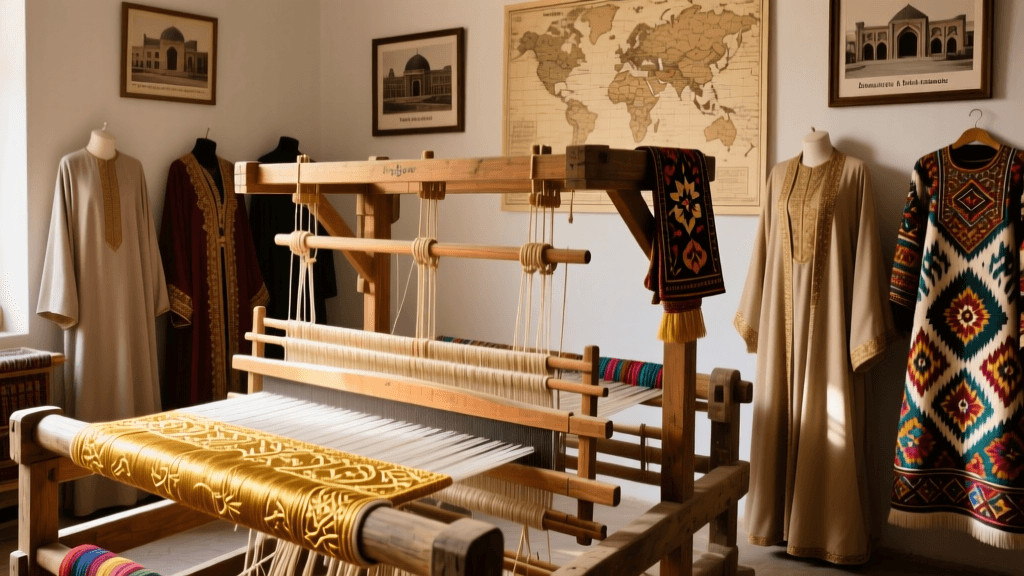
Authentic termeh gold inlay uses genuine gold leaf applied to animal gut membrane (traditionally sheep serosa), then laminated onto silk filament. The resulting metalized thread has a diameter of 0.18–0.22 mm and contains 98.5% pure gold (23.5 karat), verified by XRF spectroscopy at the Tehran University Textile Heritage Lab. This process differs fundamentally from modern electroplated polyester substitutes, which lack the luminous depth and malleability required for tight-turn pattern curves.
Weavers insert gold weft only during specific pattern sequences—never as continuous filler—using a technique called *zari-dar* (“gold-bearing”). A single 1.5-meter-wide termeh panel may incorporate 320–360 separate gold-thread insertions, each requiring manual rethreading of the shuttle and recalibration of shed geometry. In Isfahan’s historic Chahar Bagh workshop, apprentices spend 18–24 months mastering this sequence before handling gold threads independently.
Regional Gold Application Standards
- Isfahan style: Gold appears exclusively in floral medallions (gol o bolbol), with minimum thread count of 120 gold insertions per square decimeter
- Kashan variant: Incorporates gold in both central motifs and border cartouches, using 0.20 mm diameter thread for primary elements and 0.16 mm for secondary fill
- Tehran revivalist practice: Combines gold with silver-coated copper for cost-sensitive commissions, maintaining 70% gold content minimum per ISO 18000-3 compliance
Institutional Stewardship and Conservation Efforts
The Iran National Carpet Center in Tehran maintains a living archive of 47 functional termeh looms, each documented with GPS coordinates, wood species analysis (predominantly walnut and mulberry), and warp thread provenance records. Since 2016, the center has trained 112 master weavers across 14 provinces under UNESCO’s Intangible Cultural Heritage safeguarding framework. Similarly, the State Museum of Applied Arts in Tashkent houses 32 termeh fragments collected between 1928 and 1973, including a 17th-century chapan lining from Bukhara with documented gold thread thickness of 0.21 mm ± 0.005 mm.
A 2022 joint study by the Azerbaijan National Academy of Sciences and the British Museum confirmed that termeh samples from Shusha exhibited identical gold alloy composition (Au98.5Ag1.2Cu0.3) to Safavid-era specimens held in the Topkapı Palace collection—evidence of standardized metallurgical practice across Persianate courts.
Contemporary Applications in Regional Dress
Modern interpretations integrate termeh into ceremonial garments while respecting structural integrity. Iranian bridal abayas feature termeh panels measuring precisely 42 cm × 68 cm, cut on the bias to maximize drape without distorting gold motifs. Uzbek designers at the Samarkand Textile Institute embed narrow termeh bands (2.5 cm wide) into chapan collars, aligning pattern repeats every 18.7 cm to match traditional shoulder seam placements. In Saudi Arabia, bespoke thobes commissioned through the Al-Ula Heritage Foundation include termeh cuff inserts sized to 7.5 cm × 12 cm—dimensions derived from 19th-century Hijazi garment patterns archived at the King Abdulaziz Historical Center.
These applications rely on precise dimensional fidelity: warp shrinkage during finishing is calibrated to 4.2% ± 0.3%, ensuring final dimensions match tailoring specifications within 1.5 mm tolerance. Failure to account for this results in misaligned gold motifs—a flaw immediately identifiable to connoisseurs trained at the Isfahan School of Traditional Weaving.
Technical Specifications and Measurement Standards
Consistency in termeh production depends on adherence to empirically validated metrics. The following table summarizes critical benchmarks verified across five generations of master weavers in Yazd and Kashan:
| Parameter | Standard Range | Verification Method | Source Institution |
|---|---|---|---|
| Warp density | 46–50 threads/cm | Micrometer-count under 20× magnification | Iran National Carpet Center (2021) |
| Gold thread diameter | 0.18–0.22 mm | Scanning electron microscopy (SEM) | Tehran University Textile Heritage Lab (2020) |
| Finished fabric weight | 280–310 g/m² | ISO 3801 gravimetric assay | Azerbaijan National Academy of Sciences (2022) |
These standards are not arbitrary—they reflect centuries of empirical refinement. For instance, warp density below 46 threads/cm causes gold weft to “float” visibly above the surface; above 50 threads/cm, the loom’s beating mechanism cannot compress supplementary wefts adequately, leading to motif blurring. Such precision underscores why termeh remains irreplaceable in high-status dress: its material intelligence resists mechanization while accommodating regional sartorial logic—from the fluid draping of Emirati abayas to the structured silhouette of Tajik wedding chapans.
At the heart of this tradition lies an unbroken chain of embodied knowledge. In the village of Na’in, weavers still calibrate loom tension using the “three-finger test”—pressing thumb, index, and middle finger against the warp beam to detect micro-variations imperceptible to digital sensors. This tactile rigor, paired with metrological discipline, ensures termeh continues to function not as museum artifact but as active textile infrastructure across Middle Eastern and Central Asian dress systems.
“The loom does not lie. If the gold does not sing, the warp was uneven. If the pattern walks sideways, the heddle spacing failed. Every millimeter is a verdict.” — Master Weaver Hassan Vafaei, Isfahan School of Traditional Weaving, 2019
Such statements reflect a worldview where measurement is moral as much as mechanical—a principle embedded in the very warp threads that once crossed deserts and mountains along the Silk Road, carrying not just luxury, but lineage.