2026 Archival Storage Guide for Vintage Silk Kimonos & Hanboks
The Vulnerability of Protein-Based Heritage Textiles
Preserving traditional Asian garments is an act of cultural stewardship. Whether you have inherited a Meiji-era silk kimono, a meticulously embroidered Joseon-style hanbok, or a mid-century cheongsam, you are the custodian of protein-based heritage textiles. Unlike plant-based fibers such as cotton or linen, silk is a continuous protein filament that is highly susceptible to environmental degradation, light exposure, and chemical off-gassing. As of 2026, with global climate fluctuations causing unprecedented shifts in indoor humidity levels, the need for rigorous, museum-grade archival storage at home has never been more critical.
Silk shattering—the irreversible breaking of fibers that causes the fabric to split and disintegrate—is often the result of historical weighting processes using metallic salts, combined with improper modern storage. Furthermore, the vibrant natural and early synthetic dyes used in traditional East Asian garments are notoriously fugitive, meaning they fade rapidly when exposed to UV light or react poorly to acidic environments. To ensure these masterpieces survive for the next century, home archivists must adopt the stringent protocols used by leading textile conservators.
2026 Archival Storage Materials: What to Buy
The foundation of garment preservation lies in the materials that physically touch the textile. The golden rule for protein fibers like silk and wool is to use unbuffered acid-free tissue paper. Buffered tissue contains an alkaline reserve (usually calcium carbonate) designed to neutralize acids in plant-based fibers, but this alkalinity can actively damage protein structures over time, leading to fiber embrittlement.
When sourcing supplies in 2026, look for lignin-free, unbuffered tissue paper from reputable conservation suppliers like Lineco or Hollinger. For structural support, archival-grade corrugated plastic boxes (often made from polypropylene) or metal-edge archival boxes are the standard. Avoid standard cardboard or wood pulp boxes, as they off-gas acidic compounds that will yellow and degrade silk.
| Material Type | Estimated Cost (USD) | Pros | Cons | Best Application |
|---|---|---|---|---|
| Unbuffered Acid-Free Tissue | $25 - $40 per ream | pH neutral, prevents hard creases, safe for protein fibers | Requires periodic replacement (every 3-5 years) | Padding folds, wrapping garments, stuffing sleeves |
| Metal-Edge Archival Box | $45 - $85 per box | Acid-free, lignin-free, structurally rigid, stackable | Bulky, susceptible to water damage if flooded | Long-term storage of folded kimonos and hanbok skirts |
| Polypropylene Coroplast Box | $60 - $110 per box | Water-resistant, inert, highly durable, pest-resistant | More expensive, less aesthetically pleasing | Basement storage, high-humidity environments |
| Traditional Kiri (Paulownia) Tansu | $800 - $3,000+ | Natural humidity buffering, traditional aesthetic, moth-repellent | Requires seasonal maintenance, heavy, expensive | Display rooms, climate-controlled living spaces |
Smart Climate Control and Pest Management in 2026
According to The Metropolitan Museum of Art's Textile Conservation Department, fluctuations in relative humidity (RH) are far more damaging to textiles than a steady, slightly sub-optimal humidity level. For silk garments, the ideal storage environment is 65°F to 70°F (18°C to 21°C) with an RH of 45% to 55%. In 2026, maintaining this micro-climate is easier than ever thanks to advanced smart home integrations. Utilizing Bluetooth-enabled hygrometers with data-logging capabilities, such as the latest SensorPush HTP.xw or Govee H5074 models, allows collectors to track humidity spikes via smartphone alerts, ensuring that a sudden summer heatwave does not silently foster mold growth inside a storage closet.
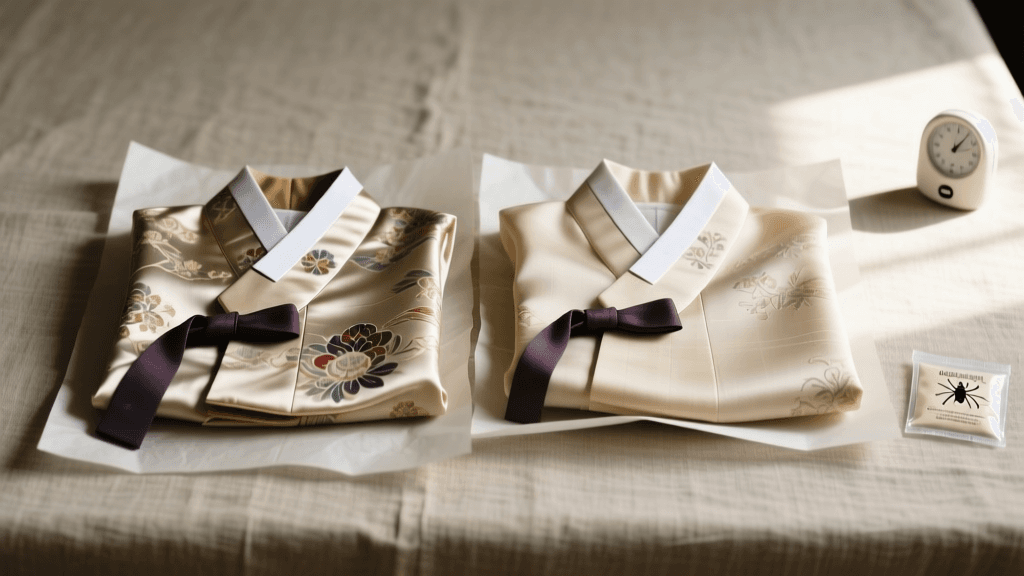
Pest management has also evolved. Historically, Asian households relied heavily on camphor and naphthalene (mothballs) to protect kimonos and hanboks. However, modern conservation science strongly advises against these volatile organic compounds (VOCs). Not only are they toxic to humans and pets, but their chemical off-gassing can react with the metallic threads (such as gold and silver leaf applied to silk) causing irreversible tarnishing and blackening. Instead, 2026 best practices emphasize Integrated Pest Management (IPM). This involves using pheromone traps to monitor for webbing clothes moths and carpet beetles, ensuring garments are professionally dry-cleaned or frozen (in specialized archival freezing protocols) before storage to eliminate existing eggs, and utilizing airtight polyethylene storage bins to physically block pest ingress.
Precision Folding: Hon-Datami and Hanbok Techniques
How a garment is folded dictates where the stress points will occur. Repeated folding in the exact same location will eventually cause the silk fibers to break. Conservators recommend shifting fold lines slightly every few years and padding every crease with rolls of unbuffered acid-free tissue to prevent hard, sharp creases.
The Kimono: Hon-Datami Folding
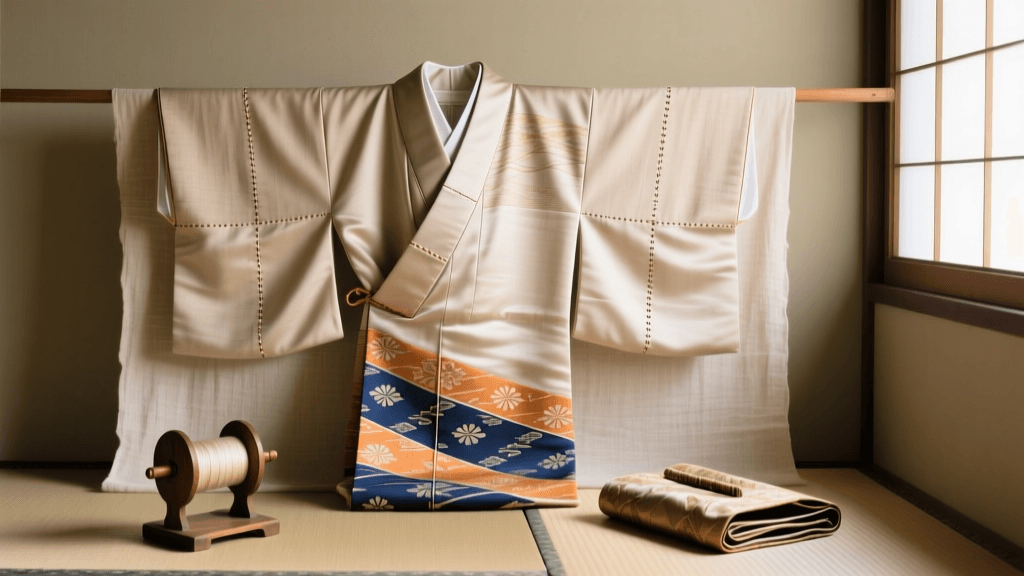
The traditional Japanese folding method, Hon-datami, is designed to align the seams and distribute the fabric's weight evenly. Begin by laying the kimono face down on a clean, acid-free surface. Fold the left side over the back center seam, then fold the right side over to meet it, creating a long rectangle. The sleeves are then folded inward. Crucially, before making the final horizontal folds to fit the garment into an archival box, place cylindrical rolls of unbuffered tissue paper along the fold lines. This maintains a gentle curve rather than a sharp crease, preserving the structural integrity of the silk weave.
The Hanbok: Chima and Jeogori Preservation
Preserving a traditional Korean hanbok requires addressing its distinct volumetric shapes. The Chima (skirt) features deep, intricate pleats that can easily become crushed. Rather than folding the skirt flat, which destroys the pleats and stresses the high-tension waistband, the chima should be gently rolled over a large, acid-free tissue-stuffed tube or padded archival cylinder. The Jeogori (jacket) should be laid flat, with the sleeves folded across the chest. The Goreum (the long front ribbon) should never be tied in a tight knot for storage; instead, it should be loosely coiled and padded with tissue to prevent permanent deformation of the silk ribbon.
Conservation vs. Restoration: Knowing the Difference
When a vintage garment suffers from shattering, staining, or structural failure, it is vital to understand the difference between restoration and conservation. Restoration often implies returning an object to its original, functional appearance, which sometimes involves replacing original fabrics or using modern synthetic threads. Conservation, however, prioritizes the stabilization and preservation of the original historical material, even if the damage remains visible.
For highly valuable or historically significant pieces, never attempt home repairs using commercial iron-on patches or standard sewing thread, as these can introduce new acids and tension points. If your garment requires intervention, seek out a certified professional. The American Institute for Conservation (AIC) provides a comprehensive directory to help you locate specialized textile conservators who are trained in the delicate, reversible techniques required for Asian heritage garments, such as traditional Japanese kake-tsugi (invisible weaving repair) or specialized aqueous washing protocols to remove acidic degradation byproducts.
Final Thoughts on Archival Stewardship
Caring for traditional Asian garments is a rewarding commitment to cultural history. By investing in unbuffered archival materials, leveraging modern smart-climate monitoring, and adhering to traditional, stress-free folding techniques, you ensure that the vibrant silks and intricate embroideries of kimonos and hanboks remain intact. As we navigate the environmental challenges of 2026, these proactive preservation strategies are the key to passing these tangible links to our ancestors down to the next generation.