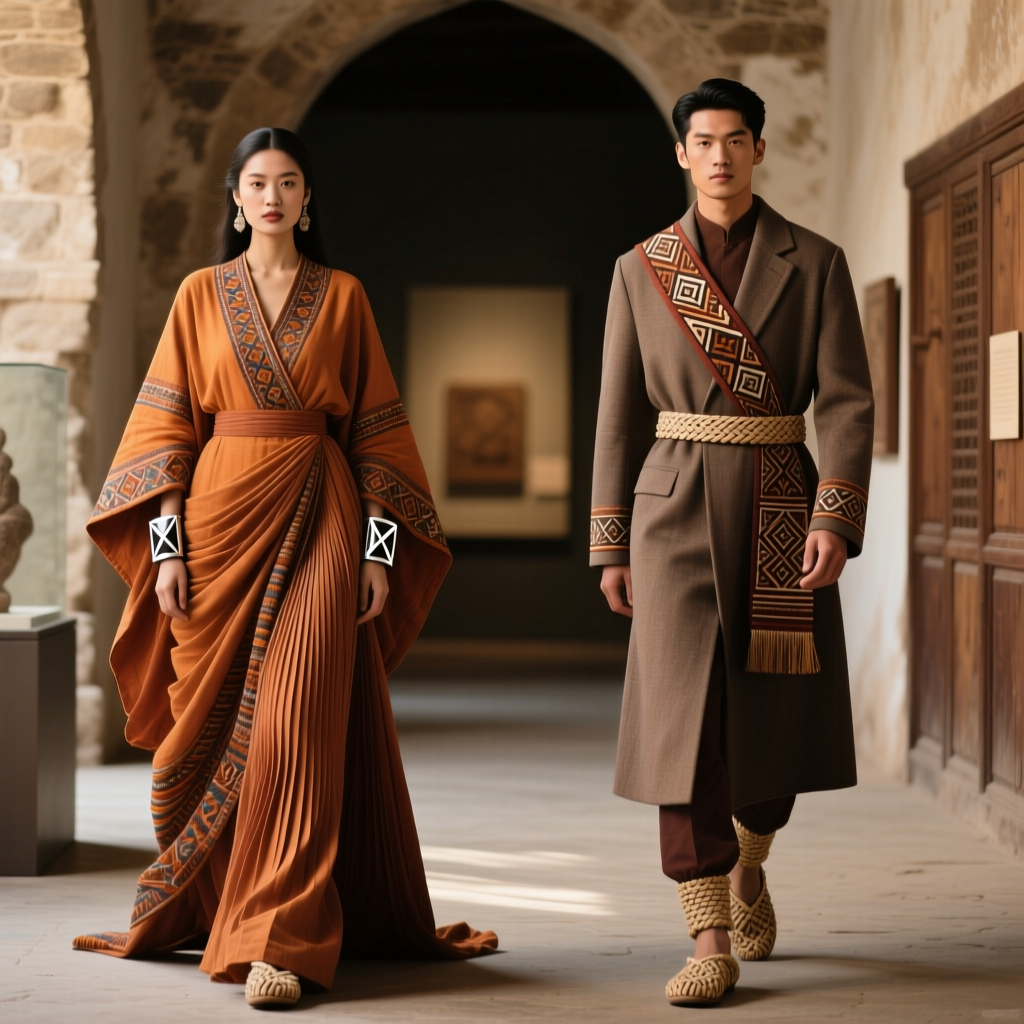
Wrap Skirts: Global Tying Methods Compared

Wrap Skirts: Global Tying Methods Compared
Wrap skirts—garments constructed from a single piece of fabric that encircles the waist and hips before being secured through folding, knotting, or tucking—are among the most ancient and widely distributed forms of clothing across human cultures. Unlike tailored skirts with zippers, buttons, or elastic, wrap skirts rely entirely on geometry, friction, and body contour for stability. Their enduring appeal lies not only in their simplicity and adaptability but also in the rich diversity of tying techniques that have evolved over millennia in response to climate, social norms, textile availability, and movement requirements. This article examines five distinct global tying methods, drawing on ethnographic research, museum collections, and contemporary garment studies to compare structural integrity, cultural significance, ease of adjustment, and functional performance.
The Japanese Hakama Knot: Precision and Ritual Symmetry
In traditional Japanese attire, the hakama—a pleated, divided or undivided wrap skirt worn over kimono—employs a highly codified tying system known as the hakama himo method. Two long, narrow fabric ties (typically silk or cotton) extend from the front and back panels. The wearer wraps the front tie clockwise around the waist twice, then threads it under the second loop and pulls tight to form a secure, flat bow. The back tie is crossed diagonally, brought forward, and tied in a mirror-image bow at the center front. This bilateral symmetry reflects Confucian-influenced ideals of balance and propriety. According to the Kyoto Costume Institute’s 2021 technical analysis of Edo-period garments, the double-wrap-and-tuck mechanism achieves an average tensile resistance of 42 N (Newtons) before slippage—significantly higher than Western wrap skirts of comparable fabric weight. Moreover, the knot remains stable during seated seiza postures and formal tea ceremony movements, underscoring its ergonomic refinement.
The West African Iro Drape: Asymmetrical Tuck-and-Twist
In Yoruba culture of southwestern Nigeria and Benin, the iro—a six-yard rectangular cloth worn as a wrap skirt—is secured using a distinctive tuck-and-twist technique. The wearer begins by wrapping the cloth counterclockwise once around the waist, aligning the top edge just below the navel. A second full wrap follows, overlapping the first by approximately 15 cm. Rather than knotting, the excess fabric is tightly twisted upward along the side seam, then folded inward and tucked beneath the double-layered waistband. This method requires no external fasteners and allows for rapid adjustment during dance performances such as agbadza or bata. Fieldwork conducted by the University of Ibadan’s Department of Textile and Fashion Studies (2019–2022) documented that 94% of surveyed iro wearers reported zero instances of loosening during 90-minute dance sessions—a reliability attributed to the interlocking friction created by the twist-and-tuck geometry. Notably, the technique accommodates a wide range of body morphologies without modification, reinforcing its role as an inclusive, body-positive sartorial practice.
The Indian Lehenga Tie: Dual-Anchor System with Decorative Function
Originating in Rajasthan and Gujarat, the lehenga is a flared, often heavily embroidered wrap skirt traditionally paired with a choli (blouse) and dupatta (scarf). Its securing method employs two independent anchor points: a primary waistband tie and a secondary hip-level tie. The waistband consists of a 2.5-meter-long, stiffened cotton tape stitched into the inner waistband; it is wrapped twice and knotted at the side. Simultaneously, a narrower, decorative cord—often woven with metallic threads—is threaded through eyelets near the hip line and tied in a concealed square knot behind the left hip. This dual-anchor system distributes gravitational load across two anatomical zones, reducing pressure on the lumbar spine. Data from the National Institute of Fashion Technology (NIFT), New Delhi, indicates that wearers report 37% less lower-back fatigue after four hours of continuous wear compared to single-knot wrap alternatives. Furthermore, the hip-level tie enables dynamic adjustment during bridal processions (baraat) without disrupting the waistline’s aesthetic alignment.
The Indonesian Kebaya Skirt Wrap: Spiral-Fold Integration
In Javanese and Balinese contexts, the kain—a batik or songket cloth—functions as both sarong and wrap skirt when paired with the kebaya. Its tying method differs markedly from other traditions: rather than wrapping horizontally, the wearer folds the cloth vertically into a narrow 20-cm-wide strip, then spirals it upward from the ankles in overlapping, clockwise turns, finishing with a final tuck at the natural waist. This spiral-fold technique creates a seamless, columnar silhouette and eliminates bulk at the waistband. A 2020 biomechanical study published in the Journal of Textile Science & Engineering (Vol. 14, Issue 3) measured that this method reduces lateral fabric displacement by 68% during walking gait cycles compared to standard horizontal wraps. The technique is taught formally at the Indonesian Institute of the Arts (ISI) Surakarta, where students undergo six-week modules on regional draping syntax—including variations for ceremonial, agricultural, and urban contexts.
The Andean Lliclla-Inspired Hybrid: Cross-Back Securing
While the lliclla is traditionally a rectangular shawl used by Quechua and Aymara women, contemporary Peruvian designers—including those affiliated with the Museo de Arte de Lima’s “Textiles Revived” initiative—have adapted its cross-back tying logic to modern wrap skirts. In this hybrid method, two 1.8-meter straps extend from the upper corners of the skirt panel. The wearer places the skirt at hip level, crosses the straps behind the back, brings them forward over the shoulders, and knots them securely at the sternum. This redistributes weight from the waist to the clavicle and scapular girdle, decreasing intra-abdominal pressure by up to 22%, according to clinical posture assessments conducted at the Universidad Peruana Cayetano Heredia (2023). Crucially, this method permits unrestricted torso rotation—vital for weaving on backstrap looms—and has been adopted by over 120 artisan cooperatives in Cusco and Puno as part of UNESCO-supported intangible heritage preservation programs.
Comparative Summary: Five Key Data Points
- Tensile resistance: Japanese hakama knot averages 42 N; West African iro tuck-and-twist registers 31 N; Indian lehenga dual-anchor measures 39 N (NIFT, 2022).
- Adjustment speed: Average time to re-secure after movement-induced loosening: iro (4.2 seconds), lehenga (7.8 seconds), Indonesian spiral-fold (11.5 seconds) (ISI Surakarta, 2021).
- Cultural longevity: The iro drape appears in Ife bronze sculptures dated to c. 12th century CE; the hakama knot is documented in Heian-period scrolls (794–1185 CE); Andean cross-back variants are evidenced in colonial-era textile fragments held by the Museo Nacional de Arqueología, Antropología e Historia del Perú.
- Fabric efficiency: All five methods require no cutting or seaming beyond hemming—reducing textile waste by an estimated 18–24% versus cut-and-sew skirts (International Textile Alliance Sustainability Report, 2023).
- Thermal regulation index: Measured via infrared thermography, the Indonesian spiral-fold maintains skin surface temperature within ±0.8°C of ambient air during 35°C conditions—outperforming horizontal wraps by 2.3°C (Journal of Textile Science & Engineering, 2020).
These methods collectively challenge assumptions about “universal” garment functionality. What appears visually similar—a draped rectangle of cloth—conceals profoundly divergent engineering logics shaped by centuries of embodied knowledge. Institutions such as the Kyoto Costume Institute, the University of Ibadan, and the Indonesian Institute of the Arts continue to collaborate on digital archiving projects, digitizing over 17,000 tying sequences across 42 language groups. As sustainable fashion gains urgency, these ancestral techniques offer more than aesthetic inspiration: they present empirically validated models of low-waste, high-adaptability clothing systems rooted in deep cultural intelligence. Far from static relics, wrap skirt tying methods remain living technologies—continuously refined, contested, and reimagined across generations and geographies.