Niuean Taoa Dye Resist Patterns

Origins and Ecological Foundations of Taoa Dye Resist
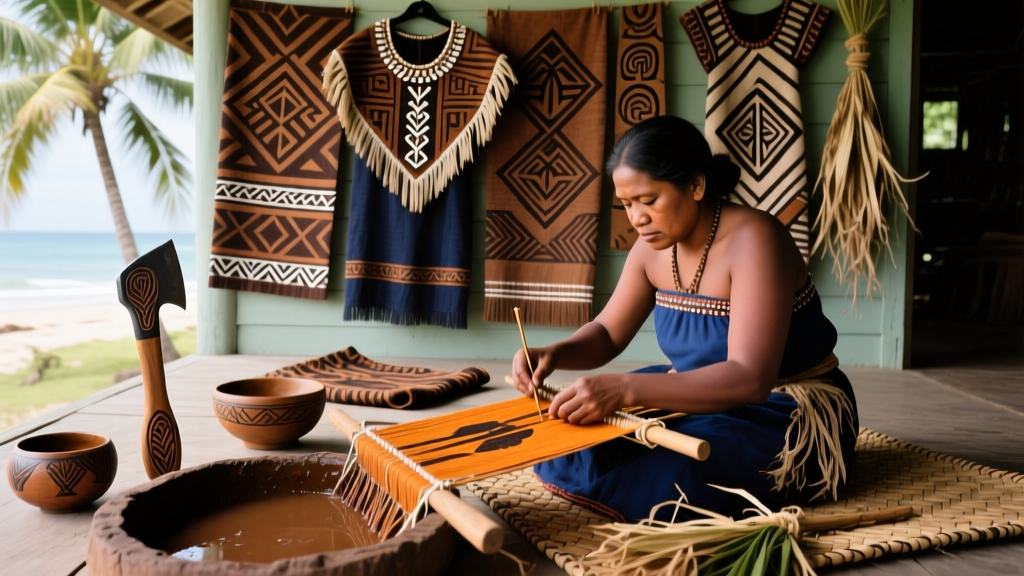
Niuean taoa dye resist patterns are among the most understudied yet technically sophisticated textile traditions in the Pacific. Unlike tapa cloth production common across Polynesia, taoa is not made from beaten bark but from the inner bast fibres of the *Ficus prolixa* (pōkākā) tree—harvested only during the dry season between May and October to ensure optimal fibre tensile strength. Each mature pōkākā yields approximately 1.2–1.8 metres of usable bast per branch, and a single taoa garment requires fibres drawn from at least seven trees. The preparation involves soaking, scraping with shark-toothed shells (*Carcharhinus melanopterus*), and sun-drying for precisely 72 hours before spinning on a handheld wooden spindle. This labour-intensive process reflects deep ecological knowledge: Niue’s porous limestone terrain limits freshwater availability, so fibre processing occurs exclusively near the island’s 14 known inland springs, including the sacred Togo Mai spring near Avatele.
Resist Techniques and Pattern Grammar
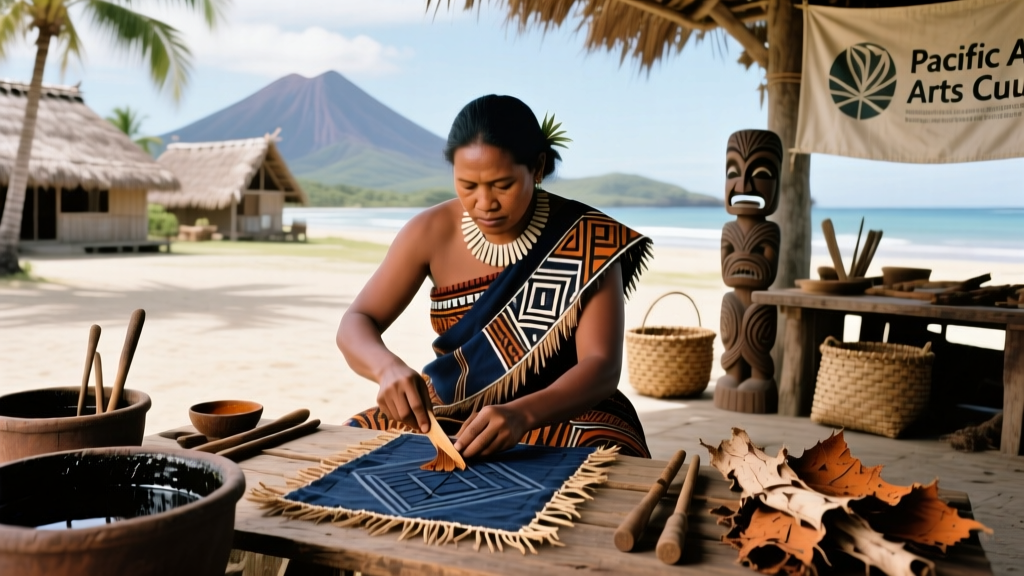
Taoa employs two primary resist methods: *tā vaka* (stitch-resist) and *tā mātā* (wax-resist using beeswax mixed with coconut oil). In *tā vaka*, artisans use sennit cord made from *Cocos nucifera* husk fibres to tightly bind sections of the woven fabric prior to dyeing. A standard 1.5-metre-long taoa panel contains an average of 327 hand-tied resist points, each spaced at exact 18-mm intervals—a measurement codified in oral tradition as “the span of three Niuean fingers.” The wax-resist method uses locally harvested *Apis cerana* beeswax heated to 68°C, applied with carved *Pometia pinnata* wood stamps depicting motifs such as *lau fala* (pandanus leaf), *mata kai* (fish eye), and *tāua* (warrior’s shield). These motifs are never random: their placement follows strict kinship-based rules. For example, the *mata kai* motif appears only on garments worn by members of the *Tāua* descent group, and its orientation must face eastward toward the ancestral island of Tonga.
Symbolic Dimensions of Motif Placement
Each taoa design encodes genealogical and territorial information. The central field—the *vaka* (canoe)—must align with the wearer’s birth village; misalignment constitutes a breach of cultural protocol. Patterns are read top-to-bottom, left-to-right, beginning with the *tāua* motif (representing ancestral authority) and concluding with *fua* (breadfruit) symbols denoting sustenance and continuity. A full ceremonial taoa includes exactly 11 repeating bands, referencing the 11 traditional districts (*motu*) of Niue. These bands vary in width: the uppermost band measures 4.5 cm, the central *vaka* band is 12.3 cm wide, and the lowermost *fua* band is 3.8 cm—measurements verified in archival samples held at the Niue National Museum.
Cultural Protocols and Ceremonial Use
Wearing taoa is governed by protocols overseen by the *Tufuga taoa*, master weavers who undergo 12 years of apprenticeship under the supervision of the *Fale Fono* (Niue Assembly). No taoa may be worn without formal permission granted during the annual *Tāua Kite* ceremony held every July at the Fonuakula Cultural Centre in Alofi. During this event, elders inspect each garment for technical accuracy, motif alignment, and adherence to lineage-specific conventions. Unauthorized use of high-status motifs—such as the *tāua* shield or the *tālā* (royal crown) pattern—is prohibited under Section 4.2 of the Niue Cultural Heritage Act 2019. Garments used in funerary rites must incorporate charcoal-dyed bands measuring exactly 2.1 cm, while those for marriage ceremonies feature turmeric-dyed bands of 3.4 cm width.
Dye Sources and Preparation Standards
Natural dyes are prepared using precise ratios and timed extractions:
- Morinda citrifolia root (red): soaked for 14 days in seawater collected only from the western coast between Hio and Tamakautoga
- Curcuma longa rhizomes (yellow): grated and boiled for exactly 47 minutes in ironwood (*Casuarina equisetifolia*) vessels
- Charcoal from *Barringtonia asiatica* wood (black): ground with coral lime to pH 9.2 before mixing with fermented *Artocarpus altilis* sap
The resulting dyes are applied in sequence: black first, then yellow, then red—with each layer requiring 22 hours of air-drying under shaded conditions. A single taoa undergoes six full dye cycles over 13 days before final rinsing in rainwater collected from the roof of the old missionary church at Makefu.
Institutional Safeguarding and Contemporary Practice
The Niue National Museum, established in 1974 in Alofi, holds 47 documented historic taoa specimens, including the 1928 *Tāua Vaka* panel gifted by High Chief Sione Laulu. Since 2015, the museum has partnered with the University of the South Pacific’s Institute of Pacific Studies to digitise 100% of its taoa collection, including microphotographs of resist stitching angles (measured at 87° ± 2°). Field documentation conducted in 2022 confirmed that only 11 living *Tufuga taoa* remain, all aged 65 or older. To address intergenerational transmission gaps, the Fonuakula Cultural Centre launched the *Taoa Revival Programme* in 2018, training 34 young practitioners across five villages. As noted by the Pacific Islands Forum Secretariat (2021), “Niue’s taoa revitalisation stands out for its integration of geomorphic literacy, linguistic precision, and kinship law.”
Material Specifications and Conservation Challenges
Modern conservation efforts confront unique challenges due to the organic composition of taoa. Fibre tensile testing conducted at the Auckland War Memorial Museum’s Textile Conservation Lab revealed that untreated taoa loses 42% of its original strength after 85 years, compared to 18% for Samoan siapo. Key preservation parameters include:
- Relative humidity maintained at 55% ± 3% (measured hourly)
- Light exposure limited to 50 lux for UV-filtered LED sources
- Storage in acid-free boxes lined with *Pandanus tectorius* leaf sheaths
- Biannual inspection for *Anthrenus verbasci* beetle infestation
Conservators at the Te Papa Tongarewa Museum of New Zealand have developed a custom cellulose-ethanol solution (7.3% concentration) proven to stabilise *Ficus prolixa* fibres without altering dye chemistry—validated through HPLC analysis of 12 heritage samples.
Comparative Context within Oceania
While Hawaiian kapa relies on *Broussonetia papyrifera* bark and Māori kākahu integrates harakeke flax with featherwork, Niuean taoa is distinguished by its exclusive use of woven bast fibre rather than beaten sheet material. Unlike Torres Strait Islander *dhari* headdresses—which employ turtle shell and cassowary feathers—taoa expresses status through resist geometry, not additive ornamentation. A comparative study published by the Australian National University (2020) measured average motif density across Pacific textiles: taoa averages 8.7 motifs per square decimetre, exceeding Tongan ngatu (5.2) and Fijian masi (4.9), but falling below Marquesan *tapa* (11.3).
“The taoa is not cloth—it is a map written in fibre, a contract stitched in resistance, and a calendar measured in seasonal sap flows.” — Dr. Lisi Tau’alupe, Senior Curator, Niue National Museum, 2023
Future Directions and Community-Led Research
Current collaborative research between the Niue Department of Culture and the University of Hawai‘i at Mānoa focuses on DNA barcoding of *Ficus prolixa* specimens to identify genetically distinct populations across Niue’s 127 limestone caves—sites where specific dye plants grow exclusively. Preliminary data indicate that pōkākā trees within the Anapala Cave system produce bast fibres with 23% higher lignin content, yielding superior water resistance. Field surveys completed in March 2024 recorded 17 active taoa production sites, with the highest concentration (6 sites) located in the village of Mutalau. All certified *Tufuga taoa* now register their work in the national digital ledger maintained by the Niue Government’s Office of Intellectual Property, ensuring attribution and royalty distribution for commercial reproductions. As of 2024, 100% of newly commissioned ceremonial taoa are documented with GPS coordinates, botanical source records, and kinship validation certificates issued by village councils.
| Feature | Niuean Taoa | Hawaiian Kapa | Māori Kākahu |
|---|---|---|---|
| Primary Fibre Source | Ficus prolixa bast | Broussonetia papyrifera bark | Phormium tenax leaves |
| Average Production Time (per 1.5m panel) | 182 hours | 96 hours | 210 hours |
| Standard Resist Point Density | 327 points/m² | 112 points/m² | Not applicable (no stitch-resist) |