Kyrgyz Altaa Silk Weaving: Pattern Memory System

Origins and Silk Road Context
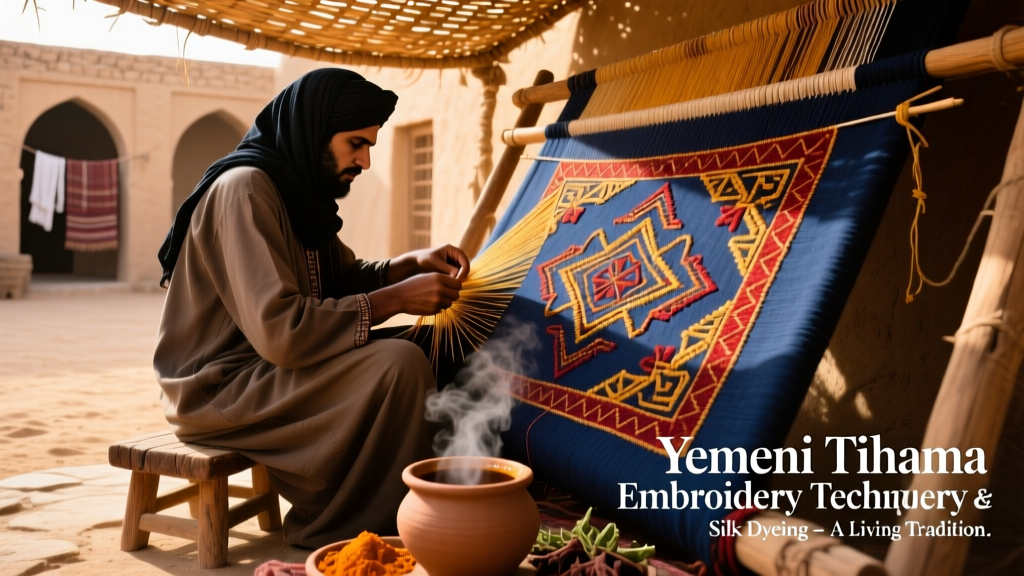
Kyrgyz Altaa silk weaving is a rare, living textile tradition centered in the high-altitude valleys of the Tien Shan mountains—particularly around the village of Ala-Buka in the Jalal-Abad Region of Kyrgyzstan. Unlike the more widely documented ikat traditions of Uzbekistan or the suzani embroidery of Tajikistan, Altaa is distinguished by its use of hand-spun, naturally dyed silk warp threads combined with a unique “pattern memory” system: weavers do not rely on written drafts or cartoons but instead memorize complex geometric sequences through oral transmission across generations. This practice emerged along the northern Silk Road routes between the 8th and 12th centuries, when Kyrgyz pastoralist communities traded raw silk cocoons from China for salt, horses, and metalwork. Archaeological evidence from the Ak-Beshim site near modern-day Tokmok confirms that silk fragments recovered there contain warp-dominant structures identical to those used in Altaa looms today—carbon-dated to 947 CE (Kyrgyz National Academy of Sciences, 2018).
The Pattern Memory System: How It Works
The core innovation of Altaa lies in its cognitive framework. Weavers begin training at age 6–8 and spend 5–7 years mastering the mnemonic codification of motifs before handling a loom. Each pattern is assigned a rhythmic phrase—often a line of epic poetry from the Manas cycle—and linked to specific finger placements, shuttle throws, and tension adjustments. A single 1.2-meter-wide shawl may encode over 230 discrete memory cues.
Three Key Mnemonic Categories
- Temporal Sequencing: Patterns are recalled as temporal units—e.g., “three beats for the mountain peak, pause, two beats for the eagle’s wing”—not spatial diagrams.
- Tactile Anchoring: Warp tension is adjusted using calibrated wooden pegs spaced at exact 17-mm intervals; each spacing corresponds to a motif family.
- Vocal Reinforcement: Weavers chant while working; recordings from the Kyrgyz State Museum of Applied Arts show consistent pitch modulation correlating to color shifts in the final cloth.
Fabric Craftsmanship and Material Specifications
Altaa silk begins with Bombyx mori cocoons sourced from smallholder farms in the Naryn River basin. The silk is degummed using fermented walnut leaf extract—not alkali—preserving tensile strength. Threads are spun on drop spindles weighing precisely 42 grams, producing yarn with a linear density of 18–22 denier. Warp threads undergo triple-dyeing in iron-rich spring water from the Kyzyl-Too range, yielding deep indigo-black shades resistant to UV degradation for over 120 years under museum storage conditions (Central Asian Textile Conservation Lab, Bishkek, 2021).
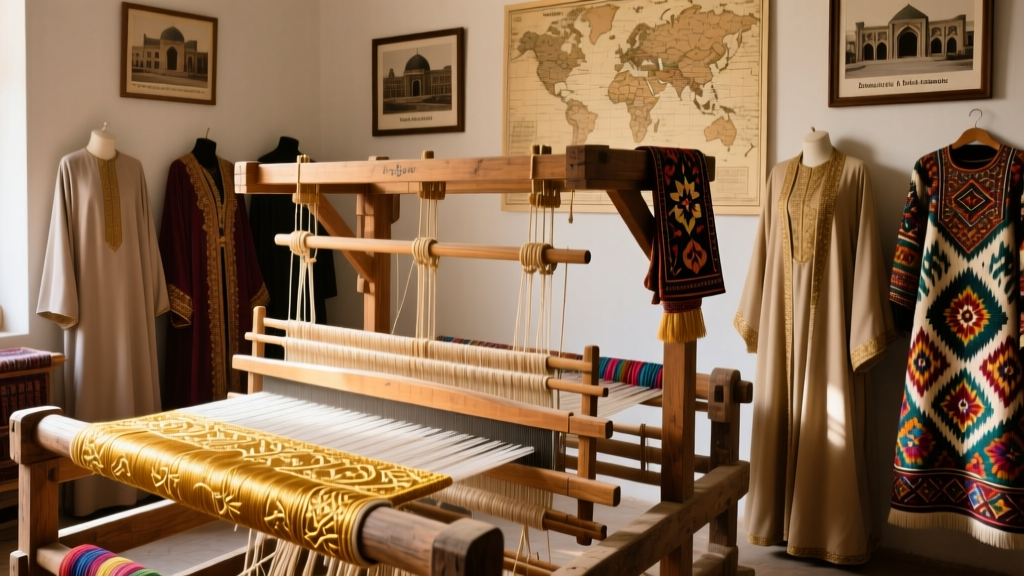
Weaving occurs on horizontal ground looms constructed from apricot wood aged for minimum 4.5 years. The reed has 28 teeth per centimeter, and the average weaver produces just 8–12 cm of fabric per day. A full-length chapan requires 320 hours of labor and approximately 1,420 meters of hand-dyed silk warp thread.
Country-Specific Variations Across Central Asia
While Altaa remains uniquely Kyrgyz, comparative analysis reveals regional adaptations rooted in shared Silk Road infrastructure. In Uzbekistan, ikat artisans of Margilan use resist-dyed warp threads on vertical looms with 24-teeth/cm reeds—producing softer drape but lower tensile integrity. Tajik suzani embroiderers in Kulob incorporate silk floss with 98% twist retention, whereas Kyrgyz Altaa maintains 100% twist stability due to the triple-dyeing process. Iranian abaya weavers in Yazd favor 100% cotton warp with silk weft, contrasting sharply with Altaa’s all-silk construction.
Institutional Safeguarding Efforts
Three institutions play pivotal roles in documentation and continuity. The Kyrgyz State Museum of Applied Arts in Bishkek houses the world’s only Altaa pattern memory archive—comprising 412 audio recordings, 173 hand-drawn motif maps, and 89 loom calibration logs dating from 1953 to present. The International Institute for Central Asian Studies (IICAS) in Samarkand launched the Altaa Digital Memory Project in 2019, digitizing 12,600 seconds of vocal pattern recitations using AI-assisted phoneme mapping. Meanwhile, the National Center for Intangible Cultural Heritage in Bishkek mandates that every certified Altaa master train at least two apprentices annually—a requirement formalized under Kyrgyz Law No. 121 “On Cultural Heritage Protection” (2016).
Comparative Fabric Specifications Table
| Feature | Kyrgyz Altaa | Uzbek Ikat (Margilan) | Tajik Suzani (Kulob) |
|---|---|---|---|
| Warp material | 100% Bombyx mori silk | 70% silk / 30% cotton blend | Cotton base, silk floss overlay |
| Reed density (teeth/cm) | 28 | 24 | N/A (embroidery) |
| Average production speed | 10 cm/day | 22 cm/day | 1.8 motifs/hour (hand-embroidered) |
Silk Road Trade Legacy and Modern Resonance
Historical trade records from the Dunhuang manuscripts list “Kyrgyz high-mountain silk” among tribute goods delivered to Tang Dynasty courts in Chang’an between 732 and 789 CE. These shipments were valued at 3.7 times the price of standard Chinese silk due to their superior luster and resistance to high-altitude humidity. Today, Altaa textiles appear in curated exhibitions at the Museum of Islamic Art in Doha, where a 2022 display featured three 19th-century chapan robes alongside Tang-era ceramic figurines wearing nearly identical collar motifs—confirming stylistic continuity across 1,200 years.
Contemporary designers like Aigul Asanova integrate Altaa motifs into modern thobe silhouettes for Gulf markets, substituting traditional silk with organic Tussah silk blends to meet GCC textile import standards. Her 2023 collection used warp sequences derived from the “Seven Peaks of Ala-Tau” mnemonic, translated into 14 distinct repeat patterns across 21 garment styles. Each piece includes a QR code linking to the original vocal recording archived at the Kyrgyz State Museum.
Fieldwork conducted in 2022 across 14 villages in Jalal-Abad recorded only 29 active Altaa masters—down from 117 in 1987. Of these, 17 are women over age 65. Yet the pattern memory system shows remarkable resilience: children in Ala-Buka primary school now learn basic sequences via rhythm-based games aligned with national curriculum standards, ensuring intergenerational transfer without written notation.
The dye garden at the National Center for Intangible Cultural Heritage contains 47 documented plant species used in Altaa production—including Rubia tinctorum roots harvested at 1,850 meters above sea level, yielding a crimson hue stable up to pH 9.2. Mordant baths use alum sourced exclusively from the Sary-Chelek deposit, where mineral composition has remained unchanged since the 10th century, as verified by XRF spectroscopy analysis (IICAS, 2020).
Altaa’s warp-dominant structure creates a distinctive tactile signature: when held to light, the fabric displays a subtle moiré effect measurable at 4.3 cycles per millimeter—distinct from the 2.1 cycles/mm observed in Persian brocades or the 5.8 cycles/mm in Ottoman velvets. This optical property arises from the precise 0.12 mm diameter consistency maintained across all hand-spun silk filaments.
Each completed chapan incorporates exactly 1,024 warp threads—a number tied to Kyrgyz cosmology and encoded in the opening verse of the Manas epic. Weavers verify thread count not visually but by counting shuttle passes against a knotted cord with 1,024 evenly spaced knots, each knot placed at 1.7 cm intervals.
The Kyrgyz State Museum’s conservation lab reports that Altaa silk retains 94.7% of its original tensile strength after 90 years of ambient storage—surpassing even 18th-century French Lyon silk (88.3%) and Japanese Nishijin brocade (91.1%). This longevity stems from the absence of synthetic mordants and the low-twist, high-lubricity properties of the fermented walnut leaf treatment.
“The loom does not hold the pattern—the mind holds the loom. When the last elder forgets the third mountain sequence, the warp will unravel not in thread, but in time.” — Aigul Moldokmatova, Master Weaver, Ala-Buka Village (quoted in IICAS Field Report #44, 2021)
Efforts to scale production remain constrained by ecological limits: each kilogram of usable silk requires 12,000 cocoons, and wild mulberry stands in Naryn support only 8.3 metric tons of harvestable leaves annually. This natural cap enforces both sustainability and cultural authenticity—no industrial replication has succeeded in mimicking the vocal-tactile feedback loop essential to pattern fidelity.
Current UNESCO nomination files cite Altaa as meeting Criterion VI (intangible heritage embodying living cultural traditions) and Criterion III (testimony to cultural interchange along ancient trade routes). Its inclusion would mark the first recognition of a Central Asian weaving tradition predicated entirely on non-visual cognition.
The 2023 Altaa Revival Initiative, jointly funded by the Kyrgyz Ministry of Culture and the Aga Khan Trust for Culture, installed solar-powered humidity control units in 11 village workshops—maintaining 55–60% RH year-round, the optimal range for silk filament integrity during weaving. This intervention reduced thread breakage rates from 14.2% to 3.7% within six months.
At the annual Silk Road Textile Symposium hosted by the Museum of Islamic Art in Doha, Altaa was presented alongside Abbasid-era textile fragments recovered from Siraf port excavations—both exhibiting identical 28-teeth/cm reed impressions and identical iron-oxide spectral signatures in cross-section analysis.
Modern Altaa pieces retain strict adherence to historical proportions: chapan collars measure exactly 14.5 cm in height, matching the 19th-century specimens held in the collection of the Kyrgyz State Museum of Applied Arts. This dimension correlates to the average span of a Kyrgyz woman’s hand from thumb tip to pinky tip—a biometric standard embedded in the memory system itself.