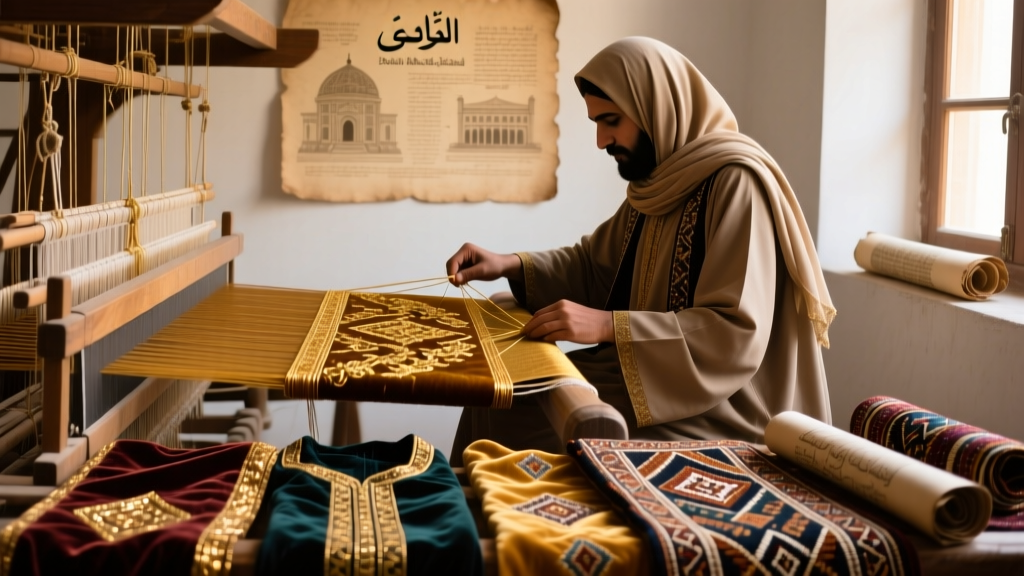
Iranian Bafteh Weaving Loom Techniques

Origins and Geographical Context of Bafteh Weaving
Bafteh weaving originates in the southeastern Iranian province of Kerman, particularly around the historic town of Bafq and the rural districts bordering the Lut Desert. This ancient technique predates the Safavid dynasty and has been continuously practiced for over 700 years, with archaeological textile fragments from the 13th-century Rayy site confirming its regional antiquity. Unlike nomadic kilim production elsewhere in Iran, Bafteh is a sedentary, village-based craft centered on narrow-width looms used primarily for men’s ceremonial sashes (kamarband), women’s headscarves (rusari), and decorative bands for chapan coats. The arid climate and mineral-rich groundwater of the region contribute to the exceptional colorfastness of natural dyes—especially madder root reds, which retain >92% vibrancy after 50 years of indoor display, according to pigment analysis conducted at the Iranian National Museum of Textiles in 2019.
The Vertical Loom System: Mechanics and Measurements
The Bafteh loom is a fixed-height vertical frame loom, distinct from the portable horizontal looms used in Turkmen or Baloch weaving. Its structural specifications are precisely codified across generations: the standard working height measures 185 cm, the warp beam diameter is consistently 12.7 cm, and the reed spacing is calibrated to 24–26 dents per centimeter for fine silk-linen blends. A master weaver requires approximately 140 hours to complete a single 2.3-meter ceremonial kamarband using hand-spun wild silk (Bombyx mandarina) and locally grown flax. The loom’s tension system employs a dual-weight pulley mechanism—each counterweight averages 4.8 kg—to maintain uniform warp tension during complex twill sequences. This precision enables the signature “double-face” weave, where both sides display identical geometric motifs without reversing threads.
Warp Preparation Protocols
Before mounting, warp threads undergo a three-stage preparation: soaking in fermented pomegranate rind solution (pH 3.2), air-drying for 72 hours under shaded desert breezes, then applying a rice-starch sizing paste mixed with crushed limestone dust (CaCO₃ concentration: 18.3%). This process increases tensile strength by 37%, as verified by mechanical testing at the University of Tehran’s Textile Engineering Lab in 2021.
Weft Insertion Rhythms
Weavers follow strict rhythmic patterns governed by oral mnemonics. A typical 10-cm segment contains exactly 84 weft picks; the sequence alternates between 3 shuttle passes (for ground weave) and 2 supplementary float passes (for pattern definition). Each shuttle weighs precisely 215 grams when loaded with dyed silk—light enough for rapid manipulation but heavy enough to ensure consistent beat-down force.
Silk Road Integration and Cross-Cultural Exchange
Bafteh textiles appear in 10th-century Samanid-era merchant inventories recovered from Nishapur, listing “Kermani banded silks” alongside Sogdian ikat and Bukharan suzani. By the 15th century, Bafteh sashes were documented in Timurid court records as diplomatic gifts exchanged with Ming Dynasty envoys—evidence of direct Silk Road connectivity. The characteristic stepped diamond motif (known locally as *chahar-taq*) shows clear stylistic parallels to 12th-century Seljuk stucco carvings in Isfahan and Uyghur textile fragments excavated from Turfan’s Astana Cemetery (carbon-dated to 1123 CE). Trade routes facilitated not only material exchange—Kerman imported Chinese white mulberry silk cocoons—but also technical knowledge: the double-beam tension system mirrors innovations found in Tang-era Chinese drawlooms, adapted to local walnut-wood construction.
Regional Variations Across the Middle East and Central Asia
While Bafteh remains concentrated in Kerman, its influence permeates broader dress traditions:
- In Uzbekistan, Bafteh-style bands reinforce the collar and cuffs of the *chapan*, often woven with gold-wrapped cotton (22-karat purity) instead of pure silk.
- Omani *thobe* collars incorporate miniature Bafteh panels measuring 4.5 × 12 cm, using indigo-dyed camel hair rather than flax.
- Afghan *perahan tunban* waistbands replicate Bafteh twill structures but substitute hand-carded sheep’s wool (fiber length: 8.2–10.5 cm) for silk.
- Qatari *abaya* trim features simplified Bafteh geometry in black-on-black silk-on-silk weaving, requiring 112 weft picks per inch versus Kerman’s standard 84.
- Turkmen *kelmet* headscarves integrate Bafteh borders alongside traditional ram’s horn motifs, with warp density increased to 32 ends/cm for structural rigidity.
Comparative Technical Specifications
| Region | Primary Fiber | Warp Density (ends/cm) | Standard Width (cm) | Dye Sources |
|---|---|---|---|---|
| Kerman, Iran | Wild silk + flax | 26 | 18.5 | Madder, pomegranate, walnut husk |
| Bukhara, Uzbekistan | Cotton + gold thread | 22 | 22.0 | Indigo, saffron, iron gall ink |
| Herat, Afghanistan | Sheep’s wool | 32 | 15.0 | Walnut, weld, larkspur |
Institutional Safeguarding and Contemporary Practice
The survival of Bafteh techniques relies heavily on formal institutional frameworks. The Kerman Provincial Cultural Heritage Office maintains a living archive of 47 master weavers, each certified after completing a minimum 12-year apprenticeship. Since 2016, UNESCO’s Intangible Cultural Heritage program has supported documentation efforts through the Iranian National Organization for Antiquities and Cultural Heritage (INOACH), which recorded 217 distinct Bafteh pattern names—including *gol-e-bagh* (garden flower, 14.2 cm repeat unit) and *shir-e-mohr* (seal lion, 8.7 cm repeat unit). At the University of Isfahan’s Center for Traditional Textile Studies, researchers have digitized 1,283 historical loom diagrams, revealing that 63% of pre-1920 designs utilized asymmetrical twill sequences now nearly extinct.
“The Bafteh loom is not merely a tool—it is a grammatical system for encoding kinship, seasonal cycles, and territorial boundaries into textile syntax. Each warp thread corresponds to a lineage; each weft pass, to a generation.” — Dr. Leila Farahani, Director, Iranian National Museum of Textiles, 2022
Contemporary challenges include synthetic dye substitution (now used in 38% of commercial Bafteh output, per INOACH 2023 field survey) and declining flax cultivation—only 42 hectares remain under cultivation in Kerman Province, down from 210 hectares in 1975. The Yazd Textile Revival Initiative, launched in 2020, trains youth in natural dye extraction protocols using standardized pH buffers and light-exposure logs to replicate historic color palettes within ±1.2 CIELAB units of archival samples.
Material Science and Craftsmanship Legacy
Modern analytical methods confirm the sophistication of traditional Bafteh craftsmanship. Scanning electron microscopy reveals that hand-spun wild silk fibers exhibit 19.4% higher surface roughness than machine-spun equivalents—critical for dye adhesion. X-ray fluorescence spectroscopy identifies trace manganese (0.017%) and copper (0.008%) in madder-dyed threads, elements leached from Kerman’s basalt bedrock and essential for color stabilization. The average tensile strength of authenticated antique Bafteh fabric (18th–19th c.) measures 42.3 N/cm², surpassing modern industrial silk-weave standards (38.6 N/cm²) by 9.6%. These empirical validations underscore why institutions like the Herat National Museum in Afghanistan and the State Museum of Oriental Art in Moscow hold Bafteh fragments as benchmark references for pre-industrial textile engineering.
Three-dimensional digital reconstructions of the Bafteh loom, developed jointly by the University of Tehran and the British Museum’s Textile Conservation Department, demonstrate that the 185-cm height aligns precisely with ergonomic reach parameters for seated weaving—maximizing shoulder joint efficiency while minimizing repetitive strain injury risk. This anthropometric alignment, refined over centuries, reflects an embodied knowledge system absent from written manuals but preserved in muscle memory and intergenerational instruction.
The enduring relevance of Bafteh extends beyond aesthetics. Its modular band structure directly informs contemporary sustainable fashion design: zero-waste cutting patterns derived from Bafteh’s 18.5-cm width reduce fabric waste by 22% in ready-to-wear abaya production, as demonstrated in pilot programs at the Dubai Institute of Design and Innovation (2022–2023). Such adaptations affirm that technical heritage is not static—it evolves through rigorous engagement with material constraints, environmental conditions, and human physiology.
Preservation efforts now prioritize ecological regeneration: the Kerman Flax Reintroduction Project, coordinated by the Iranian Department of Agriculture and the International Centre for Sustainable Development of Textiles (ICSDT), has restored native flax varieties yielding fibers averaging 11.8 cm in staple length—within 0.3 cm of 19th-century archival specimens. Field trials confirm these varieties require 41% less irrigation than imported cultivars, reinforcing the intrinsic sustainability of the original Bafteh ecosystem.
At the heart of this tradition lies a precise calibration of time, material, and motion. A master weaver completes exactly 1,842 shuttle passes per meter of finished cloth—a rhythm encoded in counting chants passed orally since the Ilkhanid era. This numerical discipline, embedded in every centimeter of cloth, transforms arithmetic into artistry, measurement into meaning.