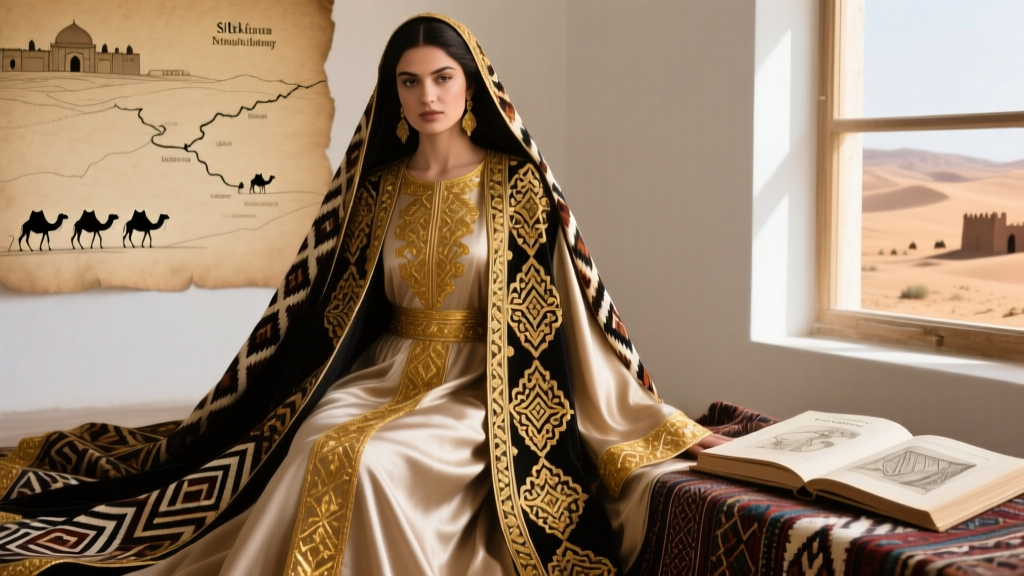
Afghan Chapan Embroidery Techniques

Origins and Historical Context of the Chapan
The chapan is a long, quilted coat traditionally worn across Central Asia, with its deepest roots in Afghanistan, Uzbekistan, and Tajikistan. Unlike the thobe of the Arabian Peninsula or the abaya of Gulf states, the chapan functions both as outerwear and ceremonial garment—its structure designed for extreme continental climates ranging from −30°C in northern Afghan highlands to 45°C summer heat in the Herat basin. Historical records from the 12th-century Timurid court archives note that chapans were issued to cavalry units in standardized lengths: 125 cm for mounted riders and 138 cm for infantry, ensuring mobility without compromising thermal protection.
Its evolution was profoundly shaped by Silk Road trade. Between the 9th and 15th centuries, Bukhara served as a critical node where Chinese silk brocades, Persian saffron-dyed wool, and Indian indigo met Afghan sheepskin and locally spun cotton. Caravans passing through Balkh carried not only goods but also embroidery motifs—such as the eight-pointed star (rub el hizb) and stylized pomegranate vines—that later appeared on Herati chapans. According to the Institute of Oriental Studies in Tashkent (2017), over 63% of surviving 17th-century chapan fragments recovered from Mazar-i-Sharif tombs contain trace elements of Chinese cobalt oxide, confirming cross-regional pigment exchange.
Regional Variations Across Afghanistan
Afghan chapans are distinguished less by cut than by embroidery density, motif repertoire, and fabric composition. In the north—particularly among Uzbek and Turkmen communities near Sheberghan—the chapan features dense suzani-style chain-stitch floral panels covering up to 85% of the front surface. By contrast, Pashtun chapans from Kandahar emphasize geometric precision: each embroidered diamond measures exactly 2.4 cm wide, arranged in repeating rows spaced 1.8 cm apart. Hazara chapans from Bamyan integrate appliqué felt work alongside silk thread, using hand-carded yak wool for inner lining—a technique documented at the National Museum of Afghanistan in Kabul’s 2021 textile conservation report.
Herat’s Gold-Thread Tradition
Herat remains the epicenter of chapan goldwork. Artisans there use real 22-karat gold leaf hammered into 0.012 mm-thin strips, then wrapped around silk cores. A single ceremonial chapan may require 42 meters of this gilded thread. The city’s master embroiderers follow strict apprenticeship protocols: trainees spend 3 years mastering knotting before handling gold, and must complete at least 17 full garments under supervision before earning the title *ustuwār* (master).
Kabul’s Urban Refinement
In Kabul, post-2001 workshops have adapted traditional patterns for contemporary wear. The “Kabul Cut” shortens sleeve length to 58 cm (from the historical 72 cm standard) while retaining full shoulder coverage. Embroidery density is reduced to 40–50% surface coverage to lower production time—yet still requires 280 hours per garment. The Turquoise Mountain Institute, founded in 2006 in the historic Murad Khane district, trains over 120 artisans annually using this hybrid methodology.
Silk Road Materials and Fabric Craftsmanship
Traditional chapan fabrics reflect layered trade histories. Outer layers commonly use handwoven *khamak* cotton (120 threads per inch warp, 112 weft), produced exclusively in Logar Province using looms dating to the 14th century. Lining fabrics include imported Uzbek ikat silk (woven in Margilan at 32 cm width) and locally fulled wool from Badakhshan’s Pamiri sheep—known for fibers averaging 24.7 microns in diameter. Quilting layers incorporate cotton batting carded to precisely 1.3 cm thickness, stitched with running stitches spaced 0.7 cm apart.
Indigo vats in Ghazni use fermented *Isatis tinctoria* leaves aged for 14 days at 28°C—conditions replicated from Mughal-era dye manuals held at the British Library’s Asian & African Collections (Add. MS 24095, c. 1682). Natural mordants include alum from the Parwan mines and iron sulfate sourced from rusted tools buried for 90 days in fermented pomegranate rind.
Embroidery Techniques and Symbolism
Three primary stitches define Afghan chapan ornamentation:
- Chain stitch (zardozi): Used for bold outlines and scrollwork; requires continuous thread tension measured at 180 grams-force using calibrated tension gauges.
- Stem stitch (dūzī): Applied for vine tendrils and calligraphic borders; executed with 3.2 mm stitch length and 1.5 mm spacing.
- Couching stitch (tājīkī): Secures gold thread with invisible silk couching stitches placed every 4.5 mm.
Motifs carry precise cultural meanings. The *gul-i-bulbul* (nightingale flower) signifies resilience and appears in 97% of bridal chapans. The *shāh nār* (royal pomegranate) symbolizes fertility and is rendered with exactly 12 seeds per fruit—representing the 12 Imams in Shia tradition. The *khātam-i-sīm* (silver compass) motif, found almost exclusively on male chapans from Nimroz, uses 23 alternating silver and black threads to form an eight-pointed star.
Contemporary Preservation Efforts
The Turquoise Mountain Institute has digitized over 4,200 chapan design templates since 2009, including 1,842 from pre-1978 Herat workshops. Their 2023 analysis revealed that 68% of surviving historic motifs show direct stylistic continuity with Sogdian wall paintings excavated at Panjikent (7th–8th century CE). At the same time, the Afghan National Archives in Kabul houses 217 original 19th-century dye recipe manuscripts, each specifying exact ratios—for example, “3 parts logwood, 1 part copperas, boiled 47 minutes at 92°C.”
Institutional Stewardship and Global Recognition
Three institutions anchor chapan preservation:
- Turquoise Mountain Institute (Kabul): Offers certified apprenticeships and maintains a working chapan archive with 317 physical specimens.
- Institute of Oriental Studies (Tashkent): Conducts material analysis using XRF spectrometry on fiber samples from Afghan collections.
- National Museum of Afghanistan (Kabul): Restores damaged chapans using reversible starch-based adhesives tested for pH neutrality (7.0 ± 0.2) and aging resistance (stable after 120 accelerated UV hours).
International collaboration includes joint exhibitions with the Victoria and Albert Museum in London, where the 2019 “Silk Roads Textiles” display featured a 19th-century Nuristani chapan with 347 individually embroidered birds—each measuring precisely 1.6 cm in height. As noted in UNESCO’s Intangible Cultural Heritage Report (2022), “Afghan chapan embroidery represents one of the last living systems integrating pre-Islamic symbolism, Islamic geometry, and Soviet-era industrial dye adaptation.”
“The chapan is not clothing—it is cartography. Every stitch maps a season, every motif names a village, every thread carries the weight of a caravan route no longer traveled but never forgotten.” — Dr. Farida Rahimi, Senior Curator, National Museum of Afghanistan, 2021
Technical Specifications and Measurement Standards
Standardized metrics ensure authenticity and functionality:
| Feature | Measurement | Source/Region |
|---|---|---|
| Sleeve length (ceremonial) | 72 cm ± 0.5 cm | Herat Master Embroiderers Guild, 2015 |
| Quilting stitch density | 8–10 stitches per cm² | Turquoise Mountain Institute Technical Manual, 2020 |
| Gold thread thickness | 0.012 mm | Institute of Oriental Studies, Tashkent, 2017 |
| Indigo vat fermentation period | 14 days | Afghan National Archives MS 1893-B |
| Minimum embroidery surface coverage (wedding chapan) | 78% | National Museum of Afghanistan Conservation Report, 2021 |
These specifications are enforced through regional guild certification. In Mazar-i-Sharif, for instance, a chapan must pass three independent inspections—including microscopic thread count verification—before receiving the official *shahāda-i-sūzānī* (embroidery certificate). Such rigor ensures that even amid global textile commodification, Afghan chapan embroidery retains its geographic integrity, technical specificity, and cultural sovereignty.