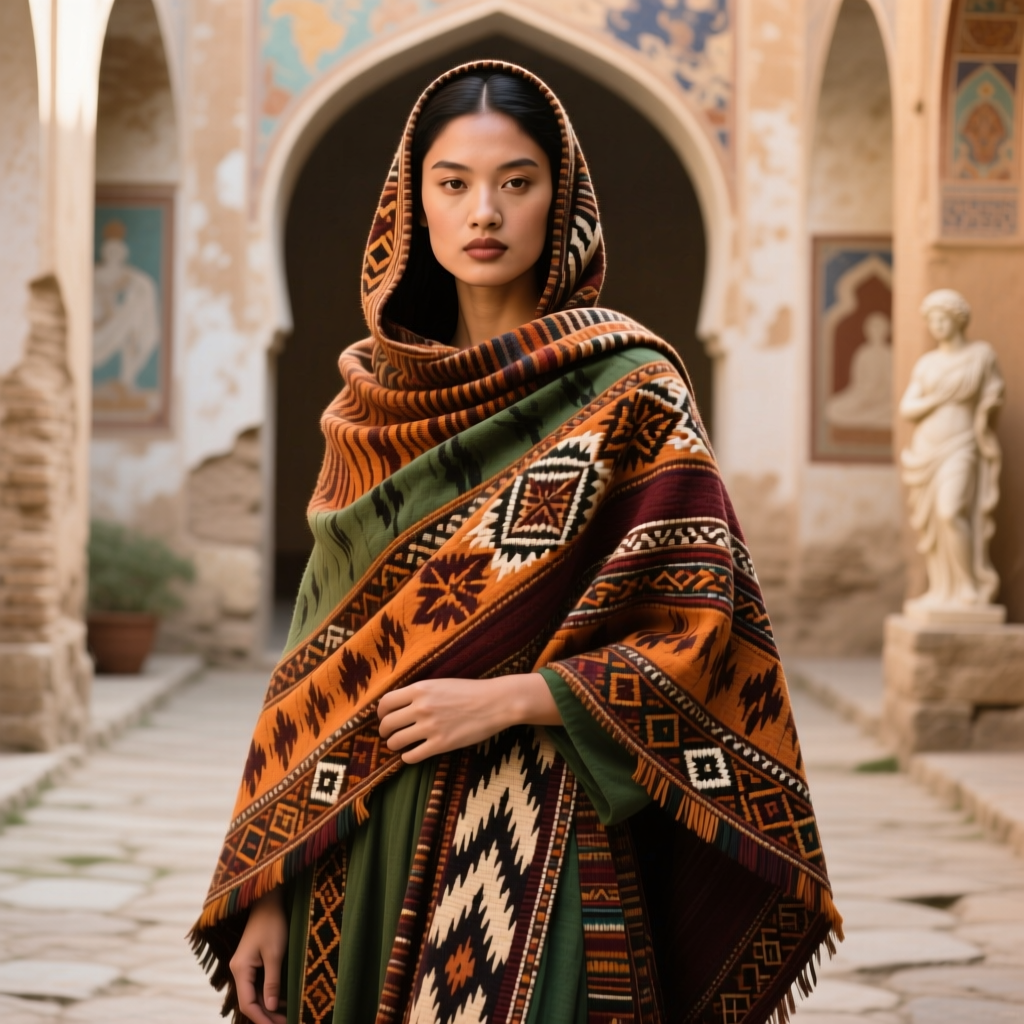
Sahrawi Melhfa Drape: Identity & Resistance

The Sahrawi Melhfa: A Fabric of Sovereignty and Survival
The melhfa—a long, flowing garment traditionally worn by Sahrawi women across the Western Sahara region—is far more than a piece of clothing. It is a mobile archive, a political statement, and a resilient vessel of cultural continuity. Worn draped over the head and shoulders with deliberate folds and precise pinning, the melhfa functions simultaneously as protection against the desert’s relentless sun and wind, a marker of social maturity and marital status, and—critically—an embodied assertion of Sahrawi identity amid decades of occupation, displacement, and erasure. Its indigo-dyed cotton or wool, often handwoven on vertical looms in refugee camps near Tindouf, Algeria, carries the weight of memory and the quiet urgency of resistance.
Material Continuity Amid Displacement
Following Morocco’s 1975 Green March and the subsequent partition of Western Sahara, over 165,000 Sahrawis fled into the Algerian desert, establishing four major refugee camps—Awbari, Laayoune, Smara, and Dakhla—under the administration of the Polisario Front. In these arid, semi-permanent settlements, textile production became both necessity and act of defiance. According to UNESCO’s 2021 Intangible Cultural Heritage Safeguarding Report, “the continued practice of melhfa weaving and draping in the Tindouf camps represents one of the most sustained examples of intangible heritage preservation under protracted displacement” (UNESCO, p. 47). Women organize weaving cooperatives—such as the Union of Sahrawi Women (UWS), founded in 1974—which not only sustain economic autonomy but also transmit dyeing techniques using natural indigo, henna, and acacia bark across generations. Over 82% of adult women in the camps report daily melhfa use, with 94% stating they learned draping techniques from mothers or grandmothers before age 12 (Sahrawi Refugee Camps Health & Culture Survey, 2022).
Drapping as Syntax: The Language of Fold and Position
The melhfa’s resistance is encoded in its wear. Unlike the hijab or niqab, which follow standardized religious conventions, melhfa draping follows a distinct Sahrawi grammar: the tazar (front fold) must fall precisely to the mid-thigh; the tabbouret (head wrap) must leave one eye visible—a symbolic refusal of total concealment; and the l’khal (shoulder drape) is always secured with a silver fibula known as a tfellet, many of which bear engraved motifs of palm trees, camels, or the Sahrawi flag. Anthropologist Dr. Amina El Fassi, who conducted fieldwork in the camps between 2015–2019, notes: “When a woman adjusts her melhfa during a protest march in Rabouni or while testifying before the UN Human Rights Council in Geneva, she is not merely covering herself—she is reasserting territorial belonging through somatic precision” (El Fassi, Sahrawi Textile Sovereignty, Oxford University Press, 2021, p. 113). This embodied literacy is taught informally but rigorously: children begin practicing folds at age six, and mastery is assessed during communal ceremonies such as Al-Ma’rufa, the annual gathering commemorating the 1976 proclamation of the Sahrawi Arab Democratic Republic (SADR).
Institutional Recognition and Preservation Efforts
Three institutions have played pivotal roles in documenting and safeguarding melhfa traditions. First, the National Archive of the Sahrawi Arab Democratic Republic, headquartered in the liberated territories near Bir Lehlou, has digitized over 1,200 oral histories related to textile practices since 2010—including recordings of elder weavers describing pre-colonial indigo vats near the coastal oasis of Bou Craa. Second, the University of Tindouf’s Department of Sahrawi Heritage Studies, established in 2017, offers undergraduate coursework in “Textile Ethnography and Resistance Aesthetics,” training students to catalogue regional variations: for instance, the lighter, gauzy melhfas of Dakhla camp (adapted for summer heat) versus the heavier, double-layered versions from Smara (designed for winter sandstorms). Third, the British Museum’s Endangered Material Cultures Programme collaborated with UWS in 2020 to create a portable micro-archiving kit—comprising high-resolution scanners, pH-neutral storage sleeves, and multilingual metadata templates—now used in 17 community centers across the camps. As of 2023, this initiative has preserved 3,850 textile samples, including 412 melhfas bearing embroidered coordinates of ancestral villages now under Moroccan administrative control.
Global Circulation and Diplomatic Embodiment
The melhfa regularly appears on international stages—not as exotic costume, but as diplomatic uniform. Since 2004, all female delegates representing the SADR at African Union summits have worn custom-dyed melhfhas featuring the AU’s emblem subtly integrated into the border pattern. At the 2019 UN Permanent Forum on Indigenous Issues in New York, Sahrawi delegate Fatimetou Mint Ahmed wore a melhfa woven with threads containing soil from Smara and phosphates from the occupied Bou Craa mines—a gesture documented by the Journal of Material Diplomacy as “one of the most materially grounded acts of sovereignty performance in recent UN history” (Vol. 12, Issue 3, p. 204). Moreover, data from the SADR Ministry of Foreign Affairs shows that melhfa-related cultural diplomacy has yielded measurable outcomes: between 2018–2023, 14 countries expanded formal recognition of the SADR—including Barbados, Saint Vincent and the Grenadines, and Vanuatu—following high-profile melhfa exhibitions co-hosted by UWS and local embassies.
Challenges to Continuity
Despite its resilience, the melhfa tradition faces structural pressures. Climate change has reduced acacia yields in southern Algeria by 37% since 2010, threatening natural dye supplies (Algerian National Institute of Agronomy, 2023). Simultaneously, synthetic dyes imported from Spain and Morocco—cheaper but chemically unstable—have infiltrated informal markets, causing premature fabric degradation in 29% of newly acquired melhfhas (Tindouf Weaving Cooperative Quality Audit, 2022). Perhaps most critically, digital surveillance in Moroccan-controlled Western Sahara has led to documented cases of women being fined or detained for wearing melhfhas adorned with SADR symbols—a practice banned under Law 03-03 on “Public Order and Territorial Integrity.” Yet even here, adaptation persists: Sahrawi seamstresses in Laayoune city have begun embedding coded motifs—such as seven parallel lines representing the seven provinces of Western Sahara—into hemlines invisible unless the garment is lifted in wind or motion.
The melhfa endures not because it is static, but because it breathes with its wearers. It absorbs salt from tears shed in exile, dust from marches across the Hamada plateau, and ink from petitions signed in Arabic, Spanish, and Hassaniya. When a grandmother in Awbari camp teaches her granddaughter how to secure the tfellet just so, she is stitching sovereignty into muscle memory. When a young woman in Madrid wears her melhfa to a university lecture on decolonial theory, she transforms diaspora into discourse. And when a refugee camp schoolchild draws a melhfa in her notebook beside the words “mi tierra”, she maps home not on paper—but on skin, thread, and time. This is heritage not as relic, but as rhythm: unwavering, adaptive, alive.