The Orenburg Lace Shawl: A Heritage of Goat Down Knitting in the Russian Steppes
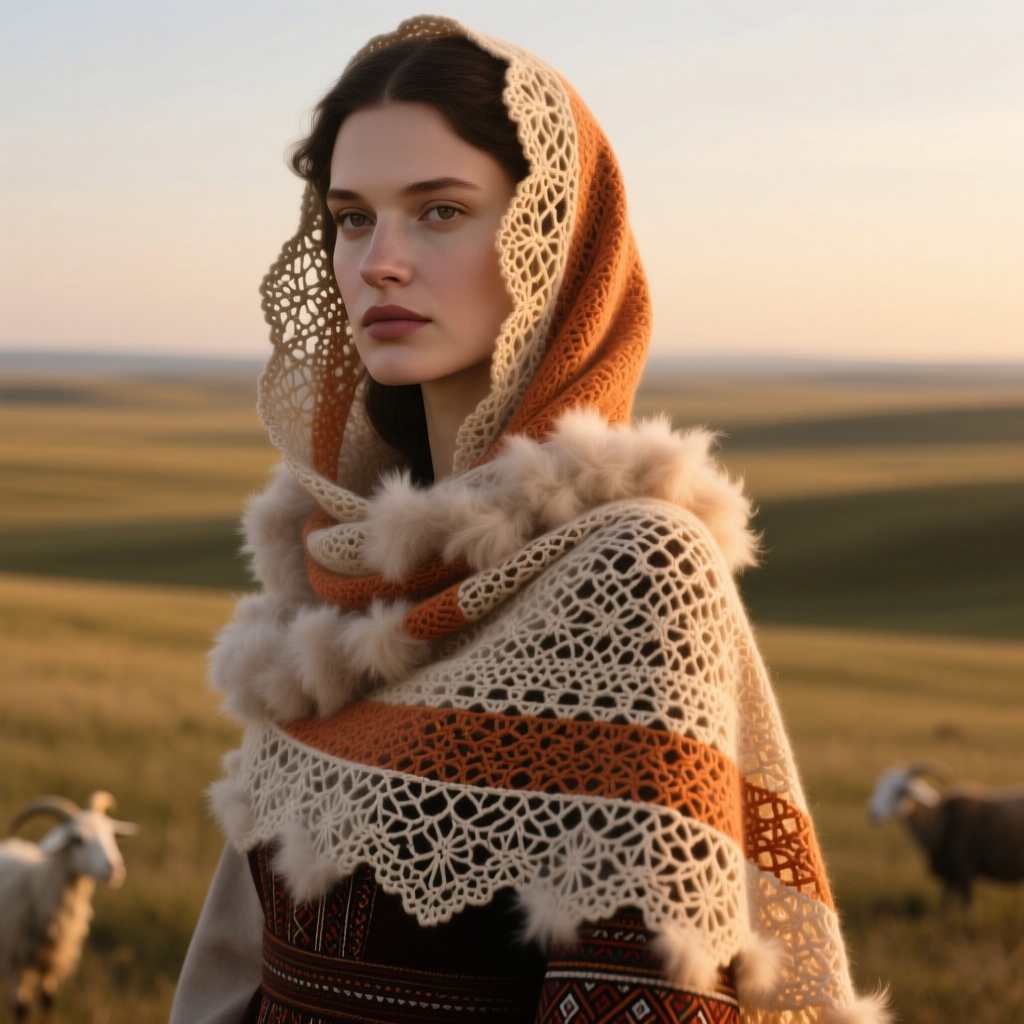
Imagine a textile so finely spun, yet so remarkably warm, that an entire shawl can be pulled effortlessly through a standard wedding ring. This is not a myth or a fairy tale, but the defining characteristic of the Orenburg lace shawl, a masterpiece of Russian textile heritage. Born in the harsh, unforgiving climate of the Ural steppes, this extraordinary garment represents a perfect synthesis of extreme warmth and gossamer delicacy. For centuries, the artisans of the Orenburg region have transformed the ultra-fine undercoat of local goats into intricate, snowflake-like webs of lace that have captivated the world.
The Orenburg shawl is far more than a mere accessory; it is a profound cultural artifact that tells the story of survival, artistry, and generational knowledge. In our exploration of global textile traditions, understanding the traditional lace-making heritage of Russia offers a unique glimpse into how extreme environments can birth unparalleled craftsmanship. This article delves deep into the history, meticulous creation process, and enduring legacy of the Orenburg goat down shawl, celebrating the artisans who continue to keep this delicate tradition alive.
The Historical Roots of Orenburg Goat Down Knitting
The origins of the Orenburg lace shawl are inextricably linked to the severe continental climate of the southern Ural Mountains and the adjacent steppes. In this region, winters are notoriously long, windy, and bitterly cold, while summers are hot and dry. It is precisely this extreme fluctuation in temperature that causes the indigenous Orenburg goats to develop an extraordinary undercoat. To survive the freezing winters, these goats grow a secondary layer of down that is exceptionally fine, soft, and insulating. When the spring winds arrive, the goats naturally shed this precious undercoat, which local populations began harvesting and utilizing for warmth.
The earliest iterations of goat down knitting were purely utilitarian. Indigenous nomadic tribes and later Cossack settlers in the region knitted thick, dense garments to protect against the biting steppe winds. However, as the region became more integrated into broader Russian trade networks, the craft began to evolve. Artisans realized that the down was not only incredibly warm but also fine enough to be spun into delicate threads. By the late eighteenth and early nineteenth centuries, the craft had transitioned from the creation of heavy, utilitarian undergarments to the production of the exquisite, openwork lace shawls that would eventually gain international acclaim.
Historically, the Orenburg shawl gained widespread recognition when it was presented at various imperial exhibitions and later at international world fairs. European aristocrats and merchants were astounded by the paradox of the shawl: it possessed the insulating properties of heavy wool but the visual lightness of a spiderweb. This global exposure elevated the Orenburg shawl from a regional necessity to a highly sought-after luxury item, cementing its place in the annals of global textile history and establishing a legacy that continues to influence winter layering techniques in high fashion.
The Craftsmanship Behind the Gossamer Threads
The creation of an authentic Orenburg lace shawl is a labor-intensive process that demands immense skill, patience, and an intimate understanding of natural fibers. The journey begins in the spring when the goats are not sheared, but carefully combed. Combing ensures that only the finest, softest undercoat is collected, leaving the coarse outer guard hair behind. This raw down is then meticulously washed, dried, and sorted by hand. The sorting process is crucial, as the artisan must separate the fibers by length and fineness to ensure a uniform yarn.
Spinning the down is perhaps the most critical and difficult step. Pure goat down lacks the tensile strength to hold the complex lace patterns on its own; a shawl knitted entirely of pure down would easily tear under its own weight. To solve this, master spinners introduce a core thread, traditionally made of natural silk or finely spun cotton. The down is spun around this invisible core, creating a composite yarn that possesses both the ethereal halo of the goat down and the structural integrity of the silk. For those interested in the science and art of such materials, our natural fibers guide provides further insights into how natural blends enhance textile durability.
Once the yarn is spun, the knitting begins. Artisans use extremely fine needles, often custom-made or specially sourced, to create the intricate openwork patterns. The knitting is done entirely by hand, and a single, large shawl can take hundreds of hours to complete. The patterns are not written down; they are memorized and passed down from mother to daughter, residing in the muscle memory and creative intuition of the knitter. After the knitting is finished, the shawl undergoes a rigorous blocking process. It is washed in special solutions to soften the fibers and then stretched taut on a large wooden frame fitted with small nails. This stretching opens up the lacework, revealing the complex geometric and floral motifs hidden within the bunched fabric.
Cultural Significance and Symbolism in Russian Heritage
In Russian culture, the Orenburg shawl transcends its function as a garment; it is a potent symbol of femininity, familial bonds, and social status. Historically, a finely knitted shawl was an essential component of a young woman's dowry. The ability to spin and knit complex lace patterns was considered a vital rite of passage, and a bride's trousseau would be judged heavily on the quality, quantity, and intricacy of her shawls. A particularly fine 'pautinka' (the Russian word for the ultra-thin web shawl) was a source of immense pride and a testament to the bride's diligence and artistic talent.
The motifs knitted into the shawls are deeply symbolic, drawing inspiration from the natural world and ancient Slavic folklore. Patterns resembling snowflakes, wheat ears, and chains are common, each carrying its own meaning. The 'snowflake' motif represents the beauty and purity of the Ural winter, while 'wheat' symbolizes fertility, abundance, and the harvest. Some patterns, such as the 'cat's paw' or 'mouse teeth,' were believed to possess talismanic properties, offering the wearer protection from evil spirits and the harsh elements. These symbolic elements connect the wearer to the land and the ancestral spirits of the steppe.
Furthermore, the shawl served as a vital economic lifeline for women in rural Ural villages. During the long winter months when agricultural work was impossible, knitting provided a crucial source of income. Women would knit by the light of oil lamps, their hands moving in a rhythmic trance, creating masterpieces that would be sold to merchants to support their families. This economic independence, albeit modest, gave women a unique standing within their communities, making the Orenburg shawl a symbol of female resilience and ingenuity. Today, incorporating such heritage pieces into a modern wardrobe is a beautiful way to honor this history, a concept we explore further in our shawl styling guide.
Regional Variations and the Anatomy of a Shawl
While the term 'Orenburg shawl' is used as a catch-all, the craft exhibits fascinating regional variations across the vast Orenburg Oblast and neighboring territories. The village of Orsk, for example, is renowned for producing the thinnest, most delicate 'pautinkas'. The artisans in this area have mastered the art of spinning the down to an almost microscopic fineness, resulting in shawls that are practically weightless and possess a luminous, ethereal glow. In contrast, shawls from the Saraktash district tend to be slightly denser, featuring bolder, more pronounced geometric patterns that prioritize warmth and structural complexity.
The anatomy of a traditional Orenburg shawl is highly structured, typically consisting of three distinct parts: the center, the border, and the edge. The center is often knitted in a simple, repetitive mesh or diamond pattern, allowing the intricate border to take center stage. The border is where the artisan showcases their mastery, employing complex lace stitches that require constant counting and intense concentration. Finally, the edge is finished with a delicate, serrated fringe known as 'mouse teeth,' which gives the shawl its characteristic scalloped silhouette. This meticulous attention to structural detail is a hallmark of high-end silk weaving and textile heritage globally, where the finishing touches define the luxury of the piece.
There are also distinct variations in the shape and intended use of the garments. While the large, square or rectangular shawls are the most iconic, artisans also produce 'palantins' (long, narrow stoles) and smaller headscarves. The 'palantin' is often knitted with a more uniform, all-over lace pattern, designed to be draped elegantly over the shoulders or wrapped around the neck. These variations demonstrate the adaptability of the craft, allowing it to serve both as a dramatic outer layer for formal occasions and as a practical, everyday insulating accessory.
Modern Preservation and the Future of the Craft
Despite its rich history and global acclaim, the authentic hand-knitted Orenburg shawl faces significant threats in the modern era. The rise of industrialization and mass production has flooded the market with cheap, machine-made imitations. These factory-produced shawls are often made from synthetic blends or coarse sheep wool, lacking the warmth, softness, and luminous halo of genuine goat down. Furthermore, machine knitting cannot replicate the complex, multi-directional lace structures created by human hands, resulting in flat, lifeless patterns that fail to capture the soul of the original craft.
To combat this, dedicated artisan cooperatives, local museums, and cultural heritage organizations in the Ural region are working tirelessly to preserve and promote authentic hand-knitting. They organize masterclasses, support elderly master knitters in passing down their knowledge to younger generations, and advocate for geographical indication protections to ensure that only shawls made in the region using traditional methods can bear the 'Orenburg' name. These efforts are crucial not only for preserving a unique textile art form but also for sustaining the rural economies that depend on this specialized craft.
For consumers and collectors, supporting authentic Orenburg artisans is the most effective way to ensure the survival of this heritage. Purchasing directly from recognized artisan guilds or reputable heritage boutiques ensures that the proceeds go directly to the women who spend hundreds of hours spinning and knitting each piece. By valuing the time, skill, and natural materials that go into these garments, we help secure a future where the Orenburg lace shawl remains a living, breathing art form rather than a relic of the past.
Frequently Asked Questions
How can you tell if an Orenburg shawl is authentic?
Authenticity can be determined through several sensory and visual tests. First, genuine goat down has a distinct, soft luminosity and a 'halo' effect that synthetic fibers cannot replicate. When you run your hand over the shawl, it should feel incredibly soft, almost like a cloud, without any prickliness. Second, an authentic hand-knitted shawl will have slight, natural irregularities in the lace pattern, whereas machine-made imitations will be perfectly uniform. Finally, the traditional 'wedding ring' test—where a fine pautinka can be pulled through a ring—is a good indicator of the fineness of the spinning, though it should be noted that thicker, warmer winter shawls may not pass this specific test despite being entirely authentic.
Why is it called a 'wedding ring shawl'?
The moniker 'wedding ring shawl' stems from the astonishing fineness of the 'pautinka' (web) style shawls. Master spinners in the Orenburg region are capable of spinning the goat down so thinly that a large, full-sized shawl can be bunched up and pulled through a standard gold wedding band. This incredible feat of textile engineering highlights the extreme delicacy of the yarn and the mastery of the artisan. It became a popular marketing term and a point of immense pride for Russian merchants showcasing the shawls at international exhibitions, cementing the legend of the Orenburg web in global textile lore.
How should an Orenburg lace shawl be cared for?
Caring for an Orenburg shawl requires gentle handling to preserve the delicate fibers and the intricate lace structure. It should be hand-washed in lukewarm water using a mild, pH-neutral detergent specifically designed for wool or delicate fibers. Avoid rubbing, wringing, or agitating the fabric, as this can cause the down to felt and ruin the openwork pattern. After washing, the shawl should be gently pressed to remove excess water and then laid flat to dry on a clean, dry towel. To restore the lace pattern and the 'halo' of the down, the shawl may need to be carefully stretched and pinned to a blocking board while damp, mimicking the traditional wooden frame method used by the artisans.
What makes Orenburg goat down different from cashmere?
While both are luxury animal fibers prized for their softness and warmth, Orenburg goat down and cashmere come from different breeds of goats adapted to different climates. Cashmere is typically sourced from goats in the high altitudes of the Himalayas and Mongolia, known for its long, uniform fibers. Orenburg goat down, however, comes from a specific breed native to the harsh, windy steppes of the southern Urals. The Orenburg down is generally shorter but possesses a unique structural crimp that traps air exceptionally well, making it warmer than cashmere by weight. Additionally, Orenburg down has a distinct, matte luminosity and a tendency to 'bloom' or halo over time, giving it a visual texture that is entirely unique to the region.
Can Orenburg shawls be worn in modern fashion?
Absolutely. The Orenburg lace shawl is a highly versatile garment that transitions beautifully into modern wardrobes. While traditionally worn draped over the shoulders or tied at the chest, contemporary fashion embraces a multitude of styling options. A delicate pautinka can be worn as an elegant wrap over an evening gown, adding a layer of ethereal warmth to formal attire. Thicker, denser shawls can be belted over a tailored wool coat or worn as an oversized scarf with denim and leather for a striking contrast of textures. The neutral tones typical of natural goat down—ranging from pure white and soft grey to warm, earthy browns—make these heritage pieces incredibly easy to integrate into modern, minimalist, or bohemian aesthetics.


