The Heritage of Kuba Kingdom Raffia Cloth and Kasai Velvet Embroidery
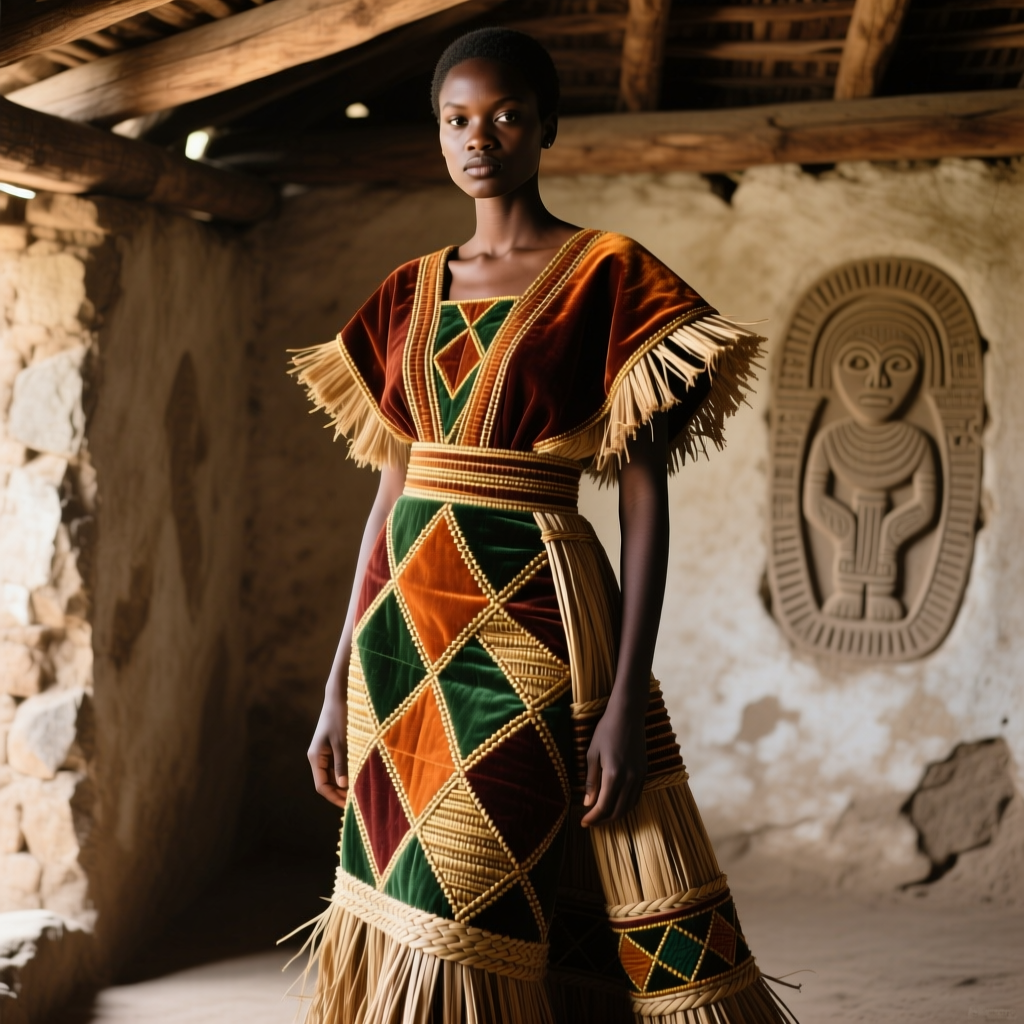
Deep within the lush, equatorial basin of the Congo River lies a legacy of artistic brilliance that has captivated historians, mathematicians, and global fashion houses for generations. The Kuba Kingdom, a sophisticated and highly structured society located in what is now the Democratic Republic of the Congo, is world-renowned for its extraordinary textile traditions. Among the most celebrated of these are the intricate raffia cloths and the breathtaking Kasai velvet, a unique cut-pile embroidery technique that transforms rigid palm fibers into plush, luxurious surfaces. To study Kuba textiles is to read the visual language of a civilization, where every geometric motif, color choice, and textured surface communicates profound truths about status, spirituality, and the cosmos.
Unlike many global textile traditions that rely on cotton, silk, or wool, the Kuba people mastered the demanding art of weaving and embellishing raffia, a fiber derived from the leaves of the raffia palm. The resulting fabrics are not merely garments or decorative items; they are historical documents, forms of currency, sacred ceremonial objects, and masterpieces of abstract art. The interplay of bold appliqué, complex embroidery, and the velvety sheen of cut-pile raffia creates a tactile and visual experience that remains entirely unique in the global tapestry of African textile heritage.
This comprehensive exploration delves into the heart of Kuba textile heritage. From the botanical harvesting of the raffia palm to the mathematical precision of the embroidery patterns, we will uncover how the Kuba Kingdom elevated cloth-making into a high art form. Furthermore, we will examine the cultural significance of these textiles, the regional variations among Kuba sub-groups, and the ongoing efforts to preserve this magnificent craft in an era of rapid globalization.
The Historical Roots of the Kuba Kingdom and Textile Tradition
The Kuba Kingdom is not a single monolithic tribe, but rather a confederation of numerous ethnic groups, including the Bushong, Ngeende, Ngoombe, and Pyaang, united under a central royal authority. The kingdom was founded in the early seventeenth century, and its history is inextricably linked to the introduction and refinement of textile arts. According to Kuba oral tradition, it was the great king Shyaam a-Mbul a Ngoong who brought the knowledge of weaving and embroidery to his people. Shyaam is revered as a culture hero who introduced not only the raffia loom but also the principles of civilization, governance, and aesthetic refinement known as bulaadi.
Under the patronage of the Nyim (the supreme king), textile production became a highly organized and deeply respected enterprise. The royal court served as the ultimate arbiter of taste and style, with specific patterns, colors, and techniques reserved exclusively for the king and his highest-ranking nobles. The creation of royal regalia was a collaborative effort that involved the kingdom’s most skilled artisans. Men were primarily responsible for the cultivation of the raffia palms and the weaving of the base cloth, while women held the exclusive domain over the complex dyeing, appliqué, and embroidery processes that transformed the plain woven panels into masterpieces.
As the kingdom expanded its influence through trade and diplomacy, Kuba textiles became highly sought-after luxury goods across Central Africa. The cloths were traded with neighboring peoples for copper, iron, beads, and cowrie shells. This widespread demand not only enriched the kingdom economically but also spread the aesthetic influence of Kuba design far beyond its borders. The historical importance of these textiles cannot be overstated; they were the physical manifestation of the kingdom’s wealth, power, and divine mandate, serving as a unifying cultural force among the diverse peoples of the Kuba confederation.
The Intricate Craftsmanship of Raffia Weaving and Velvet Embroidery
The creation of a Kuba textile is a labor-intensive process that requires immense patience, specialized knowledge, and a deep understanding of natural materials. The journey begins with the raffia palm (Raphia vinifera), a tree that thrives in the swampy regions of the Congo basin. Men carefully harvest the young, unopened fronds of the palm, stripping the leaflets and scraping away the green outer layer to reveal the pale, fibrous interior. These fibers are then dried in the sun, a process that requires careful monitoring to ensure the fibers do not become too brittle.
Once prepared, the fibers are threaded onto an inclined heddle loom, a unique weaving apparatus specific to the region. The weaver sits with the loom resting against his thighs, using a complex system of heddles to separate the warp threads and pass the weft through. The resulting base cloth, known as mbala, is woven in narrow strips that are later stitched together to form larger panels. Freshly woven raffia cloth is notoriously stiff and rough, resembling a coarse mat more than a fabric. To soften it, the cloth is repeatedly washed, pounded with wooden mallets, and rubbed with smooth stones or cowrie shells until it achieves a supple, linen-like drape.
While the weaving is the domain of men, the embellishment is the sacred domain of women. The most famous of these embellishment techniques is the cut-pile embroidery that creates the renowned Kasai velvet. To achieve this plush texture, the artisan uses a specialized needle to pull dyed raffia threads through the base cloth, creating tight loops on the surface. Before the loop is pulled completely tight, a small, razor-sharp knife is used to slice the top of the loop. When repeated thousands of times across a geometric grid, these cut loops stand upright, creating a dense, velvety pile that catches the light and invites the touch.
In addition to cut-pile velvet, Kuba women are masters of appliqué, stem stitch, and chain stitch embroidery. They utilize a rich palette of natural dyes derived from the local environment. Deep blacks are achieved using mud rich in iron oxide, while vibrant reds, yellows, and browns are extracted from various barks, roots, and seeds. For those interested in the broader spectrum of historical color extraction, our guide on natural dyeing techniques explores how indigenous cultures worldwide harness the earth for their palettes. The combination of these natural dyes with the textured surface of the raffia creates a visual depth that synthetic dyes simply cannot replicate.
Cultural Significance and Symbolic Geometry
To view a Kuba textile merely as a decorative object is to miss its profound cultural and spiritual resonance. In Kuba society, cloth is a vital medium of communication, a store of value, and a bridge between the physical and spiritual realms. The geometric patterns that adorn the textiles are not random; they are a sophisticated visual vocabulary. Many of these motifs are named after natural phenomena, historical events, or royal personages. For example, the Imbol pattern, which resembles cowrie shells, is a direct reference to wealth and prosperity, while the Mbul pattern is a complex interlocking design reserved for royal use.
From an ethnomathematical perspective, Kuba textiles are a marvel. Researchers and mathematicians have noted that the patterns often exhibit complex fractal geometry and Euler paths, demonstrating an advanced, intuitive understanding of mathematics long before these concepts were formalized in Western academia. The artisans create these designs through a process of algorithmic thinking, building complex, self-similar structures from simple geometric rules. This mathematical precision reflects the Kuba worldview, which sees the universe as an ordered, interconnected system governed by divine laws.
The cultural significance of Kuba cloth extends deeply into the rites of passage and the social hierarchy. Historically, raffia cloth served as a primary form of currency. It was used to pay tribute to the king, settle legal disputes, and negotiate marriage dowries. A man’s wealth and social standing were often measured by the quantity and quality of the textiles he possessed. Furthermore, textiles play a crucial role in funerary practices. When a respected elder or noble passes away, they are wrapped in layers of their finest Kuba cloths. The volume and quality of the burial shrouds ensure the deceased’s safe passage into the afterlife and signal their enduring status to the ancestors.
During grand state festivals and royal masquerades, the visual impact of Kuba textiles is fully realized. Dancers and dignitaries wear voluminous skirts made of dozens of raffia panels, creating a sweeping, kinetic display of color and texture. The movement of the cloth, combined with the rhythmic sounds of the masquerade, creates a multisensory experience that reinforces the social order and connects the community to its ancestral heritage. To understand how traditional garments influence modern ceremonial wear, explore our analysis of global heritage fashion and its impact on contemporary design.
Regional Variations Across the Kuba Sub-Groups
While the overarching aesthetic of Kuba textiles is cohesive, a closer examination reveals distinct regional variations among the different sub-groups of the Kuba confederation. These variations are influenced by local environmental resources, historical alliances, and the specific cultural preferences of each group. The diversity within the Kuba textile tradition is a testament to the dynamic and adaptive nature of the kingdom’s artistic culture.
The Bushong people, who form the political and royal core of the Kuba Kingdom, produce textiles that are often characterized by their intricate complexity and refined execution. As the group most closely associated with the royal court, Bushong artisans frequently utilize the most prestigious motifs and the highest quality raffia. Their cut-pile velvets are renowned for their dense, even pile and sophisticated color harmonies, often favoring deep, muted tones of black, brown, and ochre.
In contrast, the Ngeende and Ngoombe sub-groups, located in different ecological zones, often produce textiles with bolder, more graphic patterns. The Ngeende are particularly famous for their striking appliqué work, where large, contrasting shapes are stitched onto the base cloth to create dramatic visual effects. Their use of negative space and asymmetrical compositions sets their work apart from the more rigidly geometric styles of the central court. The Ngoombe, situated closer to trade routes with neighboring forest peoples, sometimes incorporate imported materials, such as European glass beads or imported cotton threads, blending external influences with traditional Kuba aesthetics.
The Shoowa people, a subgroup often associated with the Kasai region, are the undisputed masters of the cut-pile velvet technique. In fact, Kasai velvet is frequently referred to in anthropological literature as “Shoowa velvet.” Shoowa artisans favor dense, all-over patterns that completely obscure the base cloth, creating a luxurious, carpet-like surface. Their color palettes often feature striking contrasts, and their mastery of the cut-pile technique allows them to create subtle gradients and textural variations within a single panel. Understanding these regional nuances is essential for collectors and historians seeking to trace the provenance and cultural context of specific Kuba textiles.
Modern Preservation and Global Influence
The global art world has long recognized the genius of Kuba textile design. In the early twentieth century, European modernist artists such as Henri Matisse, Pablo Picasso, and Paul Klee amassed collections of Kuba cloths, drawing profound inspiration from their bold abstraction and rhythmic geometry. Matisse, in particular, was captivated by the Kasai velvets, incorporating their structural logic and pattern repetition into his own paper cut-outs and textile designs. This early cross-cultural exchange cemented the status of Kuba textiles not merely as ethnographic artifacts, but as masterworks of global modern art.
Today, the preservation of Kuba textile heritage faces both challenges and opportunities. The influx of cheap, mass-produced synthetic fabrics and the pressures of modern economic life have threatened the transmission of traditional weaving and embroidery skills to younger generations. The labor-intensive nature of raffia processing and the time required for cut-pile embroidery make it difficult for artisans to compete in a market driven by fast fashion. However, a growing global appreciation for slow fashion, ethical sourcing, and artisanal craftsmanship has sparked a revival of interest in authentic Kuba textiles.
Numerous cooperatives and fair-trade organizations are now working directly with Kuba artisans to ensure they receive equitable compensation for their work. These initiatives not only provide vital economic support to rural communities but also empower women, who are the primary creators of the embroidered and appliquéd pieces. By connecting Kuba artisans directly with international collectors, interior designers, and ethical fashion houses, these organizations help sustain the economic viability of the craft. For consumers and designers looking to incorporate heritage textiles responsibly, our guide on textile care and preservation offers essential advice on maintaining the integrity of delicate natural fibers.
Furthermore, contemporary African and diaspora designers are increasingly looking to Kuba aesthetics to inform their modern collections. By reinterpreting the fractal geometries and luxurious textures of Kasai velvet in new contexts, these designers ensure that the visual language of the Kuba Kingdom remains a living, evolving tradition. The heritage of Kuba raffia cloth and velvet embroidery is not a relic of the past; it is a dynamic, enduring art form that continues to inspire, communicate, and captivate audiences around the world.
Frequently Asked Questions
What is the difference between standard Kuba cloth and Kasai velvet?
Standard Kuba cloth generally refers to the woven raffia base panels, which may be left plain, dyed, or decorated with appliqué and surface embroidery. Kasai velvet, on the other hand, refers specifically to the highly specialized cut-pile embroidery technique. In Kasai velvet, the artisan creates thousands of tiny loops with dyed raffia thread and then slices them open to create a dense, plush, velvet-like surface. While all Kasai velvet is Kuba cloth, not all Kuba cloth features the velvet cut-pile technique.
How long does it take to create a single piece of Kasai velvet?
The creation of a high-quality Kasai velvet panel is an extraordinarily time-consuming process. Depending on the size of the panel and the complexity of the geometric pattern, a single piece can take anywhere from several weeks to several months to complete. The artisan must meticulously pull, loop, and cut thousands of individual raffia threads by hand. This immense investment of time and skill is a primary reason why authentic Kasai velvet is highly valued by collectors and textile enthusiasts.
Can Kuba raffia textiles be washed or dry-cleaned?
Authentic Kuba textiles require specialized care due to the delicate nature of the raffia fibers and the natural dyes used. They should never be submerged in water or machine washed, as this can cause the fibers to shrink, distort, or bleed their colors. Dry cleaning is also generally discouraged, as the harsh chemicals can strip the natural oils from the raffia, making it brittle. Instead, Kuba cloths should be gently vacuumed using a low-suction setting with a mesh screen to protect the pile, and stored flat in a cool, dry environment away from direct sunlight.
What do the geometric patterns on Kuba cloth represent?
The geometric patterns on Kuba cloth are a complex visual language that can represent a wide variety of concepts, including natural phenomena, historical events, social status, and philosophical ideas. Many patterns are named and carry specific meanings known to the Kuba people. For instance, interlocking knots may symbolize the bonds of community or the complexities of royal lineage, while patterns resembling cowrie shells represent wealth and trade. The repetition and mathematical precision of the fractals also reflect the Kuba understanding of cosmic order and spiritual harmony.
Where can one ethically source authentic Kuba textiles today?
To ethically source authentic Kuba textiles, it is best to purchase from reputable galleries, specialized textile dealers, or fair-trade organizations that work directly with artisan cooperatives in the Democratic Republic of the Congo. These organizations ensure that the artisans are paid fairly and that the cultural heritage of the craft is respected. When purchasing, look for dealers who can provide provenance, detail the specific sub-group that created the piece, and explain the materials and techniques used. Avoid mass-market retailers offering suspiciously cheap “Kuba-style” prints, as these do not support the actual artisans or the preservation of the heritage craft.