The Enduring Legacy of the Kashmiri Kani Shawl: A Masterclass in Pashmina Weaving Heritage
High in the trans-Himalayan plateaus, where the air is thin and the winters are unforgiving, a miracle of nature and human ingenuity converges to create one of the world’s most coveted textiles. The Kashmiri Kani shawl represents the absolute zenith of pashmina weaving heritage. Born from the downy undercoat of the Changthangi goat and elevated by the mathematical precision of Kashmiri artisans, the Kani shawl is not merely a garment; it is a woven manuscript of history, culture, and unparalleled craftsmanship. To understand the Kani shawl is to embark on a journey through centuries of royal patronage, intricate coded languages, and a relentless dedication to preserving an ancient art form against the tide of modern mechanization.
Unlike embroidered textiles where patterns are applied to a pre-woven base, the Kani shawl is woven entirely by hand on a traditional loom, using a complex tapestry technique that integrates the design directly into the fabric’s structure. This meticulous process transforms raw, delicate fibers into heirloom masterpieces that have captivated Mughal emperors, Sikh maharajas, and European royalty alike. In this comprehensive exploration of global textile traditions, we delve deep into the anatomy, history, and enduring legacy of the Kashmiri Kani pashmina shawl.
The Anatomy of a Masterpiece: Understanding Kani Craftsmanship
The creation of an authentic Kani shawl is a symphony of specialized skills, requiring the collaboration of spinners, dyers, designers, and weavers. The foundation of this craft lies in the raw material: pashm, the ultra-fine underfleece of the Capra hircus goat, which thrives in the extreme altitudes of the Changthang region. This fiber, measuring between 12 and 16 microns in diameter, is renowned for its exceptional warmth, lightness, and softness. For a deeper understanding of this remarkable material, explore our natural fibers encyclopedia.
The Language of the Loom: The Talim System
What truly sets the Kani shawl apart from other woven textiles is the talim, a unique, coded shorthand language used to translate complex designs into weaving instructions. Before a single thread is placed on the loom, a master designer (naqash) drafts the pattern on graph paper. A specialized scribe, known as the talim-guru, then transcribes this design into the talim script. This script resembles a series of cryptic symbols and numbers, dictating exactly how many warp threads a specific colored weft thread must pass over or under.
The weaver does not look at a visual picture of the pattern while working. Instead, they read the talim or memorize its rhythmic cadence, chanting the instructions aloud as they work. This binary-like system predates the Jacquard loom by centuries and represents one of the earliest forms of programmed design in human history. The weaver’s ability to interpret this code flawlessly, without a single error across millions of interlocking threads, is a testament to their extraordinary cognitive and manual dexterity.
The Kani Bobbins and the Tapestry Weave
The term ‘Kani’ refers to the small, polished wooden bobbins or sticks around which the colored weft yarns are wound. A single shawl may require dozens, sometimes hundreds, of these kanis, each holding a different hue of dyed pashmina. The weaving technique employed is a form of twill tapestry. Unlike standard weaving, where a single weft thread runs continuously from one edge of the fabric to the other, the Kani technique uses interlocking discontinuous wefts.
When a color block ends and another begins, the weaver interlocks the adjacent kanis around the same warp thread. This interlocking method ensures that the fabric remains seamless and structurally sound, without creating slits or loose threads on the reverse side. The result is a fabric where the design is virtually identical on both the front and the back, a hallmark of supreme craftsmanship. The rhythmic clicking of the wooden kanis against the loom is the heartbeat of Kashmiri weaving villages, a sound that has echoed through the valleys for generations.
Cultural Significance and Royal Patronage
The Kani shawl has never been just a functional piece of winter clothing; it has historically served as a potent symbol of status, wealth, and diplomatic currency. The cultural significance of the garment is deeply intertwined with the royal courts that patronized the artisans of Kashmir.
The Mughal and Sikh Eras
The Mughal emperors were instrumental in elevating the Kashmiri shawl to an object of imperial desire. Emperor Akbar, known for his profound appreciation of the arts, established royal karkhanas (workshops) and was said to be an avid collector of Kani Jamawar shawls. He introduced the practice of wearing shawls in pairs, stitched back-to-back, so that the intricate designs were visible on both sides and the reverse of the fabric was hidden. Subsequent rulers, including Jahangir and Shah Jahan, continued this patronage, embedding the shawl deeply into the sartorial codes of the Mughal elite.
During the Sikh Empire under Maharaja Ranjit Singh, the Kani shawl took on a new role as a tool of statecraft. The Maharaja controlled the Kashmir region and recognized the immense value of these textiles. He frequently presented Kani shawls as khilats (robes of honor) to visiting dignitaries, foreign ambassadors, and loyal generals. To receive a Kani shawl from the Lahore Durbar was to receive a tangible mark of royal favor and political alliance.
The European Obsession
The allure of the Kani shawl eventually transcended the subcontinent, traveling along ancient trade routes to the Middle East and eventually to Europe. In the late 18th and early 19th centuries, the ‘Cashmere’ shawl became the ultimate status symbol among European aristocracy. Empress Joséphine of France, the first wife of Napoleon Bonaparte, was famously obsessed with Kashmiri shawls, amassing a collection of hundreds of pieces. Her endorsement sparked a continent-wide craze, influencing European fashion, interior design, and even the development of local imitations in Paisley, Scotland, and Lyon, France. Despite these European attempts to replicate the craft, the authentic Kashmiri Kani shawl remained unmatched in its fineness and complexity.
Regional Variations and Motif Evolution
The village of Kanihama, located in the Budgam district of Kashmir, is the historic epicenter of this craft. The geographical isolation and generational transmission of skills in this region have allowed specific styles and variations of the Kani weave to flourish. Understanding these variations is crucial for collectors and enthusiasts of vintage textile authentication.
Jamawar vs. Dorusha
Within the Kani tradition, there are distinct classifications based on the density and execution of the weave. The Jamawar is perhaps the most famous and luxurious variant. In a true Kani Jamawar, the intricate tapestry weave covers the entire surface of the shawl. The warp is entirely hidden by the dense weft threads, resulting in a heavy, plush, and incredibly warm garment. Because of the sheer density of the interlocking threads, a full Jamawar shawl can take anywhere from one to three years to complete, with multiple weavers working side-by-side on a single loom.
The Dorusha (meaning ‘two-faced’) is a rarer and arguably more technically demanding variation. In a Dorusha shawl, the design is woven in such a way that it is perfectly identical on both sides, with no loose threads or interlocking knots visible on the reverse. This requires an extraordinary level of precision, as the weaver must manage the tension and interlocking of the wefts flawlessly to create a truly reversible textile.
The Evolution of the Boteh and Floral Motifs
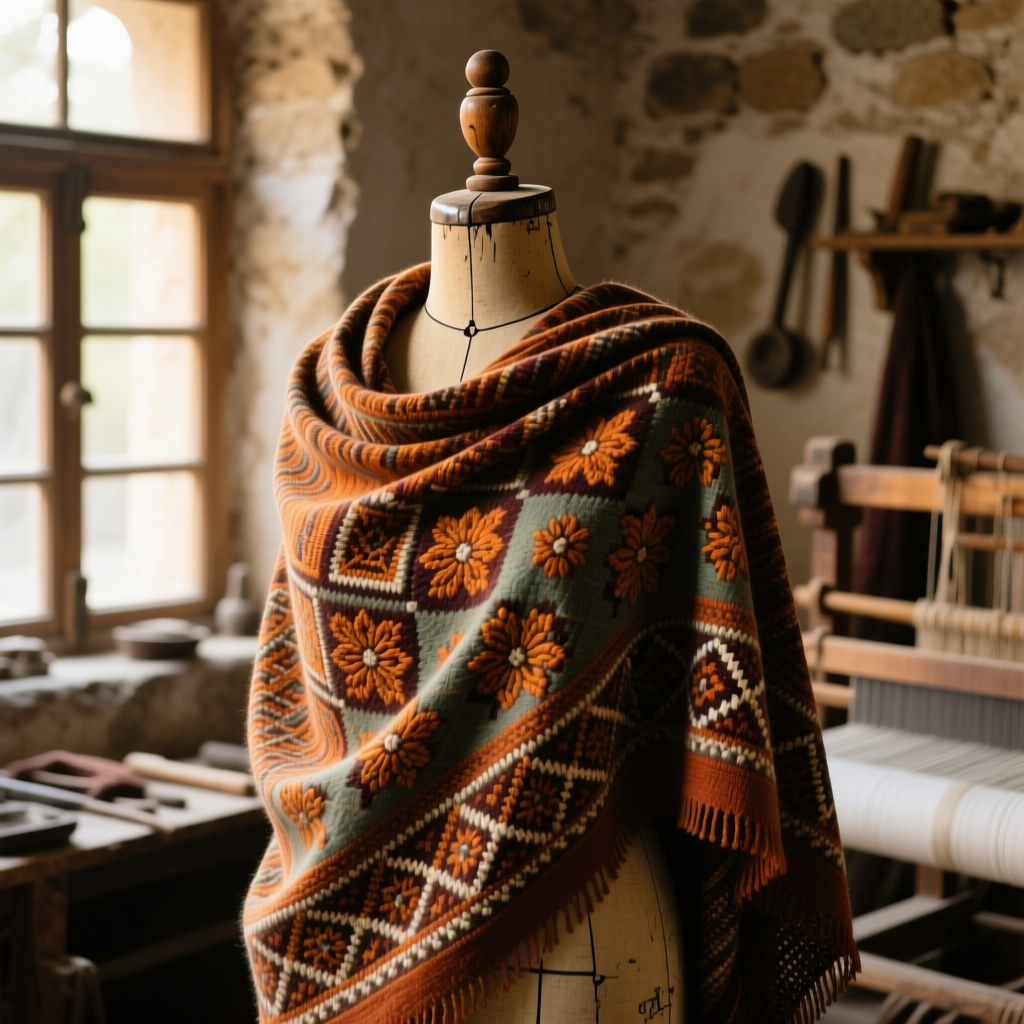
The visual language of the Kani shawl is dominated by nature-inspired motifs, the most iconic being the boteh, widely known in the West as the paisley. However, the Kashmiri boteh (or ambi, meaning mango) is far more complex than its Western derivative. Originally a simple, stylized floral spray in the early Mughal period, the motif evolved over centuries. By the Afghan and Sikh periods, it had elongated and curved, incorporating the shape of a cypress tree—a symbol of eternity and resilience in Persian art. A single Kani boteh can contain dozens of microscopic floral details, requiring dozens of different colored kanis to execute.
Other prominent motifs include the hashia (the intricate border that frames the shawl), the buta (small, scattered floral sprigs), and the badam (almond shape). The color palettes used in traditional Kani shawls were historically derived from natural, organic dyes. Master dyers utilized indigo for deep blues, madder root for rich reds, saffron and pomegranate rinds for vibrant yellows, and walnut husks for warm browns and blacks. These natural dyes not only provided a soft, luminous quality to the pashmina but also ensured that the colors aged gracefully, developing a beautiful patina over decades of use.
Modern Preservation and the Fight Against Imitations
In the contemporary era, the Kashmiri Kani shawl faces existential threats from mechanization, synthetic blends, and a global market saturated with cheap imitations. The term ‘pashmina’ has been largely co-opted by fast fashion, often used to describe loosely woven scarves made from viscose, polyester, or sheep’s wool, bearing no resemblance to the authentic Himalayan craft.
The Geographical Indication (GI) Tag
To protect the heritage and the livelihoods of the artisans, the Government of India awarded the Geographical Indication (GI) tag to both ‘Kashmir Pashmina’ and the ‘Kani Shawl.’ This certification ensures that only shawls woven from authentic Changthangi pashm, using traditional hand-spinning and hand-weaving techniques within the designated geographical region of Kashmir, can bear the name. The GI tag is a crucial tool for conscious consumers looking to invest in genuine heritage pieces and support the artisan communities of Kanihama.
Sustaining the Artisan Communities
Preserving the Kani weaving heritage requires more than just legal protection; it demands a shift in consumer consciousness. The creation of a Kani shawl is an exercise in extreme patience and physical endurance. Weavers often suffer from eye strain and back issues due to the demanding nature of the loom. By choosing to invest in authentic, ethically sourced Kani shawls, collectors and fashion connoisseurs directly sustain the master weavers, the talim writers, and the natural dyers who keep this ancient ecosystem alive. For those looking to integrate these timeless pieces into their modern wardrobes, our guide on winter layering techniques offers elegant styling solutions that honor the garment’s grandeur.
Frequently Asked Questions
What is the difference between a Kani shawl and a regular Pashmina?
A regular pashmina shawl is typically woven in a plain or twill weave on a handloom, creating a solid or subtly textured fabric that may later be embroidered (such as in Sozni or Tilla work). A Kani shawl, however, is a tapestry weave. The pattern is not added after the fabric is made; it is woven directly into the structure of the shawl using small wooden bobbins (kanis) and a coded talim script. The Kani technique is vastly more time-consuming, complex, and structurally dense than standard pashmina weaving.
How long does it take to weave an authentic Kani Jamawar shawl?
The time required to weave a Kani Jamawar shawl depends on the complexity of the design, the density of the weave, and the number of artisans working on the loom. A simple Kani border shawl might take three to six months. However, a full, densely woven Jamawar shawl with intricate, all-over boteh motifs can take anywhere from one to three years to complete. It is common for two or even three weavers to sit at a single wide loom, working in perfect unison to finish a single masterpiece.
How can I verify the authenticity of a Kashmiri Kani shawl?
Authenticating a Kani shawl involves examining several key factors. First, check for the official Geographical Indication (GI) label and a unique holographic serial number. Second, examine the reverse side of the fabric; a true Kani shawl will have a clean reverse with interlocking threads that closely mirror the front design, without the loose, floating threads characteristic of machine-made embroidery. Third, assess the texture; genuine pashmina is incredibly soft, warm, and possesses a subtle, natural luster, unlike the synthetic sheen of viscose or polyester blends. For comprehensive care instructions to maintain your authentic piece, consult our pashmina care guide.
What is the best way to care for and store a vintage Kani shawl?
Vintage Kani shawls are delicate heirlooms that require meticulous care. They should never be machine washed or aggressively wrung. Instead, they should be dry-cleaned by specialists who have experience with antique tapestry textiles and natural dyes. When storing, avoid wire hangers or tight folds, which can break the delicate pashmina fibers over time. Wrap the shawl in unbleached, acid-free muslin cloth and store it in a cool, dry place, layered with natural moth repellents like cedar wood or dried neem leaves to protect against insect damage.
Can Kani shawls be integrated into modern wardrobes?
Absolutely. While historically worn draped over the shoulders as a mark of royalty, the Kani shawl is incredibly versatile in contemporary fashion. A Kani Jamawar can be draped over a tailored evening gown or a structured wool coat as a statement piece for formal events. Smaller Kani stoles can be looped elegantly over the neck to add a touch of heritage luxury to minimalist winter outfits. The rich, natural color palettes and intricate motifs of the Kani weave provide a striking contrast to modern, solid-colored garments, bridging the gap between ancient craftsmanship and modern sartorial elegance.