The Vibrant Heritage of Hungarian Matyó Floral Embroidery
Deep within the heart of Central Europe lies a textile tradition so vibrant, intricate, and culturally profound that it has captivated artisans and historians for generations. Hungarian Matyó floral embroidery is far more than a mere decorative craft; it is a visual language, a marker of identity, and a testament to the resilience and creativity of the Matyó people. Originating from the Matyóföld region in northeastern Hungary, this extraordinary folk art transforms simple linen, wool, and sheepskin into breathtaking canvases of overflowing botanical motifs. Recognized globally for its dense, exuberant patterns and striking color palettes, Matyó embroidery stands as a pinnacle of European textile heritage.
To understand the profound impact of this craft, one must look beyond the needle and thread. The creation of these elaborate textiles was historically intertwined with the social fabric of rural Hungarian life, dictating everything from marital prospects to community standing. Today, as the world increasingly values slow fashion and artisanal heritage, the legacy of Matyó embroidery offers invaluable lessons in craftsmanship, cultural preservation, and the enduring power of handmade textiles. In this comprehensive guide, we explore the historical roots, meticulous techniques, regional nuances, and modern preservation of this magnificent folk art, providing a deep dive for enthusiasts of European folk costumes and textile history alike.
The Historical Roots and Cultural Significance of Matyó Folk Art
The story of Matyó embroidery begins in the Matyóföld region, an ethnographic area primarily encompassing the town of Mezőkövesd and the neighboring villages of Tard and Szentistván. The Matyó people, a distinct Catholic ethnic group living in a predominantly Calvinist region, developed a unique cultural identity forged by geographic isolation and challenging agricultural conditions. The soil in this region was notoriously poor, yielding meager harvests. To compensate for the economic hardships, the women of Matyóföld turned to needlework, transforming a domestic necessity into a highly lucrative and culturally significant art form.
Historically, embroidery was not merely a pastime; it was a vital socio-economic tool and a strict indicator of social status. A young woman’s dowry was the ultimate display of her family’s wealth and her own industriousness. The sheer volume and quality of embroidered textiles a bride brought to her marriage could elevate her family's standing within the village. It was common for a bride to spend years preparing her trousseau, which included heavily embroidered bed linens, towels, and an astonishing array of garments. The wedding costume itself was a masterpiece of textile engineering, sometimes weighing up to twenty kilograms due to the dense layers of embroidered fabric and heavy pleating.
Beyond weddings, Matyó embroidery played a crucial role in the lifecycle of the community. Specific motifs and color palettes were reserved for distinct life events. While vibrant reds, yellows, and greens celebrated youth, fertility, and joy, the community also developed a profound tradition of mourning embroidery. When a loved one passed away, women would stitch intricate patterns using only black and white, or dark blue and black threads. This somber variation demonstrated that the Matyó aesthetic was not solely about exuberance, but also about processing grief and honoring the dead through the meticulous, meditative act of stitching.
The cultural significance of this art form was so deeply embedded in the local psyche that it became a defining characteristic of the Matyó identity. The phrase 'Matyó blood' became synonymous with a fierce pride in one's heritage, a pride that was literally worn on the sleeves, bodices, and aprons of the community's traditional garments.
The Craftsmanship: Techniques, Threads, and Motifs
The creation of authentic Matyó embroidery is a masterclass in textile manipulation, requiring an intimate understanding of traditional embroidery techniques and an exceptional eye for spatial composition. Unlike styles that rely on rigid, pre-printed grids, traditional Matyó patterns were historically drawn freehand onto the fabric by a specialized artisan known as the íróasszony (the writing woman). These master draftswomen possessed an encyclopedic knowledge of motifs and an innate sense of balance, allowing them to scale and adapt patterns to fit any garment or household textile perfectly.
The motif vocabulary of Matyó embroidery is overwhelmingly botanical, characterized by a lush, almost chaotic abundance of flora. The central motif is the matyó rózsa (Matyó rose), a stylized, multi-petaled bloom that anchors the design. Surrounding the roses are an array of tulips, carnations, lilies, and heart-shaped leaves. The leaves, often serrated and curling, are just as important as the flowers, creating a dense, interlocking network that leaves very little negative space on the fabric. This 'horror vacui' (fear of empty space) is a hallmark of the mature Matyó style, where the textile is entirely consumed by a riot of color and form.
The evolution of color in Matyó embroidery is a fascinating reflection of global trade and technological advancement. In the late eighteenth and early nineteenth centuries, the palette was strictly limited by the availability of natural dyes, resulting in elegant but restrained combinations of red, blue, black, and white. However, the introduction of synthetic aniline dyes in the late nineteenth century revolutionized the craft. Artisans eagerly embraced these vibrant, colorfast threads, introducing brilliant yellows, vivid greens, and striking purples into their work. This explosion of color is what defines the classic, globally recognized Matyó aesthetic.
The stitches employed are as varied as the motifs. The foundation of the craft relies heavily on the satin stitch (laposöltés), which is used to fill in the broad petals of the roses and tulips, creating a smooth, raised surface that catches the light. The chain stitch (láncöltés) and buttonhole stitch are utilized for outlining and creating delicate, linear details, while specialized filling stitches add texture to the leaves and stems. The interplay of these stitches gives the embroidery a sculptural, three-dimensional quality that elevates it far above simple surface decoration.
Regional Variations Within the Matyóföld
While the term 'Matyó' is often used as a blanket descriptor for the embroidery of the region, a closer examination reveals distinct stylistic variations among the three primary settlements: Mezőkövesd, Tard, and Szentistván. Understanding these nuances is essential for any serious student of folk art, as each village developed its own visual dialect based on local traditions and the influence of specific master artisans.
Mezőkövesd is universally acknowledged as the epicenter of Matyó embroidery. The style developed here is the most famous, characterized by its massive, overflowing floral compositions and bold, contrasting colors. The Mezőkövesd aesthetic favors large, dominant central roses surrounded by a dense thicket of smaller blooms and curling leaves. The embroidery from this town is unapologetically extravagant, reflecting the town's historical status as the wealthiest and most influential of the three settlements.
In contrast, the embroidery of Tard retains a stronger connection to the older, more archaic forms of Hungarian folk art. The patterns in Tard are generally more geometric, structured, and symmetrical. The color palette historically leaned heavily on the traditional red and blue, and the motifs often feature stylized, almost abstracted floral forms rather than the lush, naturalistic blooms of Mezőkövesd. The Tard style is celebrated for its elegance, restraint, and the mathematical precision of its layout.
Szentistván presents a third, highly distinctive variation. The artisans of Szentistván developed a unique approach to color blocking and motif arrangement. Their embroidery often features a higher proportion of leaf motifs compared to flowers, and the use of color is more segmented, with distinct areas of solid color rather than the heavily blended gradients seen in Mezőkövesd. The Szentistván style is easily identifiable by its rhythmic, almost kaleidoscopic repetition of patterns, creating a mesmerizing visual effect that sets it apart from its neighbors.
Matyó Embroidery in Traditional Garments and Textiles
The true majesty of Matyó embroidery is best understood when viewed in the context of the traditional garments it was designed to adorn. The application of these intricate patterns to clothing was not arbitrary; it followed strict cultural codes regarding placement, density, and color. For those studying the broader spectrum of European folk costumes, the Matyó wardrobe offers a masterclass in layering and textile manipulation.
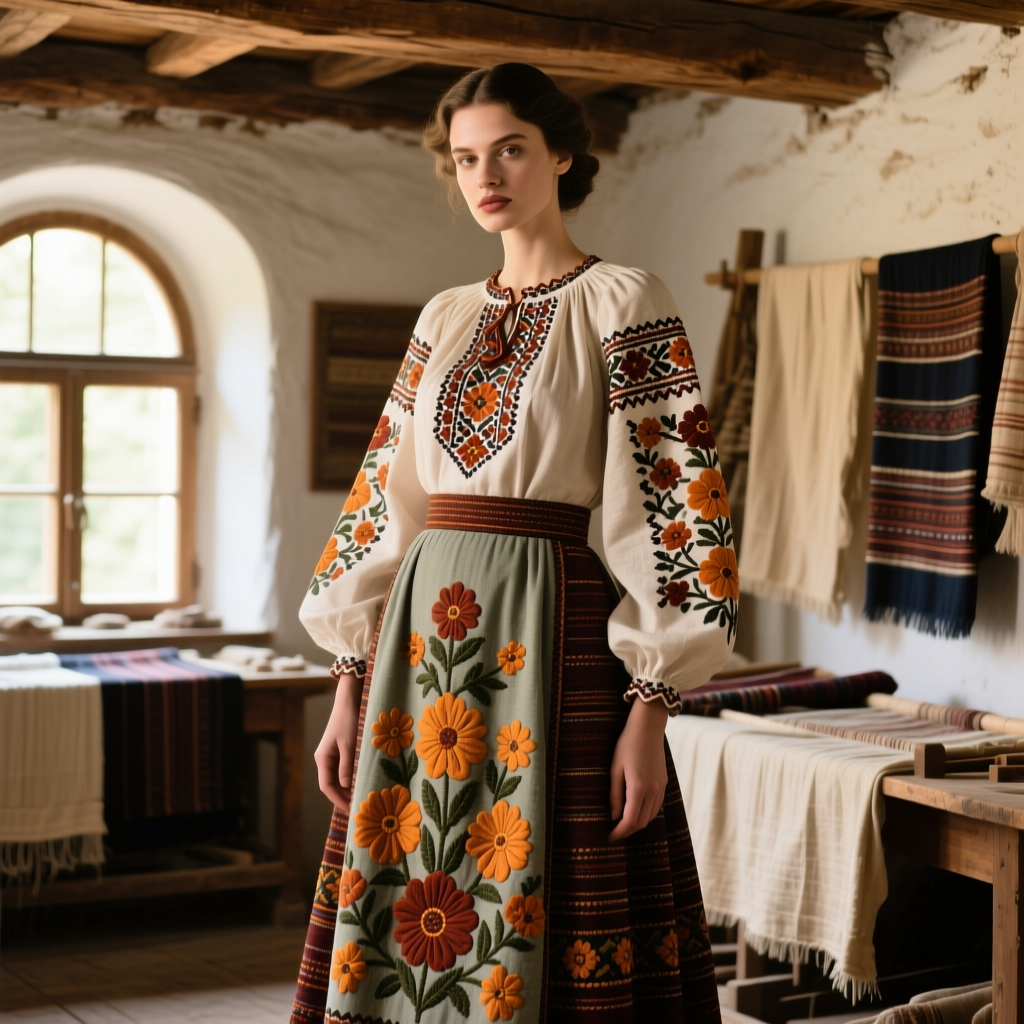
The foundation of the women's traditional dress was the pendely, a linen chemise that served as the primary canvas for some of the finest embroidery. The sleeves and the neckline of the pendely were heavily decorated, with the cuffs often featuring the most complex and densely packed motifs. Over the chemise, women wore a pruszlik, a fitted bodice made of velvet, silk, or fine wool. The pruszlik was often embroidered with metallic threads or adorned with contrasting ribbons, providing a rich textural contrast to the matte linen of the chemise.
The most visually striking element of the ensemble was the kötény (apron). Far from being a mere protective garment, the Matyó apron was a spectacular display of wealth and skill. Made from heavily pleated linen or cotton, the apron was embroidered across its entire surface, with the hem featuring massive, sweeping floral borders. The pleating technique itself was an art form, with the fabric carefully folded and stitched to create a rigid, sculptural silhouette that framed the embroidery perfectly. Proper maintenance of these delicate, heavily stitched garments requires specialized knowledge, which is why many collectors refer to a dedicated linen care guide to preserve the integrity of the antique threads and fabrics.
Men's garments were equally impressive, though they utilized different base materials. The suba, a heavy sheepskin cloak worn with the fleece on the inside, was a canvas for spectacular leather embroidery and appliqué. The szűr, a thick woolen mantle, was adorned with dense floral embroidery that mirrored the women's motifs but was executed in heavier wool threads. These garments were not only functional, providing essential warmth during harsh winters, but they also served as a mobile exhibition of the family's artistic heritage.
Modern Preservation and the Evolution of a Living Heritage
As industrialization and urbanization swept through rural Europe in the mid-twentieth century, the daily wearing of traditional folk costumes declined sharply. The immense time and financial investment required to create a Matyó trousseau became incompatible with modern lifestyles. However, recognizing the impending loss of this irreplaceable cultural treasure, concerted efforts were launched to preserve, document, and revitalize the craft.
The crowning achievement of these preservation efforts was the recognition of Matyó folk art by UNESCO. Its inclusion on the Representative List of the Intangible Cultural Heritage of Humanity brought global attention to the craft, securing funding for educational programs and artisan workshops. Today, master embroiderers in Mezőkövesd, Tard, and Szentistván actively teach the next generation, ensuring that the complex stitches and the art of the íróasszony are not relegated to museum archives but remain living, breathing practices.
In the realm of contemporary design, Matyó embroidery has experienced a renaissance. Modern fashion designers and interior decorators are increasingly looking to incorporating vintage textiles into a modern wardrobe and home decor. Rather than simply copying the motifs, contemporary artisans are adapting the vibrant color palettes and dense floral structures to modern silhouettes, creating bespoke jackets, handbags, and upholstery that honor the past while appealing to modern aesthetics. This evolution ensures that Matyó embroidery remains a dynamic, relevant art form, proving that true heritage is not static, but continually adapting to the hands that craft it.
Frequently Asked Questions
What makes Matyó embroidery different from Kalocsa embroidery?
While both are celebrated Hungarian folk arts, they possess distinct visual and structural differences. Matyó embroidery, originating from the Matyóföld region, is characterized by its dense, overflowing floral patterns, heavy use of the satin stitch, and a slightly more structured, symmetrical layout. The motifs often feature heart-shaped leaves and large, multi-petaled roses. In contrast, Kalocsa embroidery, which developed later, is famous for its highly stylized, almost surreal floral and fruit motifs, including paprika and grapes. Kalocsa designs tend to be more open, airy, and asymmetrical, utilizing a wider variety of specialized filling stitches and a distinctly different approach to color shading.
What are the most common motifs used in Matyó folk art?
The Matyó motif vocabulary is deeply rooted in the natural world, specifically the flora of the Hungarian plains. The most iconic motif is the matyó rózsa (Matyó rose), a stylized, multi-layered bloom that serves as the focal point of most designs. This is surrounded by tulips, carnations, lilies of the valley, and hyacinths. The foliage is just as important, featuring heavily serrated, curling leaves, often described as heart-shaped or oak-like. Additionally, motifs like the peacock feather and the wheat sheaf occasionally appear, symbolizing beauty, resurrection, and agricultural prosperity, respectively.
How is traditional Matyó embroidery preserved today?
Preservation is driven by a combination of institutional support, community initiatives, and global recognition. Following its UNESCO Intangible Cultural Heritage designation, local governments and cultural ministries have funded specialized schools and workshops in Mezőkövesd, Tard, and Szentistván. Master artisans are officially recognized and compensated for teaching apprentices, ensuring the transmission of complex techniques like freehand pattern drafting and traditional stitch work. Furthermore, local museums actively collect, conserve, and exhibit historical garments, while cultural festivals provide a platform for artisans to showcase and sell their work to a global audience.
Can Matyó embroidered garments be worn in modern fashion?
Absolutely. While the traditional, multi-layered folk costume is now primarily reserved for cultural festivals and ceremonies, the embroidery itself has successfully transitioned into modern fashion. Contemporary designers frequently integrate Matyó motifs into modern silhouettes, such as denim jackets, tailored blazers, and evening gowns. For those interested in sustainable and historical fashion, learning the principles of incorporating vintage textiles into a modern wardrobe allows collectors to wear authentic, antique Matyó aprons or bodices as statement pieces. The key is to balance the intense visual weight of the embroidery with clean, minimalist modern garments.
What materials were traditionally used for Matyó embroidery?
The foundation of traditional Matyó embroidery was almost exclusively hand-woven linen or hemp, prized for its durability and ability to hold heavy embroidery threads without warping. For outerwear, thick woolen cloth (szűr) and tanned sheepskin (suba) were utilized. The embroidery threads evolved over time: early pieces featured hand-spun wool and linen threads dyed with natural substances like madder root (for red) and indigo (for blue). The late nineteenth-century introduction of commercially produced, mercerized cotton and silk flosses allowed for the brilliant, colorfast polychrome palettes that define the classic Matyó style. Today, high-quality cotton and silk flosses remain the standard for authentic reproduction work.