The Heritage of Ecuadorian Toquilla Straw Hat Weaving
The Enduring Heritage of Ecuadorian Toquilla Straw Hat Weaving
Few garments in the history of global fashion carry as much mystique, elegance, and geographical confusion as the Toquilla straw hat. Universally known to the world as the “Panama hat,” this iconic headpiece is, in fact, a masterpiece of Ecuadorian heritage. Born from the humid coastal plains and the misty Andean highlands of Ecuador, the art of Toquilla straw weaving is a testament to human patience, botanical mastery, and generational artistry. Recognized by UNESCO as an Intangible Cultural Heritage of Humanity, the craft represents far more than a simple defense against the tropical sun; it is a woven tapestry of Ecuadorian identity, indigenous resilience, and sartorial excellence.
To understand the Toquilla straw hat is to embark on a journey through Latin American garment heritage. It is a story that begins with the indigenous hands that first coaxed fibers from the palm fronds and extends to the classic menswear icons who made the silhouette a staple of international summer style. In this comprehensive exploration, we unravel the intricate threads of Ecuadorian Toquilla straw hat weaving, examining its historical roots, the meticulous craftsmanship required to birth a single crown, the distinct regional variations, and the ongoing efforts to preserve this magnificent artisan legacy in a rapidly changing world.
The Historical Roots & Cultural Significance
The origins of Toquilla straw weaving predate the arrival of the Spanish conquistadors by centuries. Long before European boots touched South American soil, the indigenous Manteño-Huancavilca cultures of the Ecuadorian coast were weaving head coverings from the fronds of the Carludovica palmata plant. These early iterations were practical, wide-brimmed shields against the equatorial sun, designed for agricultural labor and coastal navigation. The Spanish, upon arriving in the 16th century, noted the intricate, almost fabric-like quality of these indigenous weavings, remarking that they resembled delicate lace or fine linen rather than rustic straw.
As the colonial era progressed, the shape of the hat began to evolve, influenced by European styles brought across the Atlantic. The indigenous artisans adapted their traditional techniques to create brims and crowns that mirrored the felt hats of the Spanish elite, resulting in the sophisticated silhouettes we recognize today. The weaving of Toquilla straw became a vital economic engine for the coastal provinces, providing a sustainable livelihood for generations of rural families.
The great geographical misnomer—the labeling of this Ecuadorian treasure as a “Panama hat”—is a fascinating chapter in the annals of global trade. During the California Gold Rush of the mid-19th century, thousands of prospectors traveled from the East Coast of the United States to California. The fastest route involved sailing to the Isthmus of Panama, crossing overland, and catching another ship northward. Ecuadorian hats were heavily exported through the bustling trade hubs of Panama, and the prospectors, buying them to shield themselves from the harsh sun, naturally associated the hats with their point of purchase rather than their origin. Decades later, during the construction of the Panama Canal, the hats became ubiquitous among workers and engineers. When U.S. President Theodore Roosevelt visited the canal site and was photographed wearing a crisp, white Toquilla straw hat, the image was broadcast globally, cementing the “Panama hat” moniker in the international consciousness forever.
Despite the global misnomer, within Ecuador, the hat remains a profound symbol of national pride. It is deeply embedded in the cultural fabric of the nation, worn by politicians, musicians, and everyday citizens alike. The craft is a communal endeavor, binding families and villages together in a shared economic and cultural pursuit that has survived the rise of industrialization.
The Meticulous Craftsmanship of Toquilla Weaving
The creation of a genuine Toquilla straw hat is an astonishingly complex process that defies mass production. It is a multi-stage endeavor that involves botanists, harvesters, processors, weavers, and finishers, each playing a critical role in transforming a raw palm frond into a work of wearable art. For those fascinated by global textile weaving traditions, the Toquilla process offers a masterclass in natural fiber manipulation.
Harvesting & Preparation
The journey begins in the humid forests of the Ecuadorian coast, where the Carludovica palmata—commonly known as the Toquilla palm—grows in abundance. Harvesters, known as recolectores, carefully select the unopened, pale green shoots of the palm, known as cogollos. Only the youngest, most tender shoots possess the flexibility and fine texture required for high-quality weaving.
Once harvested, the shoots are transported to processing centers where they undergo a rigorous preparation. The outer green sheath is stripped away to reveal the delicate, pale inner fibers. These fibers are then boiled in large vats of water, often mixed with natural wood ash or sulfur, to remove the plant’s natural chlorophyll and resins. This cooking process, known as cocinado, softens the fibers and prevents them from rotting. Following the boil, the fibers are hung to dry in the shade and then bleached, traditionally using the smoke of burning sulfur or natural wood fires, which gives the finest hats their brilliant, luminous ivory hue.
The Art of the Weave
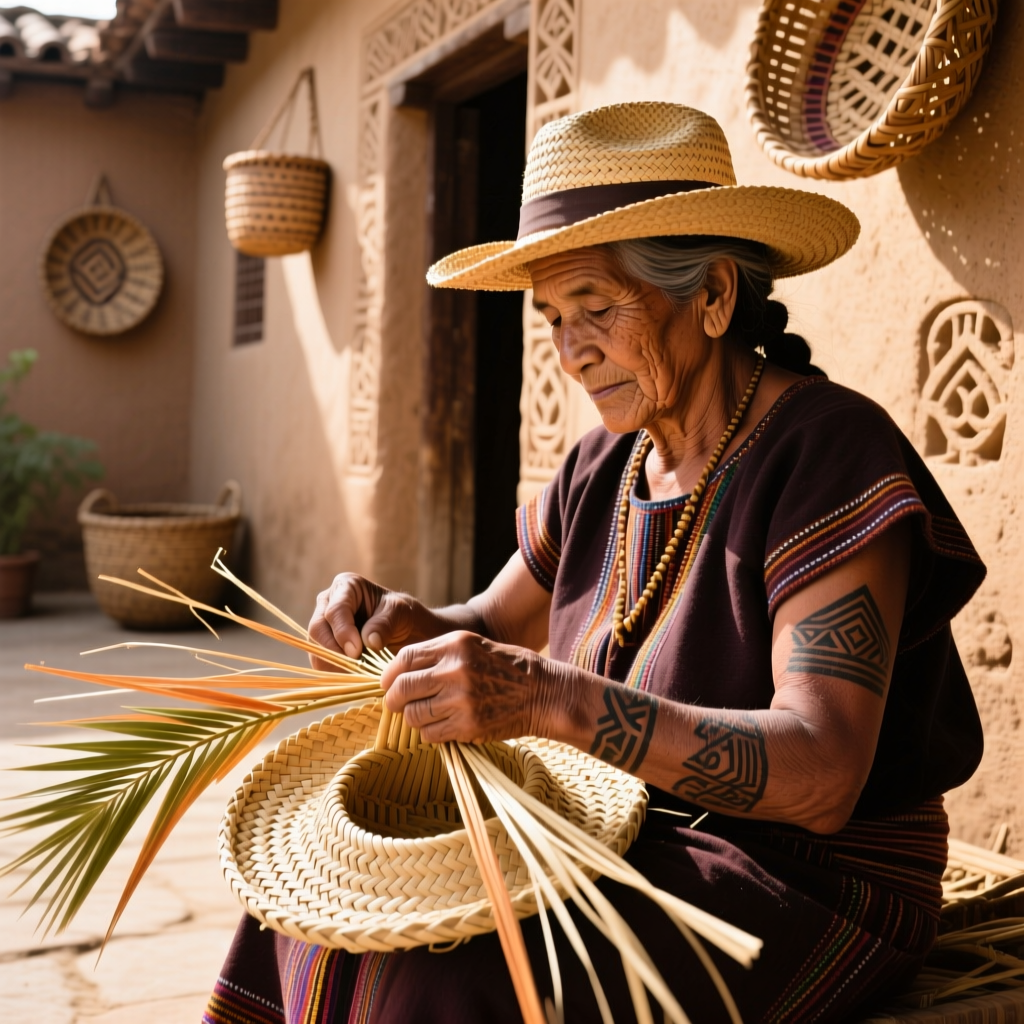
The actual weaving process is where the true magic occurs, requiring immense dexterity, eyesight, and patience. The weaver, or tejedor, begins at the very center of the crown, a point known as the rosita or inicio. From this central rosette, the weaver expands outward in concentric circles, a technique that requires maintaining perfect, even tension across thousands of individual strands.
As the crown expands, the weaver transitions into the cruzado, the crucial stage where the flat crown transitions into the vertical sides of the hat. This requires an intuitive understanding of geometry and tension. Once the desired depth is reached, the brim is extended outward. The weaving concludes with the remate, a highly specialized finishing technique where the loose ends of the straw are woven back into the brim to create a seamless, secure edge that will never unravel.
Finishing & Blocking
A freshly woven hat, known as a sombrero crudo (raw hat), is limp and shapeless. It must be passed to the azocador, who tightens the weave and trims excess fibers, and then to the planchador, who washes, bleaches, and irons the straw to set the weave. Finally, the hat is handed to the blocker, who uses steam, wooden molds, and immense physical pressure to shape the soft straw into classic silhouettes like the Fedora, the Optimo, or the Gambler. The addition of a sweatband, a silk lining, and a grosgrain ribbon completes the transformation.
Regional Variations: Montecristi, Cuenca, & Beyond
While Toquilla straw hats are woven in various pockets of Ecuador, two regions dominate the landscape, each offering distinct characteristics, weaving styles, and historical significance: the coastal town of Montecristi and the Andean city of Cuenca.
Montecristi: The Pinnacle of Fine Weaving
Montecristi, a small, sun-baked town in the Manabí province, is the undisputed spiritual home of the finest Toquilla straw hats in the world. The microclimate here is uniquely suited to the craft; the high humidity allows the straw to remain pliable, preventing it from snapping during the weaving of ultra-fine fibers. Montecristi weavers are renowned for producing the legendary superfino grade, a weave so tight and uniform that the hat can hold water like a solid vessel and, when folded, can pass through a wedding ring.
The weaving environment in Montecristi is highly specific. Artisans often weave in darkened, damp rooms or during the cool hours of the night and early morning to maintain the necessary moisture in the air. A single Montecristi superfino can take anywhere from three to eight months of continuous, painstaking labor to complete. The result is a hat of unparalleled lightness, flexibility, and elegance, highly sought after by collectors and connoisseurs of classic menswear accessories.
Cuenca: The Commercial & Cultural Hub
Located high in the Andean mountains, Cuenca offers a stark contrast to the coastal humidity of Montecristi. The cooler, drier climate means the straw is naturally less pliable, resulting in a weave that is generally slightly thicker and more robust than the coastal superfino. However, what Cuenca lacks in ultra-fine micron counts, it makes up for in durability, commercial scalability, and breathtaking artistic variations.
Cuenca is the commercial engine of the Ecuadorian hat trade. The weavers here are incredibly innovative, often incorporating intricate, optical-illusion patterns into the weave, known as fantasía designs. These geometric patterns are woven directly into the straw, showcasing a level of mathematical precision that is awe-inspiring. Cuenca hats are the backbone of the global export market, providing high-quality, durable, and beautifully blocked hats that serve as the standard for premium summer headwear worldwide.
Jipijapa & the Coastal Tradition
Jipijapa, another coastal town in Manabí, holds immense historical significance. In fact, for a time in the 19th century, the hats were known internationally as “Jipijapa hats” before the Panama misnomer took over. The weaving style here bridges the gap between the rustic durability of everyday work hats and the refined elegance of Montecristi. The artisans of Jipijapa maintain deeply traditional methods, often using natural, plant-based dyes to create striking, earth-toned hats that stand out in a market dominated by bleached ivory straw.
Toquilla Straw in Classic & Modern Style
The transition of the Toquilla straw hat from a piece of indigenous agricultural workwear to a cornerstone of global high fashion is a testament to its inherent elegance and versatility. In the early 20th century, the hat became an indispensable accessory for the global elite. From the Riviera to the Hamptons, the crisp white crown and contrasting black ribbon became synonymous with leisure, wealth, and sophisticated summer travel.
In the realm of classic menswear, the Toquilla hat is the undisputed king of warm-weather headwear. It pairs effortlessly with the natural drape of linen suits, the breezy elegance of cotton seersucker, and the relaxed sophistication of the guayabera. The interplay of textures—the matte, woven finish of the straw against the smooth sheen of a silk tie or the rough slub of raw silk—creates a visual depth that is fundamental to classic summer styling. For a deeper dive into building a warm-weather wardrobe, our summer headwear guide explores how to match hat silhouettes to face shapes and sartorial contexts.
Modern style has also embraced the Toquilla hat, moving beyond the rigid formality of the mid-century. Today, fashion-forward individuals pair unblocked, wide-brimmed Toquilla hats with relaxed, bohemian resort wear, or opt for stingy-brim Fedoras to add a touch of vintage flair to contemporary streetwear. The natural, biodegradable nature of the Carludovica palmata fiber also aligns perfectly with the modern consumer’s desire for sustainable, eco-conscious fashion, making it a preferred choice over synthetic, petroleum-based alternatives. Understanding the properties of such materials is further detailed in our comprehensive natural fibers guide.
Preserving the Artisan Legacy in a Modern World
Despite its UNESCO recognition and enduring global appeal, the heritage of Ecuadorian Toquilla straw hat weaving faces significant modern threats. The primary adversary is the proliferation of cheap, mass-produced imitations. Hats made from paper straw, synthetic plastics, and chemically treated grasses flood the global market, often deceptively marketed as genuine Panama hats. These factory-made knock-offs undercut the prices of authentic, hand-woven Ecuadorian hats, making it increasingly difficult for artisans to earn a living wage from their craft.
Furthermore, the craft is grappling with a demographic crisis. The weaving of a superfino hat requires extraordinary eyesight and joint flexibility, meaning the most skilled weavers are often older. As younger generations in rural Ecuador migrate to urban centers in search of more lucrative and less physically demanding employment, the unbroken chain of generational knowledge transfer is at risk of being severed.
However, there is a robust and growing movement dedicated to preserving this magnificent heritage. Artisan cooperatives in Montecristi and Cuenca are organizing to ensure fair-trade practices, cutting out exploitative middlemen and connecting weavers directly with international buyers who value ethical sourcing. Educational initiatives are being established in local schools to teach the basics of weaving, instilling a sense of pride and offering a viable economic future for the next generation of artisans.
As consumers, the most powerful tool for preservation is education and conscious purchasing. By learning to identify the hallmarks of a genuine, hand-woven Toquilla hat—the irregularities of human touch, the distinct scent of natural palm, the seamless remate on the brim—and by supporting transparent, ethical brands, we can ensure that the rhythmic sound of straw weaving continues to echo through the villages of Ecuador for centuries to come.
Frequently Asked Questions
Why is an Ecuadorian hat called a Panama hat?
The misnomer originated in the 19th century due to global trade routes. During the California Gold Rush and the later construction of the Panama Canal, Ecuadorian hats were shipped in massive quantities through the Isthmus of Panama, which was the primary transit hub for travelers and goods moving between the Atlantic and Pacific oceans. International buyers purchased the hats in Panama and naturally assumed they were manufactured there. The name was solidified globally when U.S. President Theodore Roosevelt was photographed wearing one during his visit to the Panama Canal construction site.
How long does it take to weave a genuine Montecristi superfino?
A true Montecristi superfino is a marvel of human endurance and dexterity. Depending on the exact fineness of the straw and the size of the hat, a single superfino can take anywhere from three to eight months of dedicated, daily weaving to complete. The weaver must work in specific humidity conditions, often restricting their work to the early morning or late evening to prevent the ultra-fine fibers from drying out and snapping. This immense investment of time is why genuine superfino hats command premium prices in the luxury market.
How should I care for and store my Toquilla straw hat?
Toquilla straw is a natural fiber that requires proper hydration to maintain its flexibility and prevent cracking. Avoid leaving your hat in extremely dry, hot environments, such as the dashboard of a car or near a heating vent. When handling the hat, always pick it up by the brim rather than pinching the crown, as repeated pinching can eventually crack the straw. For storage, keep the hat in a breathable cloth bag or a dedicated hat box in a cool, moderately humid room. If the straw feels dry, you can gently wipe it with a barely damp cloth or use a specialized straw hat conditioner.
What is the difference between Toquilla straw and synthetic imitations?
Genuine Toquilla straw is harvested from the Carludovica palmata plant and is entirely biodegradable, breathable, and possesses a unique, slightly organic texture and natural sheen. Synthetic imitations, often made from extruded plastics, nylon, or chemically treated paper, lack the breathability of natural straw, making them uncomfortably hot to wear in the sun. Furthermore, synthetics do not possess the tensile strength or the elegant drape of natural Toquilla, and they will not age with the same grace, often cracking or yellowing unnaturally over time.
Can Toquilla straw hats be worn in the rain?
While a high-quality, tightly woven Toquilla hat can repel a light drizzle due to the natural resins in the palm and the tightness of the weave, it is not a waterproof rain hat. Prolonged exposure to heavy rain will cause the straw to absorb water, which can lead to warping, shrinking, or the growth of mildew if not dried properly. If your hat does get wet, allow it to dry naturally at room temperature, away from direct heat sources like radiators or hair dryers, and reshape the brim and crown gently with your hands as it dries.