The Living Threads of the Dragon Kingdom: Bhutanese Kira and Kushuthara Silk Weaving Heritage
The Living Threads of the Dragon Kingdom: Bhutanese Kira and Kushuthara Silk Weaving Heritage
Nestled deep within the eastern Himalayas, the Kingdom of Bhutan has long maintained a unique cultural identity, shielded by towering mountain passes and a deliberate approach to modernization. At the very heart of this cultural preservation lies the nation’s textile heritage, a vibrant language of color, pattern, and technique that speaks volumes about Bhutanese history, spirituality, and social structure. Among the most iconic expressions of this heritage is the Kira, the traditional national dress for Bhutanese women, and its most prestigious, intricate iteration: the Kushuthara.
To understand the Kira and the Kushuthara is to understand the soul of Bhutan. These garments are not merely functional clothing; they are wearable archives of Himalayan textile traditions, representing countless hours of painstaking labor, deep spiritual devotion, and an unbroken lineage of maternal knowledge passed down through generations. As we explore the heritage of Bhutanese silk weaving, we uncover a world where the rhythmic clack of the wooden loom echoes the heartbeat of a nation determined to weave its past into its future.
The Cultural Tapestry: Significance of the Kira in Bhutanese Society
In Bhutan, textiles are deeply intertwined with social identity, religious belief, and national pride. The wearing of traditional dress is not left to chance or fleeting fashion trends; it is enshrined in the Driglam Namzha, the official code of etiquette and dress established in the 17th century by Zhabdrung Ngawang Namgyel, the unifier of Bhutan. This code mandates that all citizens wear the national dress in public, during official business, and on formal occasions. For women, this means the Kira.
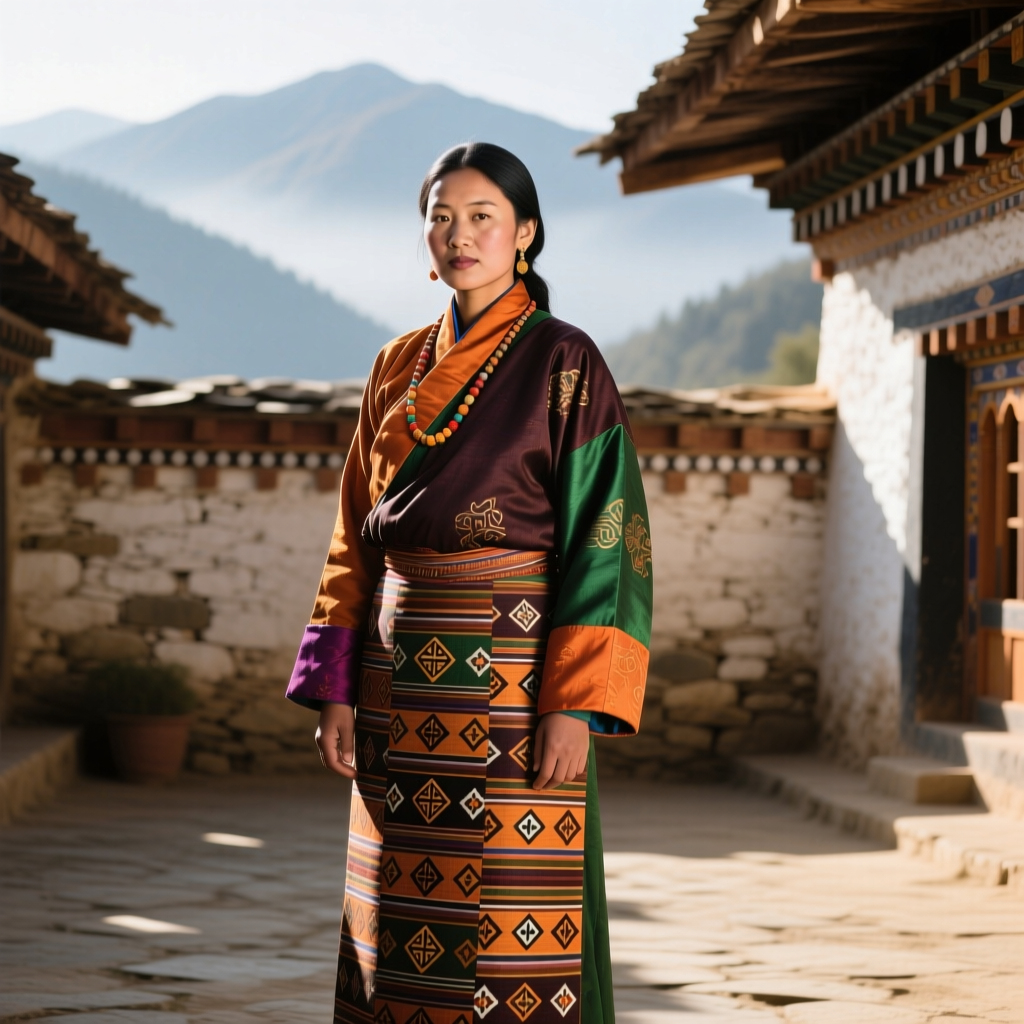
The standard Kira is an ankle-length, rectangular piece of cloth that is wrapped around the body, folded into wide, elegant pleats, and secured at the shoulders by ornate silver or gold brooches known as koma. It is then cinched at the waist with a kera, a beautifully woven belt that serves both a functional and decorative purpose. Beneath the Kira, women wear a long-sleeved blouse called a tego, and over it, a short, open jacket. The ensemble is completed with a rachu, a ceremonial shoulder cloth draped over the left shoulder, which signifies respect and is essential when entering sacred spaces or approaching authority figures.
While the silhouette of the Kira remains constant, the fabric itself acts as a subtle but powerful indicator of social status, regional origin, and the formality of the occasion. This is where the hierarchy of Bhutanese textiles becomes apparent. Everyday Kiras might be made of cotton or wool, featuring simpler stripes or subtle geometric patterns. However, for weddings, religious festivals (tshechus), and state functions, women don the Kushuthara. To explore more about how wrap skirts function across different cultures, our guide to traditional wrap skirts offers a fascinating global perspective, though few require the sheer technical mastery of the Bhutanese Kira.
The gifting and inheritance of textiles also play a crucial role in Bhutanese society. Historically, a family’s wealth was measured not in currency, but in the quality and quantity of their textile holdings. A masterfully woven Kushuthara is often passed down from mother to daughter as a cherished heirloom, carrying the blessings, history, and spiritual merit of the weaver. In this way, the Kira is a deeply personal artifact, binding the wearer to their ancestors and their community.
The Loom and the Legend: Craftsmanship Behind Kushuthara Weaving
The creation of a Kushuthara is a triumph of human patience and technical brilliance. The traditional Bhutanese art of weaving, known as Thagzo, is one of the thirteen traditional arts and crafts (Zorig Chusum) of Bhutan. Unlike the wide, floor-standing looms found in many Western or industrialized textile traditions, the Kushuthara is woven on a pangthag, or backstrap loom. This ancient device relies entirely on the weaver’s body to maintain the tension of the warp threads.
The weaver sits on the floor, a strap passing around her lower back and connecting to the far end of the loom. By leaning forward or backward, she micro-adjusts the tension of the hundreds of warp threads, a physical engagement that makes the weaving process an extension of her own breath and posture. This intimate connection between artisan and loom allows for extraordinary precision but is physically demanding, often resulting in a lifetime of occupational aches for master weavers.
What elevates the Kushuthara above all other Bhutanese textiles is the use of highly complex supplementary weft techniques, specifically sapma (continuous supplementary weft) and thrima (discontinuous supplementary weft). While the base fabric is woven with a ground weft that provides the structure, the weaver simultaneously introduces additional, brightly colored silk threads to create the elaborate brocade patterns. In the thrima technique, the weaver manually wraps and interlocks the colored silk threads only where the pattern requires them, essentially embroidering the design into the fabric as it is being woven. This requires a profound mental map of the pattern, as the weaver works from the back of the textile, visualizing the front without seeing it.
The materials used in a genuine Kushuthara are as luxurious as the techniques. Historically, weavers utilized wild silks, nettle fibers, and locally sourced cotton, dyed with natural dyeing processes derived from roots, bark, and insects. Today, while cultivated mulberry silk and vibrant, colorfast commercial dyes are frequently used for their brilliance and durability, the highest echelons of Kushuthara weaving still incorporate raw silk and, occasionally, threads wrapped in real gold or silver. The time investment is staggering. While a simple cotton Kira might take a few weeks to complete, a single, masterwork Kushuthara can require anywhere from six months to over a year of continuous, daily labor. To understand the mechanics of these intricate brocades, our resource on silk weaving techniques provides a deeper dive into supplementary weft structures.
Motifs and Meanings: Decoding the Patterns of the Dragon Kingdom
The visual language of the Kushuthara is a dense, vibrant tapestry of symbols drawn from Bhutan’s Vajrayana Buddhist traditions, its animist Bon roots, and its natural environment. Every motif woven into the silk carries specific auspicious meanings, designed to confer protection, prosperity, and spiritual merit upon the wearer. The study of these patterns is a vital part of understanding symbolism in traditional textiles.
One of the most prominent motifs is the Druk, the Thunder Dragon, from which Bhutan derives its name (Druk Yul, or Land of the Thunder Dragon). The dragon represents divine power, protection, and the sovereignty of the nation. Alongside the dragon, weavers frequently incorporate the Palbhe, or the Endless Knot. This ancient Buddhist symbol, featuring interlocking lines with no beginning and no end, represents the interconnectedness of all things, the eternal cycle of life, and the infinite wisdom of the Buddha.
Floral and faunal motifs are also abundant. The lotus flower, rising pure from muddy waters, symbolizes spiritual awakening and purity. The swastika, known in the Himalayas as the yungdrung, is an ancient symbol of eternity, immutability, and auspiciousness, long predating its tragic misappropriation in the 20th century. Birds, particularly the mythical Garuda and the snow lion, are woven into the borders and central panels to denote courage and spiritual triumph.
Color symbolism in the Kushuthara is equally codified. Historically, certain colors were strictly reserved for royalty and high-ranking monastic officials. Saffron yellow and deep crimson red were the exclusive domain of the King and senior monks, respectively. A Kushuthara featuring a predominantly yellow or red ground would instantly signal the wearer’s proximity to the throne or the highest echelons of the clergy. For the general populace, weavers utilized a spectacular spectrum of jewel tones—emerald greens, sapphire blues, and vibrant magentas—often set against a dark, contrasting background to make the supplementary silk patterns appear as though they are glowing from within the fabric.
Regional Variations and the Evolution of Bhutanese Textiles
While the Kushuthara represents the zenith of ceremonial Bhutanese weaving, the broader tradition of the Kira showcases a remarkable diversity of regional styles, reflecting the distinct microclimates and cultural nuances of Bhutan’s various dzongkhags (districts). The geography of Bhutan, characterized by deep, isolated valleys, allowed distinct weaving traditions to flourish independently before the advent of modern roads.
In the central valleys of Bumthang, the traditional textile is the Mathra. Unlike the shimmering silk of the Kushuthara, the Mathra is traditionally woven from sheep’s wool or cotton, featuring distinctive, tightly spaced geometric patterns, often in deep reds, greens, and blacks. The Mathra is heavier, designed to withstand the biting cold of the central Himalayan winters, and its cross-hatched patterns are believed to ward off evil spirits.
Moving to the eastern regions, particularly around Trashigang and Mongar, one encounters the Aikapur and the Shingka Chem. These textiles are renowned for their intricate, supplementary warp patterns and the use of raw, unspun silk that gives the fabric a slightly nubby, organic texture. The weavers of eastern Bhutan are also famous for their bangchung (bamboo bowls) and their distinct approach to color blocking, favoring bold, horizontal bands of contrasting colors that create a striking visual rhythm.
The evolution of these regional styles into a cohesive national identity is a testament to Bhutan’s internal cultural exchange. As roads connected the valleys in the latter half of the 20th century, weavers began to share techniques and motifs. Today, a master weaver in the west might incorporate a central Bhutanese geometric border into a silk Kushuthara, creating a hybrid garment that honors the diverse traditional Asian garments and textile heritage of the entire kingdom. Despite this cross-pollination, the discerning eye can still trace the lineage of a textile back to its regional roots, preserving the local identities within the national fabric.
Preserving the Loom: Modern Efforts to Safeguard Thagzo
The modernization of Bhutan, while carefully managed through the philosophy of Gross National Happiness, has inevitably brought challenges to traditional crafts. The influx of cheap, power-loomed, synthetic textiles from neighboring countries threatened to marginalize the labor-intensive art of Thagzo. Recognizing that the loss of this craft would mean the erosion of a core pillar of Bhutanese identity, the government, the monarchy, and various cultural institutions have launched robust preservation initiatives.
Her Majesty the Queen Mother, Ashi Sangay Choden Wangchuck, has been a paramount patron of Bhutanese textiles. Under her visionary leadership, the Royal Textile Academy of Bhutan was established to preserve, promote, and research the nation’s weaving heritage. The Academy not only houses an extensive archive of antique and royal garments but also conducts workshops, documents vanishing techniques, and provides a prestigious platform for master weavers to showcase their work. This royal patronage has elevated the status of the weaver from a domestic laborer to a respected national artist.
Furthermore, the National Institute for Zorig Chusum in Thimphu and Trashigang offers formalized training in the thirteen traditional arts, ensuring that young women (and increasingly, men) can learn the complex mathematics and physical techniques of backstrap weaving. The government has also integrated textile arts into the school curriculum and supports rural weaving cooperatives, allowing women in remote villages to achieve financial independence through their craft without having to migrate to urban centers.
Tourism and the global appreciation for ethical, slow fashion have also played a role in preservation. International collectors and textile enthusiasts seek out authentic, hand-woven Bhutanese silk, providing a lucrative market that incentivizes the continuation of traditional methods. However, this global interest requires careful navigation to ensure that the sacred and cultural significance of garments like the Kushuthara is respected, and that the economic benefits flow directly back to the artisan communities. Through these multifaceted efforts, the rhythmic clack of the backstrap loom continues to resonate through the valleys of Bhutan, a defiant and beautiful testament to the enduring power of heritage.
Frequently Asked Questions
What distinguishes a Kushuthara from other types of Kira?
The primary distinction lies in the complexity of the weave, the materials used, and the occasion for which it is worn. While a standard Kira might feature simple stripes or basic geometric patterns woven in cotton or wool, the Kushuthara is a highly formal, ceremonial garment. It is characterized by dense, intricate brocade patterns created using discontinuous supplementary weft techniques, almost exclusively utilizing high-quality silk threads. A Kushuthara is significantly heavier, more expensive, and takes exponentially longer to weave than an everyday Kira.
How does the backstrap loom influence Bhutanese textile design?
The backstrap loom (pangthag) dictates the physical dimensions and structural characteristics of Bhutanese textiles. Because the loom is limited by the length of the weaver’s reach and the tension her body can provide, textiles are woven in long, narrow panels. A standard Kira, for instance, is constructed by weaving three separate, identical panels and then meticulously stitching them together edge-to-edge. This necessity has influenced the design language, leading to a strong emphasis on horizontal banding, repeating motifs, and intricate borders that align perfectly when the panels are joined.
What is the significance of the Driglam Namzha in preserving the Kira?
The Driglam Namzha is the official code of conduct and dress in Bhutan. By legally and culturally mandating the wearing of the national dress (the Kira for women and the Gho for men) in public, educational, and official settings, the Driglam Namzha guarantees a constant, domestic demand for traditional textiles. This systemic requirement prevents the Kira from becoming a mere museum artifact or a costume reserved only for festivals; it remains a living, breathing, and evolving part of daily Bhutanese life, ensuring that the weaving economy remains viable.
Are natural dyes still used in contemporary Kushuthara weaving?
While the vast majority of contemporary Kushuthara weaving utilizes high-quality, colorfast synthetic dyes to achieve the brilliant, jewel-toned palettes favored today, there is a strong revivalist movement focused on natural dyes. Institutions like the Royal Textile Academy and various artisan cooperatives are actively researching and reintroducing traditional dyeing methods using local flora, such as madder root for reds, indigo for blues, and lac insects for purples. Textiles dyed entirely with natural materials are highly prized by collectors and are considered the pinnacle of authentic, heritage craftsmanship.
How can one ethically source and support authentic Bhutanese textiles?
Ethical sourcing requires bypassing mass-produced imitations and purchasing directly from recognized artisan cooperatives, government-sponsored craft emporiums, or reputable galleries that guarantee fair compensation to the weavers. When purchasing a high-value item like a Kushuthara, buyers should look for documentation of the weaver’s identity and the materials used. Supporting organizations that provide education, healthcare, and micro-loans to weaving communities in rural Bhutan is also an excellent way to ensure the long-term sustainability of this magnificent heritage.