The Art of Traditional Indian Clothing Drawing: A Comprehensive Guide
India’s sartorial heritage is a mesmerizing tapestry woven with centuries of history, diverse cultural influences, and unparalleled artisanal craftsmanship. For fashion illustrators, artists, and designers, traditional Indian clothing drawing presents a unique and deeply rewarding challenge. Unlike Western fashion illustration, which often focuses on the structured tailoring and rigid silhouettes of garments, illustrating Indian attire requires a profound understanding of fluid drapes, intricate layering, and the dynamic interplay between the human form and unstitched fabrics. From the sweeping pleats of a Kanjeevaram saree to the heavily embellished skirts of a bridal lehenga, capturing the essence of these garments on paper or a digital canvas is an exercise in both technical precision and cultural reverence.
Whether you are a fashion student looking to expand your portfolio, an illustrator aiming to capture the vibrancy of South Asian fashion, or a designer conceptualizing a new collection, mastering the art of traditional Indian clothing drawing is essential. This comprehensive guide will walk you through the historical origins, core characteristics, essential rendering techniques, and regional variations necessary to bring these magnificent garments to life. For a deeper dive into the fabrics that make these designs possible, explore our extensive archive on Indian textiles heritage.
The Origins & Evolution of Indian Garment Illustration
The practice of depicting Indian clothing is as ancient as the garments themselves. Long before the advent of modern fashion sketching, the silhouettes and draping styles of the Indian subcontinent were immortalized in stone and pigment. The Ajanta and Ellora cave murals, dating back to the 2nd century BCE, provide some of the earliest visual records of Indian attire. These ancient frescoes showcase the elegant, flowing drape of early unstitched garments, highlighting the importance of the antariya (lower garment) and uttariya (upper garment). Artists of that era masterfully used sweeping, continuous lines to convey the lightweight, breathable nature of handwoven cottons and silks.
As centuries passed, the evolution of Indian garment illustration was heavily influenced by the arrival of new dynasties. The Mughal era introduced a revolutionary shift in both clothing and its depiction. Mughal miniature paintings are a treasure trove for fashion illustrators, offering meticulously detailed renderings of layered angarkhas, flowing peshwaz, and intricate floral motifs. The artists of the royal courts utilized fine brushes and vibrant mineral pigments to capture the stiffness of brocades and the delicate sheerness of muslin. To understand how these historical shifts shaped modern silhouettes, read our guide on the Mughal influence on fashion.
During the colonial period, the 'Company School' of painting emerged, blending traditional Indian subjects with European watercolor techniques. These works documented the everyday attire of various regions, castes, and professions, serving as an early form of ethnographic fashion illustration. Today, contemporary traditional Indian clothing drawing bridges the gap between these rich historical archives and modern fashion design. Modern illustrators must balance the romanticism of historical miniatures with the practical, dynamic croquis required by today’s fashion industry, capturing both the structural reality and the poetic movement of the garments.
Core Characteristics of Traditional Indian Attire
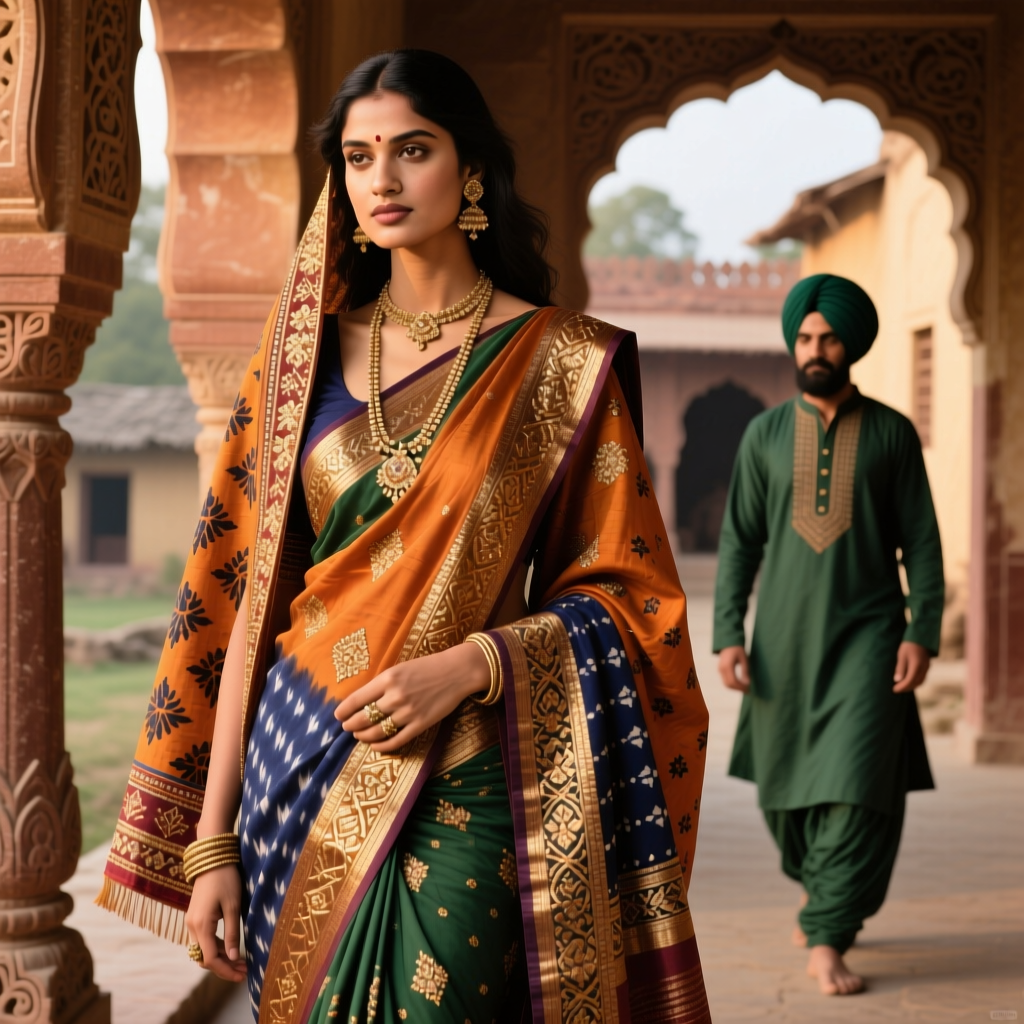
To accurately draw traditional Indian clothing, one must first understand the fundamental philosophy behind its construction. The most defining characteristic of Indian attire is the predominance of the unstitched garment. While tailored pieces like the choli (blouse) and kurta (tunic) exist, the most iconic garments—the saree, the dhoti, the dupatta, and the turban—are essentially lengths of fabric draped directly onto the body. This means that the silhouette is not fixed by seams but is created by the wearer’s movements, the weight of the fabric, and the tension of the folds.
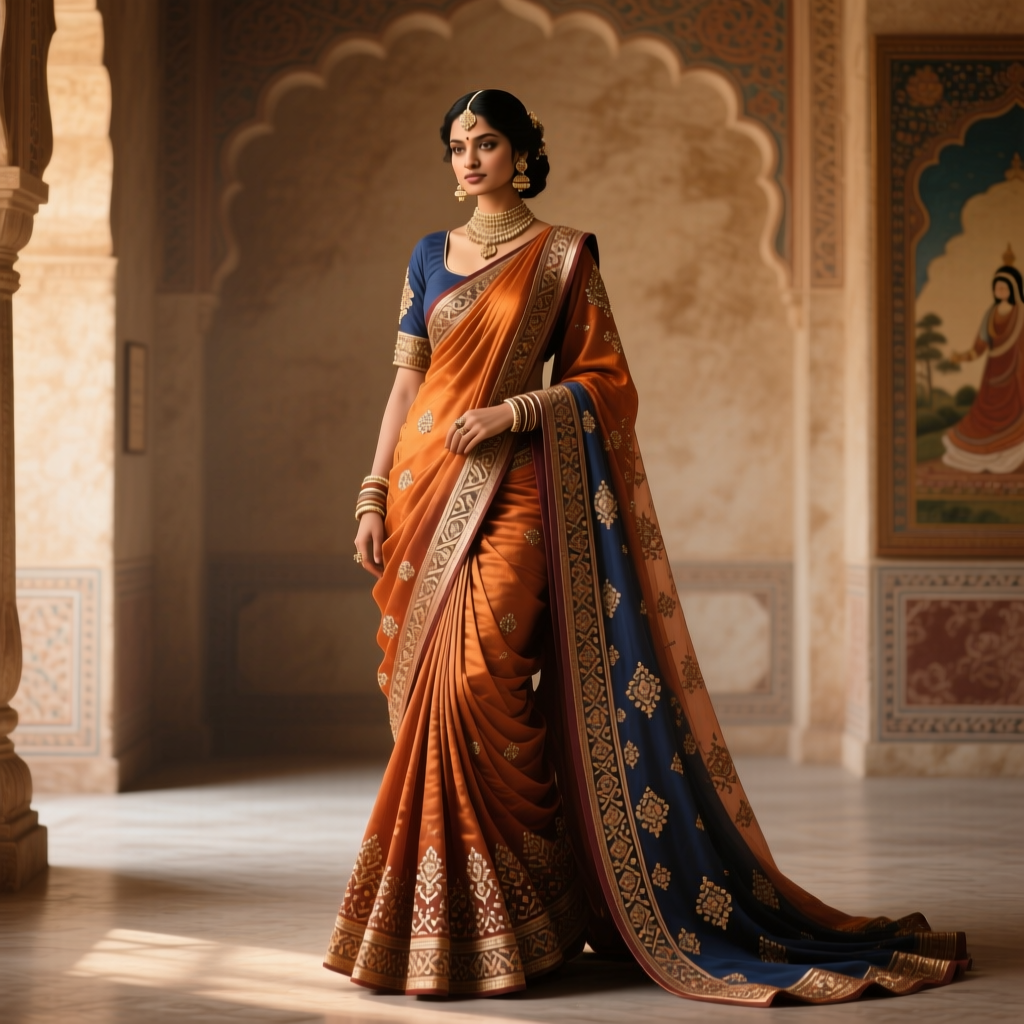
When sketching, the illustrator must pay close attention to the physics of the drape. A saree is not merely a skirt and a shawl; it is a continuous six-to-nine-yard piece of fabric that wraps, pleats, tucks, and cascades. The tension points—such as the waist where the fabric is tucked, or the shoulder where the pallu rests—dictate the flow of the rest of the garment. Understanding how gravity pulls on heavy silk versus how it allows sheer chiffon to float is crucial for realistic rendering.
Another core characteristic is the concept of layering and modesty, often achieved through the interplay of opaque and sheer textiles. A traditional ensemble rarely consists of a single piece. It involves a base layer, a primary drape, and an accessory drape (like the dupatta), accompanied by significant jewelry. Jewelry in Indian fashion is not an afterthought; it is integral to the silhouette. Heavy jhumkas (earrings), stacked bangles, and elaborate haar (necklaces) alter the posture and drape of the fabric, adding weight and visual complexity to the illustration. Mastery of these elements ensures your sketches reflect the true grandeur of the attire.
Essential Techniques for Drawing Indian Clothing
Translating the complexity of Indian garments onto a two-dimensional surface requires specialized illustration techniques. The first step is mastering the line weight. In Western fashion illustration, sharp, angular lines are often used to depict tailored seams. In contrast, traditional Indian clothing drawing demands fluid, variable line weights. Use thicker, softer lines to indicate deep, heavy folds in a silk saree, and incredibly fine, broken lines to suggest the delicate, translucent edges of a net dupatta. Cross-hatching should be used sparingly, reserved only for the deepest shadows within tight pleats.
Rendering the diverse textures of Indian textiles is perhaps the most challenging and rewarding aspect of the process. Take, for example, the Banarasi brocade. This fabric is heavy, stiff, and woven with metallic threads. To illustrate it, avoid drawing every single motif; instead, suggest the stiffness through broader, more sculptural folds, and use a stippling or metallic gel pen technique to imply the scattered glint of zari (gold thread). Conversely, when drawing Chanderi cotton or Chiffon, the folds should be numerous, shallow, and cascading. Watercolor washes or soft digital airbrushing are ideal for capturing the ethereal, see-through quality of these lighter fabrics.
Embellishment is another critical focal point. Indian bridal and festive wear is renowned for its intricate embroidery, such as Zardozi, Chikankari, and mirror work. When illustrating Zardozi embroidery, it is vital to convey the three-dimensional relief of the metal wires and beads. Use high-contrast highlights and deep shadows to make the embroidery pop off the page. For mirror work (shisha), use sharp, stark white highlights to mimic the reflection of light on glass. Remember that heavily embellished fabrics drape differently; the weight of the beads and threads pulls the fabric downward, creating a distinct, weighted hemline that must be reflected in your sketch.
Regional Variations in Garment Design & Illustration
India’s vast geography and diverse climates have given rise to a staggering array of regional garments, each with its own unique silhouette and draping style. A skilled illustrator must be able to distinguish and accurately depict these regional variations.
The North: Structure & Volume
Northern Indian attire is heavily influenced by the colder climates and the historical presence of the Mughal empire. The Salwar Kameez and the Anarkali suit are staples here. When drawing an Anarkali, focus on the dramatic flare of the skirt, which often features dozens of kalis (panels). The lehenga choli design guide is also essential for understanding the voluminous, heavily pleated skirts worn in states like Punjab and Rajasthan, often paired with a tightly fitted blouse and a sweeping dupatta.
The South: Crisp Pleats & Rich Silks
Southern Indian clothing is synonymous with the traditional saree, particularly the Kanjeevaram and the Kasavu. The draping style here, often the Nivi style or the traditional Madisar, features a distinct, fan-like arrangement of crisp pleats at the front. When illustrating these garments, the focus must be on the heavy, lustrous silk and the stark, contrasting borders (zari borders). The stiffness of the silk means the pleats hold their shape rigidly, creating sharp, geometric lines at the hem.
The East: Elegance & Simplicity
In Eastern India, particularly West Bengal and Assam, the draping styles and textiles are uniquely elegant. The Bengali saree drape is characterized by its lack of front pleats, relying instead on wide, sweeping folds that wrap around the body, with the pallu draped over both shoulders. Illustrators should capture the fluid, unstructured grace of this drape. In Assam, the Mekhela Chador is a two-piece garment that resembles a saree but features a distinct, sarong-like lower half with deep, box pleats, requiring a different approach to rendering the waistline.
The West: Vibrant Flares & Mirror Work
Western India, encompassing Gujarat and Rajasthan, is famous for the Chaniya Choli (or Ghagra Choli). This ensemble features a heavily flared, often tie-dye (Bandhani) or block-printed skirt, a short blouse, and a large odhni (veil). The illustration of a Chaniya Choli should emphasize movement and twirl. The skirts are designed for the energetic dances of Navratri, so drawing the garment in motion, with the hem flaring outward and the mirror work catching the light, captures its true cultural essence.
Cultural Significance & Symbolism in Illustration
Traditional Indian clothing drawing is not merely an exercise in rendering fabric; it is an act of visual storytelling. Every color, motif, and drape carries profound cultural and symbolic weight. An illustrator who understands this symbolism can infuse their work with deeper meaning and authenticity.
Color is the most immediate communicator of meaning in Indian attire. Red, for instance, is not just a vibrant hue; it is the quintessential color of matrimony, symbolizing prosperity, fertility, and the divine feminine energy of Shakti. When illustrating a bridal ensemble, the richness of the crimson or maroon must be palpable. Turmeric yellow signifies purity and is central to pre-wedding rituals, while stark white is traditionally associated with mourning and widowhood in many Hindu communities, though it is also worn as a symbol of purity in certain regional contexts.
Motifs woven or embroidered into the garments are equally significant. The ambi or paisley motif, resembling a mango or a cypress tree, represents fertility and eternal life. The lotus flower symbolizes divine beauty and purity, rising unblemished from muddy waters. Peacocks, the national bird, denote grace, beauty, and the arrival of the monsoon rains. When detailing these motifs in your sketches, referencing our guide on the symbolism in Indian motifs can help you place them accurately according to traditional design principles, such as clustering them heavily at the hem and the pallu while leaving the bodice relatively sparse.
Frequently Asked Questions
What are the best mediums for drawing traditional Indian clothing?
The choice of medium depends on the specific textile you wish to render. For the sheer, flowing qualities of chiffon, georgette, and fine cotton, watercolors and soft pastels are unparalleled, allowing for delicate washes and translucent layering. For heavy silks, brocades, and bridal wear, markers (like Copics) combined with colored pencils provide the saturation needed to depict rich jewel tones and metallic embellishments. Digital illustration tools, particularly Procreate or Adobe Fresco with custom texture brushes, are highly favored in the modern industry for their ability to simulate both the sheen of silk and the grit of heavy embroidery efficiently.
How do I accurately draw the pleats of a saree?
Accurately drawing saree pleats requires an understanding of geometry and gravity. Start by establishing the waistline and the point where the pleats are tucked in. The pleats should fan out slightly as they descend, resembling a folded hand fan. Avoid drawing them as perfectly parallel, rigid lines; instead, introduce slight variations in width and curvature to mimic the organic nature of fabric. Use a strong light source from one side to create deep shadows in the valleys of the folds and bright highlights on the ridges. This high-contrast shading is what gives the pleats their three-dimensional volume. For more on how the base drape affects the pleats, review our saree draping styles guide.
What are the most common motifs to include in Indian fashion sketches?
When conceptualizing or illustrating traditional Indian garments, incorporating authentic motifs adds a layer of cultural accuracy. The most ubiquitous motifs include the paisley (mango), the lotus, the peacock, the elephant, and the jaali (lattice) pattern. Floral vines, heavily influenced by Mughal art, are also incredibly common, particularly in Chikankari and Kashmiri embroidery designs. When sketching these, ensure the scale of the motif is appropriate to the fabric; a large, bold paisley might suit a heavy bridal lehenga, while a delicate, repeating floral vine is better suited for a lightweight kurta.
How can I depict the weight and texture of heavy bridal lehengas?
Heavy bridal lehengas are constructed with multiple layers of canvas, lining, and heavy silk or velvet, adorned with kilograms of metal embroidery and beads. To depict this weight, avoid drawing the skirt with light, breezy folds. Instead, use deep, sculptural, column-like folds that suggest stiffness and volume. The hemline should be drawn with a thick, grounded appearance, often pooling slightly on the floor to emphasize its mass. Use high-contrast shading to render the metallic threads, and consider adding a subtle drop shadow beneath the garment to anchor its visual weight to the page.
Where can I find reference materials for regional Indian garments?
Finding authentic reference materials is crucial for accurate illustration. Museums with dedicated textile departments, such as the Victoria and Albert Museum in London or the Calico Museum in Ahmedabad, offer extensive online archives of historical garments. Contemporary fashion weeks in India, such as the FDCI (Fashion Design Council of India) showcases, are excellent for observing how modern designers adapt traditional silhouettes. Additionally, studying classical Indian dance forms like Bharatanatyam and Kathak can provide invaluable insights into how these garments move, drape, and flare in real-time, bringing a dynamic realism to your fashion sketches.