Traditional Clothing in Germany: A Historical Origins Guide
When researchers, historians, and enthusiasts search for traditional clothing in Germany, the mind often defaults to the alpine stereotypes of Oktoberfest: the dirndl and lederhosen. However, the authentic history of German Tracht (traditional dress) is a vastly more complex tapestry of regional isolation, sumptuary laws, and 19th-century romantic nationalism. To understand German folk dress is to understand the socio-economic history of the Holy Roman Empire's fragmented territories, where a valley's distance from a trade route could entirely alter a garment's silhouette, fabric, and meaning.
The Etymology and Evolution of German Tracht
The word Tracht derives from the Old High German traht, meaning "that which is worn or carried." Historically, it did not refer exclusively to rural folk dress, but simply to clothing. It was not until the late 18th and early 19th centuries that scholars and the bourgeoisie began using Volkstracht to specifically denote the slow-changing, regionally specific garments of the rural peasantry, distinguishing them from the rapidly shifting fashions of the urban elite.
Authentic Tracht is defined by its historical continuity and strict adherence to local codes. This is in stark contrast to modern Trachtenmode (fashionable country-style clothing), which borrows aesthetic elements like corset-style lacing and checkered patterns but lacks the historical lineage, specific regional markers, and artisanal construction techniques of true traditional dress.
Sumptuary Laws: How Class and Faith Dictated the Cut
To trace the origins of regional variations, one must examine the Kleiderordnungen (sumptuary laws) enforced between the 16th and 18th centuries. Local lords and magistrates dictated exactly which fabrics, colors, and embellishments different social classes could wear. Peasants were generally forbidden from wearing silk, velvet, or bright dyes like crimson and saffron, which were reserved for the patrician and noble classes.
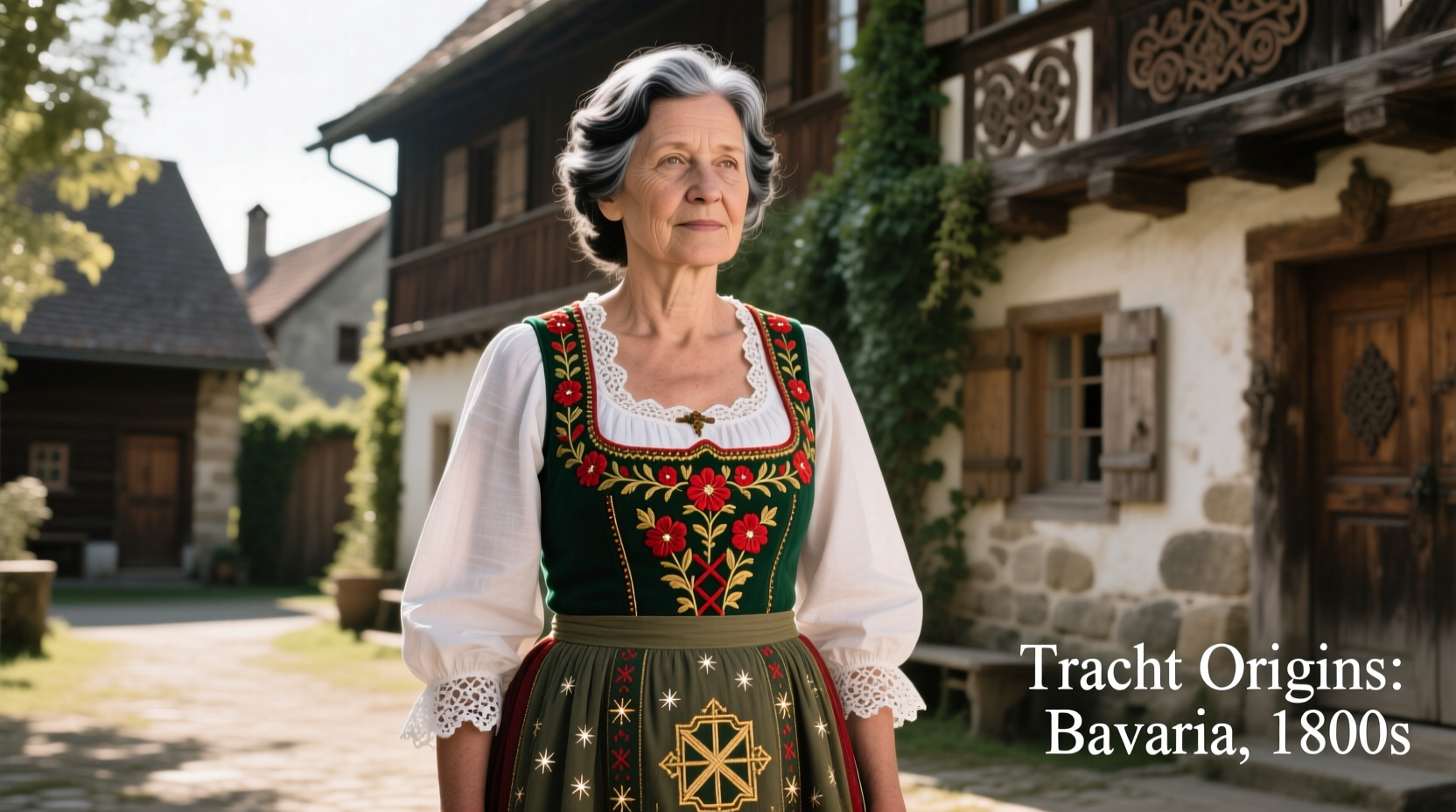
Religion also played a pivotal role in shaping traditional clothing in Germany. In deeply Protestant regions, such as parts of Northern Germany and Franconia, dress codes favored modesty. Garments were constructed from dark, unadorned Wolltuch (wool cloth) and linen, with jewelry minimized. Conversely, in Catholic regions of Bavaria, Swabia, and the Rhineland, rural populations incorporated vibrant embroidery, silver filigree, and imported ribbons into their festival and church attire, reflecting a theological embrace of visual splendor.
Regional Divergence: Beyond the Bavarian Stereotype
While Bavarian and Austrian alpine dress dominates global media, Germany's historical landscape boasts dozens of distinct Trachtenlandschaften (tracht regions).
The Black Forest Bollenhut
The iconic Bollenhut of the Black Forest (Schwarzwald) is perhaps the most globally recognized piece of German headwear, yet it is geographically restricted to just three villages: Gutach, Kirnbach, and Hornberg-Reichenbach. Originating around 1797, the wide-brimmed straw hat is adorned with 14 woolen pom-poms. According to strict local tradition, the pom-poms are red for unmarried women and black for married women. The hat is worn only over a specific silk bonnet and is reserved for Sunday church attendance and major festivals, never for daily labor.
East Frisian Silk and Silver
In the windswept coastal region of Ostfriesland (East Frisia), traditional clothing reflects the area's historical wealth from maritime trade and Dutch influence. The Ostfriesische Tracht for women is characterized by dark, heavy silks and intricate, lace-trimmed aprons. The most striking element is the Philigran jewelry—elaborate silver filigree brooches, necklaces, and ear irons that were historically used to secure the lace caps, serving as a portable display of a family's mercantile success.
Sorbian Dress in Lusatia
In the eastern states of Brandenburg and Saxony lives the Sorbian minority, a Slavic people with a rich textile heritage. The Serbska drasta (Sorbian dress) is a masterclass in regional coding. As documented by the Sorbisches Institut, the attire varies drastically between the Catholic Schleife region and the Protestant Bautzen area. The garments feature breathtakingly complex pleating, vibrant floral embroidery, and the Borta, an intricately crafted lace and ribbon cap that denotes the wearer's exact village, age, and marital status.
Anatomy of Authentic Garments: Materials and Construction
True traditional clothing in Germany is defined by labor-intensive construction methods that have been passed down through generations of Schneidermeister (master tailors) and Stickerinnen (embroiderers). According to archives at the Deutsches Trachtenmuseum in Bayreuth, the value of a garment historically lay not in the cut, but in the sheer volume of fabric and the hours of hand-finishing.
| Garment Component | Authentic Material | Construction Marker | Estimated Price Range (EUR) |
|---|---|---|---|
| Dirndl Skirt (Rock) | Worsted wool, heavy linen, or raw silk | Hand-pleated (gelegt) using steam and vinegar; requires 3-5 meters of fabric. | €250 – €600 |
| Bodice (Mieder) | Brocade, velvet, or linen reinforced with horn/wood | Front-lacing with silver hooks (Haken) and chain; patterned to match specific regional codes. | €200 – €500 |
| Lederhosen (Kniebundhose) | Hirschleder (Deer hide) or Chamois | Tanned via Sämischgerbung (cod liver oil); features regional Stickerei (embroidery) on the drop-front. | €700 – €1,500+ |
| Men's Vest (Gilet) | Silk brocade or fine loden wool | Hand-stitched buttonholes; back panel traditionally made of plain linen to save expensive fabric. | €150 – €350 |
The 19th-Century Revival and Romantic Nationalism
Ironically, the preservation of traditional clothing in Germany was largely driven by the urban elite. In the early 19th century, the Romantic movement sparked a deep nostalgia for rural, "untainted" life. The bourgeoisie began adopting rural dress for hunting, hiking, and summer retreats.
A pivotal moment occurred in 1853 when King Maximilian II of Bavaria issued a royal decree encouraging the preservation and wearing of national dress. His goal was political: to foster a unified Bavarian identity among the diverse Franconian, Swabian, and Alpine populations recently absorbed into his kingdom. This led to the formation of the first Trachtenvereine (traditional dress clubs), which codified local garments and prevented them from being lost to the industrial revolution's mass-produced clothing.
Acknowledging the Dark Interruption of the 1930s
Any comprehensive historical guide must address the appropriation of German folk dress during the 1930s and 40s. The Nazi regime sought to weaponize Tracht, attempting to standardize it into a homogenous "Reichstracht" to promote a fabricated, pan-Germanic agrarian ideal. They stripped away regional diversity and banned Jewish artisans from the tailoring guilds. Following World War II, authentic Trachtenvereine worked tirelessly to distance themselves from this political hijacking, returning to rigorous, hyper-local historical research to preserve the true, diverse origins of their regional garments.
Modern Preservation and Authentic Acquisition
Today, traditional clothing in Germany is a living heritage, maintained by cultural historians, rural communities, and dedicated artisans. Institutions like the Bayerisches Nationalmuseum house extensive collections that serve as blueprints for modern revivalists.
For collectors and enthusiasts seeking authentic pieces, it is vital to avoid mass-market tourist shops. Instead, seek out certified Dirndlmanufakturen or bespoke leatherworkers who utilize Sämischgerbung (chamois tanning). Authentic hand-pleated skirts and naturally tanned deer-hide trousers are investments in wearable history, often costing upwards of €1,000 for a complete, historically accurate ensemble. When wearing these garments at cultural festivals or Kirchweih (church dedication festivals), adhering to the specific regional protocols—such as the correct tying of the Dirndl apron bow or the appropriate hat for one's marital status—demonstrates a profound respect for the communities that have safeguarded these traditions for centuries.
"Tracht is not a costume to be put on for a performance; it is the sartorial diary of a region, recording its trade routes, its faith, and its social structures in every stitch and pleat."
— Curatorial Archives, Deutsches Trachtenmuseum
Understanding the historical origins of traditional clothing in Germany transforms the garments from mere festival wear into profound artifacts of European cultural history. Whether examining the silver filigree of the Frisian coast or the intricate embroidery of a Bavarian bodice, each piece offers a masterclass in the intersection of geography, politics, and human artistry.