Chinese Women's Dress: Hanfu, Qipao & Heritage
When examining the global tapestry of historical clothing, china women traditional dress stands out for its profound philosophical underpinnings, intricate textile engineering, and enduring legacy. While our primary focus at The Garment Atlas often centers on European folk dress, understanding the structural and sartorial brilliance of Chinese historical garments is essential for any serious student of global textile history. The cross-pollination of ideas along the Silk Road deeply influenced European textile traditions, from the Chinoiserie motifs of the 18th century to the structural pleating techniques seen in Renaissance dress. This deep dive explores the anatomy, cultural significance, and modern acquisition of China's most iconic women's garments.
The Philosophical Architecture of Hanfu
Hanfu (汉服) refers to the traditional clothing of the Han Chinese, spanning over three millennia before the Qing dynasty's imposition of Manchu dress codes. The defining characteristic of Hanfu is the jiaoling youren (交领右衽), or cross-collar right lapel. The left side of the garment crosses over the right, securing at the waist with a sash. This is not merely a stylistic choice; in traditional Chinese cosmology, the left represents the east, the sun, and life, while the right represents the west and death. Reversing this lapel was historically reserved strictly for funerary dress.
The Hanfu system is broadly categorized into several silhouettes:
- Yichang (衣裳): A two-piece system consisting of an upper garment (yi) and a lower wrap-around skirt (chang), representing the separation of heaven and earth.
- Shenyi (深衣): A deep robe that connects the upper and lower garments into a single piece, symbolizing unity and harmony.
- Ruqun (襦裙): A short jacket or blouse paired with a high-waisted skirt, widely popular during the Tang Dynasty (618–907 CE) and characterized by flowing, wide sleeves and vibrant, cosmopolitan textile patterns.
The Mamianqun: Engineering the Horse-Face Skirt
Arguably the most structurally fascinating garment in the Chinese wardrobe is the Mamianqun (马面裙), or 'horse-face skirt.' Originating in the Song Dynasty and reaching its zenith during the Ming Dynasty (1368–1644 CE), this skirt features two flat, overlapping front and back panels (the 'horse faces') with heavily pleated side panels. From a European garment construction perspective, the Mamianqun's side pleating shares structural DNA with the cartridge pleating used in 16th-century European gowns to gather heavy fabrics tightly at the waistband.
Ming dynasty Mamianqun were often woven using the zhuanghua (妆花) technique, a complex supplementary weft weaving method that allowed for vibrant, multi-colored patterns directly on the loom. Today, the Mamianqun has experienced a massive revival among young Chinese women, who pair these historically accurate skirts with modern blouses for daily wear, bridging the gap between museum artifact and living street fashion.
The Qipao: Shanghai's Sartorial Revolution
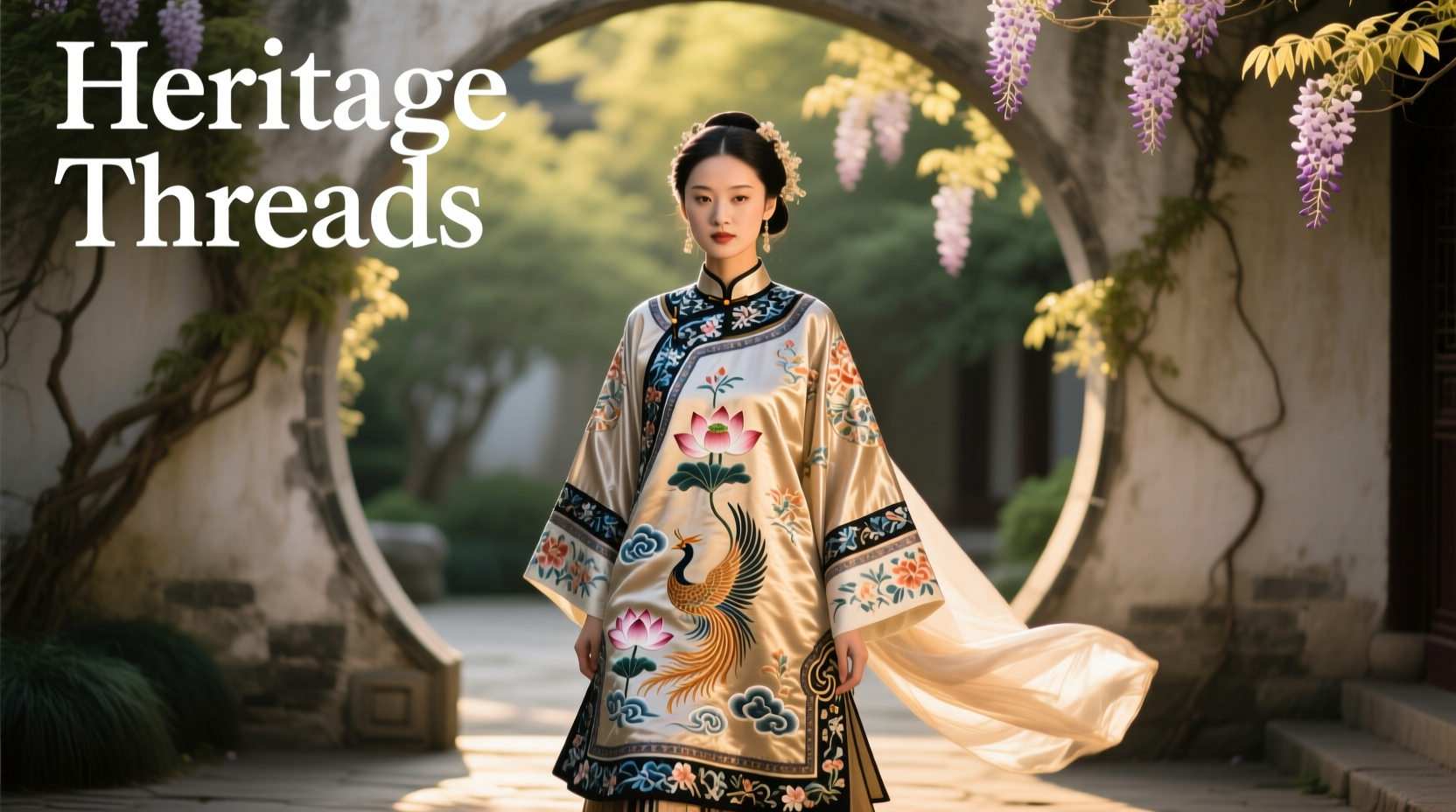
No discussion of china women traditional dress is complete without the Qipao (旗袍), also known in the West as the Cheongsam. Evolving from the loose, A-line robes worn by Manchu women during the Qing Dynasty (1644–1912 CE), the Qipao was radically reimagined in 1920s Shanghai. Influenced by Western tailoring techniques and the feminist movements of the era, the modern Qipao became a form-fitting, knee-length dress featuring a Mandarin collar, side slits for mobility, and intricate pankou (frog fasteners).
The pankou knots are functional art, crafted from silk bias tubing and shaped into motifs like plum blossoms, butterflies, or longevity knots. The garment requires a master tailor to execute the guiba (归拔) technique—a specialized ironing and stretching method that molds the flat fabric to the body's curves without the use of Western-style darts, preserving the unbroken canvas of the textile's embroidered patterns.
Textile Alchemy: Xiangyunsha and Brocades
The cultural weight of these garments is inextricably linked to their fabrics. Xiangyunsha (香云纱), or gambiered Canton gauze, is an intangible cultural heritage textile from Guangdong province. It involves dyeing silk in the juice of the gambier yam, then coating it with iron-rich river mud. The chemical reaction between the tannins and the iron creates a lustrous, dark, leather-like fabric that is waterproof, cooling, and historically prized for its durability. Similarly, Song Brocade (宋锦) and Yun Brocade (云锦) represent the pinnacle of Chinese silk weaving, often incorporating peacock feather yarns and gold leaf threads.
Acquisition Guide: Pricing and Authenticity
For collectors, historians, and enthusiasts looking to acquire authentic pieces, the market ranges from mass-produced polyester to bespoke artisan silk. Below is a structured guide to current market prices and sourcing.
| Garment Type | Era of Origin | Defining Features | Authentic Fabric | Price Range (USD) |
|---|---|---|---|---|
| Ming-style Mamianqun | Ming (1368–1644) | Flat front/back panels, side pleats, woven motifs | Mulberry Silk, Zhuanghua weave | $150 – $600 |
| Tang Dynasty Ruqun | Tang (618–907) | High waist, wide sleeves, chest-tied sash | Silk chiffon, damask | $80 – $350 |
| Bespoke Qipao | 1920s Shanghai | Mandarin collar, pankou knots, side slits | Heavy silk crepe, Xiangyunsha | $400 – $2,500+ |
| Qing Dynasty Aoqun | Qing (1644–1912) | High-collared jacket, pleated skirt, heavy embroidery | Silk satin with Su embroidery | $300 – $1,200 |
Note: Authentic Xiangyunsha Qipaos from certified heritage artisans in Shunde, Guangdong, often start at $1,500 due to the months-long, weather-dependent dyeing process.
Global Resonance: Preservation in European Archives
The study of china women traditional dress is heavily supported by European cultural institutions, which house some of the most pristine examples of Qing and Ming textiles outside of Asia. Researchers frequently consult the Victoria and Albert Museum's Asian Collections in London to study the evolution of the aoqun (jacket and skirt) ensemble and the degradation patterns of early synthetic dyes used in late 19th-century trade textiles. Furthermore, the China National Silk Museum frequently collaborates with European textile conservationists to share data on the preservation of fragile kesi (silk tapestry) weaves.
For those studying the intersection of global dress, the Metropolitan Museum of Art's Heilbrunn Timeline of Art History provides invaluable essays on how Chinese silk weaving techniques, particularly the drawloom technology used for complex brocades, eventually influenced the silk weaving centers of Lyon, France, and Genoa, Italy. Understanding the engineering of the Mamianqun or the tailored precision of the Qipao offers a masterclass in garment construction that transcends borders, proving that the language of textiles is truly universal.
Wearing Etiquette and Cultural Respect
As traditional Chinese garments gain global visibility, wearing them requires cultural mindfulness. When wearing Hanfu, always ensure the left lapel crosses over the right. Avoid purchasing cheap, mass-produced 'costume' versions made of shiny polyester for formal cultural events, as this undermines the artisan heritage of the garment. Instead, support verified Hanfu brands like Minghuatang or Shisanyu, which invest heavily in historical accuracy and traditional loom weaving. By treating these garments with the same reverence afforded to a Scottish Highland kilt or a Norwegian Bunad, we honor the living history woven into every thread.