Traditional Costumes of China: Craftsmanship Guide

The Structural Geometry of the Traditional Costumes of China
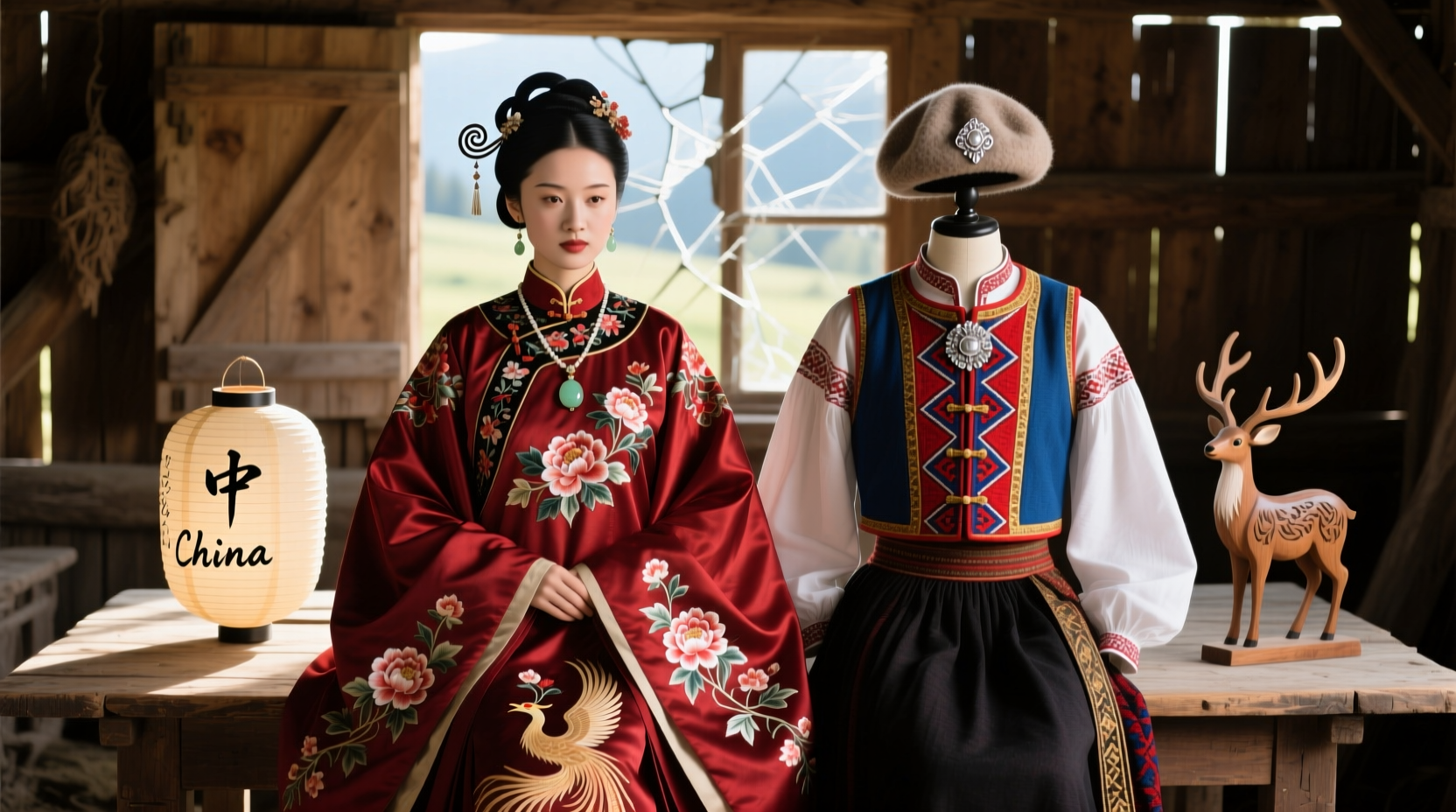
When examining the traditional costumes of China, one must first discard Western concepts of three-dimensional tailoring. For millennia, Chinese garment construction was rooted in flat-cutting geometry, a direct consequence of the traditional drawloom and a profound cultural reverence for preserving the integrity of the woven cloth. Unlike European folk dress, which often evolved to sculpt fabric around the body through darts and curved seams, historical Chinese clothing prioritized two-dimensional panels that draped dynamically. To truly understand these garments—from the flowing Hanfu of the Han majority to the intricately tailored Qipao of the 20th century—one must examine the masterful craftsmanship, natural dyeing alchemy, and specialized materials that define them.
The Geometry of the Loom: Hanfu Construction
The foundational garment system of the Han people, known collectively as Hanfu (汉服), is dictated by the historical width of the silk bolt. Traditional Chinese looms produced fabric bolts measuring approximately 60 to 75 centimeters in width. Rather than cutting curves into this precious material, artisans developed a system of rectangular pattern pieces. The iconic Shenyi (deep robe) and the Ruqun (a top-and-skirt ensemble) are constructed by folding, pleating, and overlapping these rectangular panels.
This flat-cutting method, characterized by the Jiaoling Youren (cross collar, right lapel) and wide, sweeping sleeves, minimizes textile waste and allows the garment to drape elegantly over the wearer. The structural integrity of a high-quality Mamianqun (horse-face skirt), a staple of Ming Dynasty dress, relies entirely on precise knife-pleating and heavy silk brocades that hold their architectural folds without the need for synthetic stiffeners. Today, authentic Ming-style Mamianqun skirts woven from real mulberry silk and metallic threads cost between $250 and $800 USD from specialized ateliers in Hangzhou, reflecting the immense labor required to set and heat-press the pleats.
Xiangyunsha: The Alchemy of Mud and Sun
When discussing the materials of southern Chinese folk and historical dress, no textile is as revered or as complex as Xiangyunsha (香云纱), also known as Gambiered Canton Gauze. Originating in the Pearl River Delta, specifically the Shunde district of Guangdong, this fabric is a masterclass in natural chemical engineering. The craftsmanship of Xiangyunsha is a grueling, multi-step process recognized for its deep ties to broader Chinese silk heritage, as documented by institutions like UNESCO.
Artisans weave a lightweight, open-structure silk gauze, which is then repeatedly dipped in the tannin-rich juice of the Dioscorea cirrhosa (Shoulang) yam. After dozens of dyeing cycles, the fabric is coated with the iron-rich mud from local riverbeds. The tannins and iron undergo a chemical reaction, transforming the silk into a dark, lustrous, and water-resistant material that feels akin to soft leather or rustling paper. The entire process requires intense sunlight and can only be performed during specific months of the year. Because of this painstaking labor, genuine Xiangyunsha commands prices ranging from $150 to over $400 USD per meter. Authentic pieces can be identified by their distinct two-tone coloration: the exterior is deep black, while the interior remains a warm, earthy brown.
The Evolution of the Qipao: Tailoring and Material Shifts
While Hanfu represents ancient geometries, the Qipao (or Cheongsam) illustrates the dramatic shift in Chinese craftsmanship during the 1920s and 1930s. Originating from the loose, A-line robes of Manchu women, the Shanghai Qipao was radically re-engineered through contact with Western tailoring techniques. The modern Qipao introduced three-dimensional darting, bias-cutting, and fitted side seams to accentuate the silhouette.
However, its most defining craftsmanship element remains the Pankou (frog buttons). Creating authentic Pankou is a meticulous art: silk cords are stiffened with copper wire or heavy starch, then folded and knotted into intricate motifs like plum blossoms, swallows, or longevity knots. A master tailor in Shanghai or Hong Kong may spend up to 15 hours crafting a single set of complex Pankou for a bespoke silk crepe Qipao, which typically starts at $1,200 USD and can exceed $5,000 for hand-embroidered commissions.
The Needle and the Thread: Su Xiu Embroidery
Surface ornamentation on the traditional costumes of China frequently involves Su Xiu (Suzhou embroidery), one of the four major styles of Chinese silk embroidery. The craftsmanship here borders on the microscopic. Master embroiderers practice thread splitting, where a single strand of silk floss is divided into up to 48 finer filaments. Using a 1/48th strand allows for imperceptible color gradients, particularly when rendering the scales of a koi fish or the feathers of a kingfisher. According to archives at the China National Silk Museum, historical court garments often required tens of thousands of hours of continuous embroidery, utilizing metallic gold and silver threads spun around a silk core.
Comparative Analysis of Heritage Silk Weaves
To navigate the market for authentic Chinese traditional garments, one must understand the distinct properties of regional weaves. The following table outlines the primary heritage textiles utilized by contemporary artisans and historical preservationists.
| Textile Name | Region of Origin | Structural Characteristics | Primary Garment Application | Approx. Market Price (USD/m) |
|---|---|---|---|---|
| Kesi (缂丝) | Suzhou / Dingzhou | Tapestry weave; cut silk creating carved-looking color blocks | Imperial dragon robes, high-end Qipao panels | $800 - $2,500+ |
| Songjin (宋锦) | Suzhou | Compound weave; matte finish, highly durable, geometric patterns | Ming-style Aoqun jackets, book mounting | $120 - $300 |
| Yunjin (云锦) | Nanjing | Brocade; heavy use of peacock feather yarns and gold foil | Ceremonial Hanfu, wedding skirts | $400 - $1,500 |
| Xiangyunsha | Guangdong | Plain weave gauze; mud-dyed, rustling texture, water-resistant | Summer Ruqun, scholar robes, wide-leg trousers | $150 - $450 |
Sourcing and Preserving Living Traditions
The market for the traditional costumes of China is currently experiencing a massive renaissance, driven by the Hanfu movement among Chinese youth. However, this surge in demand has flooded the market with mass-produced polyester imitations that lack the breathability, drape, and historical accuracy of natural fibers. For collectors, historians, and cultural enthusiasts seeking authentic pieces, it is vital to source from recognized artisan cooperatives and established silk mills in Jiangsu and Zhejiang provinces.
Institutions like the Victoria and Albert Museum frequently highlight the importance of preserving these intangible heritage techniques, noting that the survival of complex weaves like Kesi relies entirely on a dwindling number of master weavers. When purchasing, always request fiber burn tests or microscopic weave analyses to verify the presence of genuine mulberry silk and traditional hand-loomed structures. By understanding the profound material science and artisanal labor behind these garments, enthusiasts can ensure they are investing in a true, living artifact of Chinese textile history.