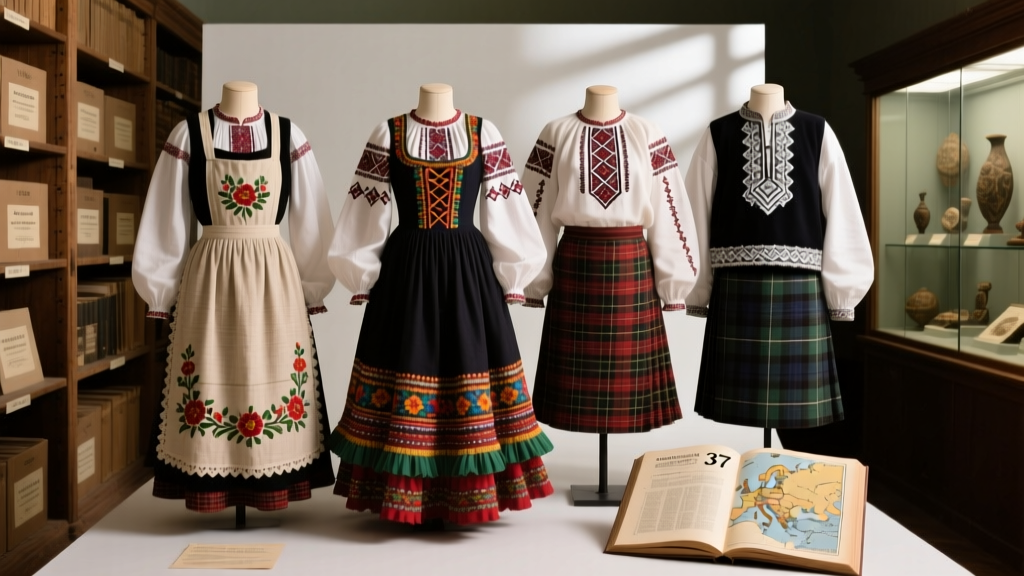
Chinese & European Folk Dress: Textile Compared
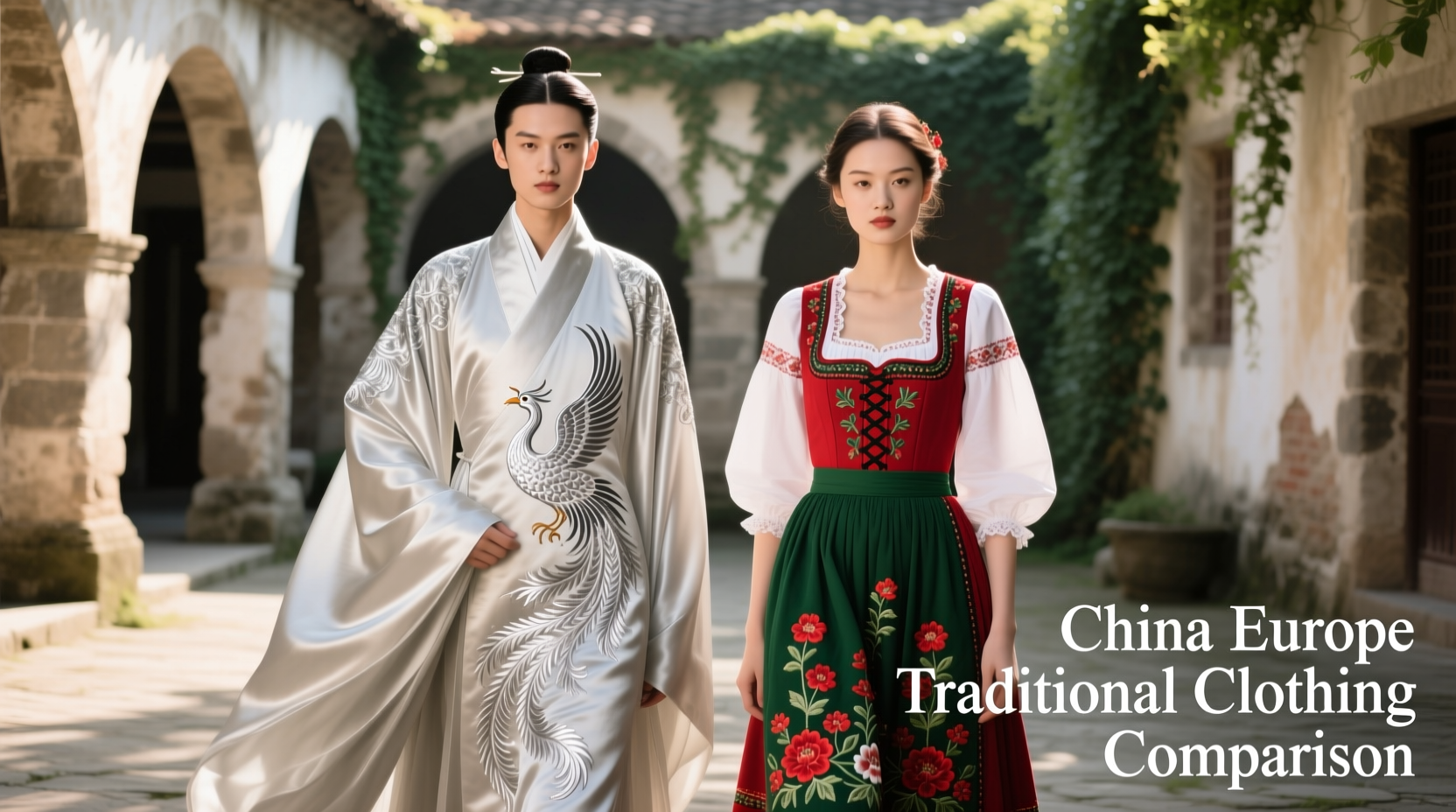
The Silk Road Thread: Connecting East and West
When curating a comprehensive encyclopedia of global dress, examining traditional clothing China alongside European folk dress reveals profound historical intersections. While the Bavarian Tracht and Norwegian Bunad are deeply rooted in Alpine and Scandinavian agrarian life, the ancient Silk Road facilitated a centuries-long exchange of textiles, motifs, and tailoring philosophies between East Asia and Eastern Europe. This comparative analysis explores the structural variants, historical textile exchanges, and modern revival movements that connect Chinese heritage garments with European regional costumes, offering a unique lens for textile historians and cultural enthusiasts alike.
Structural Philosophies: Flat Cutting vs. Tailored Contours
The most striking divergence between historical Chinese garments and European folk dress lies in their foundational cutting philosophies. Traditional Hanfu (the historical dress of the Han Chinese) is celebrated for its flat, geometric cutting. Garments like the Shenyi (deep robe) and Ruqun (blouse and skirt) were constructed using whole widths of woven silk or ramie, minimizing waste and preserving the integrity of the textile. The fabric was draped, pleated, and tied, allowing the garment to flow over the body rather than restrict it.
Conversely, European folk dress, particularly from the 18th century onward, embraced curved seams, darts, and bias cutting to contour the body. The iconic Bavarian Dirndl features a tightly fitted, structured bodice designed to sculpt the silhouette, while the Swedish Folkdräkt utilizes tailored wool waistcoats and fitted sleeves. This reflects a broader cultural divergence: Eastern traditions often prioritized the harmony between the woven cloth and the natural form, whereas Western traditions increasingly sought to mold the fabric to an idealized bodily shape.
Cross-Cultural Construction & Material Comparison
| Garment Variant | Region of Origin | Primary Historical Fabric | Cutting Technique | Fastening Method |
|---|---|---|---|---|
| Hanfu (Ming Dynasty Mamianqun) | China (Han) | Mulberry Silk, Ramie | Flat, geometric pleating | Silk ties, no buttons |
| Dirndl | Bavaria / Austria | Linen, Wool, Cotton | Tailored, curved bodice | Hook-and-eye, buttons |
| Bunad (Hardanger) | Norway | Hand-woven Wool | Fitted, structured bodice | Sterling silver Sølje pins |
| Qipao (Cheongsam) | China (Manchu/Shanghai) | Silk Brocade, Jacquard | Contoured, bias-cut | Pankou (knotted buttons) |
| Sarafan | Russia (Northern) | Silk Damask, Wool | A-line, gored panels | Front buttons, sashes |
The Influence of Chinese Silk on Eastern European Folk Costumes
The intersection of traditional clothing China and European regional dress is most visible in the historical adoption of Chinese textiles by Eastern European nobility, which eventually trickled down into folk traditions. During the Polish-Lithuanian Commonwealth, the Kontusz sash—a vital component of noble male dress—was heavily inspired by Persian and Chinese silk weaving techniques. Artisans utilized complex damask and brocade methods originating from Chinese looms to weave metallic threads into silk, creating motifs that blended Eastern dragons and peonies with local heraldry.
Similarly, the Russian Sarafan, a traditional pinafore dress, was frequently crafted from imported Chinese silk and brocade for wealthy merchants and nobility in the 17th and 18th centuries. Over time, the visual language of these imported Chinese textiles—such as the cloud collar motifs and lotus patterns—was adapted into local embroidery techniques, influencing the floral medallions seen in traditional Russian and Ukrainian cross-stitch (vyshyvka).
Semiotics of Wearing Etiquette: A Comparative Guide
Both Chinese and European traditional garments utilize strict visual codes to communicate the wearer's social and marital status. Understanding these protocols is essential for anyone studying or wearing these garments today.
- Hanfu Lapel Etiquette: The defining feature of traditional clothing China is the Jiaoling youren (cross-collar, right lapel). The left side of the collar must always cross over the right, symbolizing life and the yang principle. Crossing right-over-left is strictly reserved for dressing the deceased and is considered highly inauspicious for the living.
- Dirndl Apron Knots: In Alpine traditions, the placement of the apron bow communicates marital status. A bow tied on the left indicates the wearer is single; on the right, she is married or in a relationship; in the center, she is a virgin (or keeping her status secret); and tied at the back, she is widowed or working as a waitress.
- Bunad Silver (Sølje): In Norwegian folk dress, the amount and complexity of the silver filigree brooches worn at the collar and cuffs historically denoted family wealth and regional parish affiliation. Wearing silver from a parish you have no ancestral or residential tie to is frowned upon in strict traditionalist circles.
Modern Revivals: The Hanfu Movement vs. European Trachten
The 21st century has witnessed massive cultural revivals in both spheres. The Hanfu Yundong (Hanfu Movement) in China has seen millions of young people reclaiming pre-Qing dynasty garments as everyday streetwear, driven by social media and a desire to reconnect with Han heritage. This mirrors the Trachten revival in Germany and Austria, where high-end designers are reimagining the Dirndl and Lederhosen for contemporary urban wear beyond the Oktoberfest tents.
Buying Guide: Authentic Garments and Price Ranges
For collectors and cultural enthusiasts seeking authentic pieces, the market varies drastically based on materials and artisanal labor.
- Authentic Hanfu (Ming Dynasty Reproduction): A high-quality Mamianqun (horse-face skirt) woven from genuine mulberry silk with metallic brocade patterns typically ranges from $120 to $350 USD. Brands like Shisan Yu and Ming Huatang specialize in historically accurate flat-cutting and period-correct motifs.
- European Dirndl (Premium): A handcrafted Dirndl from heritage brands like Gössl or Trachten Angermaier, featuring silk brocade bodices and hand-stitched aprons, costs between $400 and $1,200 USD.
- Norwegian Bunad: Due to the strict regulations by the Landsnemnda for Bunadsspørsmål (National Bunad Council) and the requirement for hand-woven wool and local embroidery, a complete Bunad ensemble costs between $3,000 and $6,000 USD, excluding the mandatory sterling silver jewelry.
Curatorial Perspectives and Authoritative Sources
To deeply understand the cross-pollination of Eurasian textiles, researchers and enthusiasts should consult the archives of leading cultural institutions. The Metropolitan Museum of Art's Asian Art and European Sculpture departments offer extensive digital archives on Silk Road textile fragments, demonstrating the exact migration of the pearl-roundel motif from Tang Dynasty China to Byzantine and Eastern European weavers.
Furthermore, the Victoria and Albert Museum provides comparative analyses of garment construction, highlighting the mathematical precision of Chinese flat-cutting versus Western draping. For primary sources on Chinese weaving history and the evolution of the Hanfu silhouette, the China National Silk Museum in Hangzhou remains the premier global authority, housing thousands of preserved textiles that trace the lineage of traditional clothing China from the Neolithic era to the modern revival.
By studying these garments not in isolation, but as nodes on a vast historical network of trade and cultural exchange, we gain a richer, more nuanced appreciation for the threads that weave human history together.