Yukata vs Komon vs Houmongi: The Ultimate Kimono Buying Guide
Introduction to Kimono Classifications and the TPO Rule
The kimono is arguably the most recognizable garment in global fashion history. Evolving from the basic kosode (small sleeve) of the Muromachi period, the T-shaped robe has transformed into a complex sartorial system governed by strict cultural codes. According to The Metropolitan Museum of Art, the kimono's flat, linear construction serves as a canvas for exquisite textile arts, but its true complexity lies in how it is worn and when it is worn.
For international collectors, tourists, and fashion enthusiasts, navigating the kimono market can be overwhelming. The secret to mastering Japanese traditional fashion is understanding the TPO Rule: Time, Place, and Occasion. A garment that is perfectly appropriate for a summer fireworks festival would be considered deeply disrespectful at a formal wedding. In this comprehensive buying guide, we will break down three of the most common and essential kimono types—Yukata, Komon, and Houmongi—providing you with the actionable knowledge needed to build an authentic, versatile, and culturally respectful wardrobe.
Understanding the TPO (Time, Place, Occasion) rule is the golden key to unlocking the Japanese wardrobe. The fabric, pattern, and accessories must always harmonize with the environment and the event.
The Casual Staple: Yukata (浴衣)
Origins, Fabric, and Styling
The Yukata is the most accessible and widely recognized form of traditional Japanese clothing, especially among international visitors. Originally worn as a lightweight bathrobe in onsen (hot spring) towns during the Edo period, the yukata has evolved into the quintessential summer festival garment. Unlike formal silk kimonos, the yukata is made from breathable, unlined cotton or cotton-blend fabrics. Because it is designed for warm weather and casual settings, it is worn directly over basic undergarments (such as a hadajuban), eliminating the need for the formal nagajuban (full-length under-robe).
When styling a yukata, the accessories are equally relaxed. It is paired with a hanhaba obi (a half-width, informal sash) and secured with simple ties rather than elaborate, stiff brocade knots. Footwear consists of bare feet slipped into wooden geta sandals, completing the breezy, summer aesthetic.
Buying Advice and Cost
Yukatas are the most budget-friendly entry point into kimono collecting. A brand-new, mass-produced polyester or cotton yukata set (which often includes the obi and geta) can be purchased for $30 to $80 USD. High-end, hand-dyed cotton yukatas from regions like Arimatsu or Omiya can cost between $150 and $400 USD. When buying vintage, expect to pay $15 to $40, but always check the cotton for thinning or fading along the shoulder seams.
The Everyday Classic: Komon (小紋)
Patterns, Formality, and Versatility
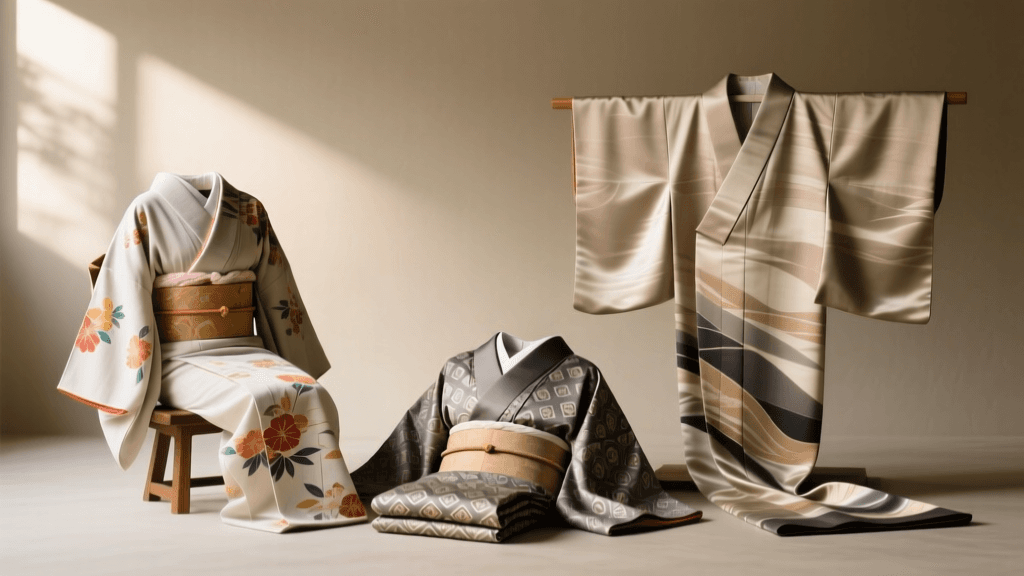
The Komon, translating to 'small pattern,' is the workhorse of the traditional Japanese wardrobe. It is characterized by repeating patterns that cover the entire garment. These patterns can range from traditional motifs like cranes, cherry blossoms, and geometric shapes to modern, quirky designs featuring cats, coffee cups, or musical notes. Because the pattern is repetitive and does not align across the seams, the Komon is strictly classified as informal or semi-formal wear.
Komon kimonos are typically crafted from silk, though modern washable polyester versions (often branded as 'washable silk') are increasingly popular for daily use. Unlike the yukata, a Komon must be worn over a nagajuban to protect the delicate silk from sweat and oils, and to provide the proper collar layering at the neckline.
Buying Advice and Cost
The Komon is ideal for theater outings, casual dinners, daytime sightseeing, and informal tea gatherings. It is usually paired with a Nagoya obi (a pre-folded, semi-formal sash) and zori sandals. New silk Komon kimonos range from $200 to $600 USD, while vintage silk Komon are abundant in Japanese thrift markets and online stores, often priced between $40 and $120 USD. When buying vintage silk, inspect the lining for yellowing and ensure the repeating pattern is not severely misaligned at the side seams, which can indicate poor alteration.
The Formal Elegance: Houmongi (訪問着)
The Art of the Eba Pattern
The Houmongi, meaning 'visiting wear,' is a highly formal kimono worn by both married and unmarried women for prestigious events such as weddings, formal tea ceremonies, and graduation ceremonies. The defining characteristic of the Houmongi is the eba pattern technique. As highlighted by the Victoria and Albert Museum, the eba technique involves a design that flows continuously across the seams of the kimono, creating a single, cohesive 'picture' when the garment is laid flat or worn. This requires immense skill, as the fabric must be temporarily basted together, hand-painted or dyed as a single canvas, and then taken apart for final tailoring.
Houmongi are almost exclusively made from high-quality silk, often featuring luxurious shibori (tie-dye) backgrounds, gold leaf application, or intricate embroidery. The formality is further elevated by the inclusion of one to three family crests (kamon) on the back and sleeves.
Buying Advice and Cost
Due to the labor-intensive eba dyeing process, Houmongi are significant investments. A new, custom-tailored silk Houmongi can easily cost between $1,500 and $5,000+ USD. Vintage pieces are a more accessible option for international buyers, typically ranging from $150 to $450 USD. When purchasing a formal kimono, verify the condition of the hem (suso) and the collar (eri), as formal garments are often dry-cleaned, which can sometimes dull metallic threads or gold leaf accents.
Comparison Chart: Yukata vs. Komon vs. Houmongi
| Feature | Yukata (浴衣) | Komon (小紋) | Houmongi (訪問着) |
|---|---|---|---|
| Formality | Casual / Summer | Informal / Everyday | Formal / Ceremonial |
| Primary Fabric | Cotton, Linen | Silk, Polyester | Premium Silk |
| Pattern Style | Varied, often bold | Repeating, seamless | Eba (continuous picture) |
| Undergarments | Hadajuban (half-slip) | Nagajuban (full robe) | Nagajuban (full robe) |
| Obi Type | Hanhaba (half-width) | Nagoya (pre-folded) | Fukuro (double-width) |
| Footwear | Geta (wooden), bare feet | Zori, Tabi socks | Zori, Tabi socks |
| Avg. Vintage Cost | $15 - $40 USD | $40 - $120 USD | $150 - $450 USD |
The Rule of Seasonality: Koromogae
Beyond the TPO rule, a kimono buyer must understand Koromogae, the traditional changing of the wardrobe according to the seasons. Japanese fashion dictates not just the color of the motifs, but the physical structure of the garment based on the month.
- Awase (Lined): Worn from October to May. These kimonos feature a solid silk lining for warmth.
- Hitoe (Unlined): Worn in June and September. The transitional garment lacks a lining, allowing for better airflow during the humid start and end of summer.
- Ro and Sha (Sheer): Worn strictly in July and August. These are woven with intentional gaps in the silk threads to create a breathable, translucent mesh effect, always worn over a sheer under-robe.
When buying vintage online, always check the product description to see if the kimono is awase or hitoe, as this will dictate when you can comfortably wear it in your home country's climate.
Essential Sizing and Measurement Guide
Kimonos are not sized like Western clothing (S, M, L). Instead, they are tailored to specific body measurements. When browsing online markets or visiting antique shops in Kyoto's Shijo-dori district, you must know three critical measurements:
- Yuki (Sleeve Span): Measured from the center of the back of the neck, across the shoulder, and down to the wrist. For most modern wearers, a Yuki of 62cm to 66cm is standard. If the Yuki is too short, the garment will look ill-fitted; if too long, it will restrict arm movement.
- Mihaba (Body Width): The width of the front panel. To ensure the kimono wraps comfortably around your body without exposing the undergarments, the Mihaba should be at least 15-20cm wider than your hip measurement divided by two.
- Take (Total Length): Measured from the base of the neck to the floor. The ideal Take is exactly equal to your height, as the excess fabric is folded at the waist (the ohashori) to adjust the hemline.
Sourcing Authentic Garments
Whether you are buying a casual Yukata for a summer trip or a formal Houmongi for a collection, provenance and condition are paramount. For those interested in the regional textile techniques that inform these garments, such as Nishijin weaving or Kyo-yuzen dyeing, the Kyoto Museum of Traditional Crafts offers invaluable insights into authenticating regional hallmarks and understanding the artisans behind the textiles.
When inspecting vintage pieces, pay special attention to the collar area for foundation stains, which are notoriously difficult to remove from silk. Trust your sense of smell; a strong odor of camphor or mustiness indicates long-term storage in a traditional tansu chest, which will require professional airing and dry cleaning. By understanding the distinct roles of the Yukata, Komon, and Houmongi, you can curate a traditional Japanese wardrobe that is not only visually stunning but deeply respectful of the culture from which it originates.